Overview of the Study
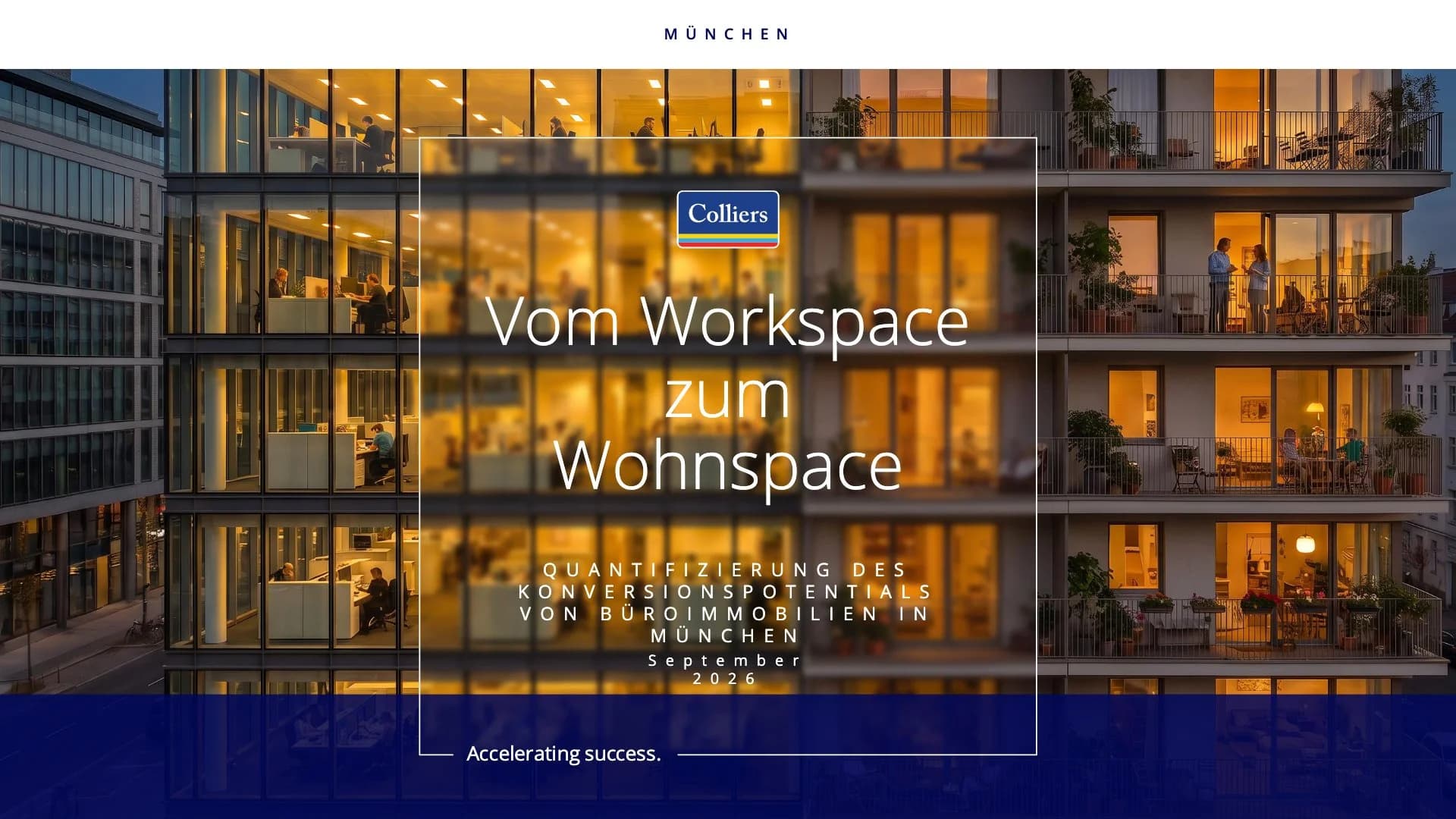
Colliers International, a leading global real‑estate services firm, presents a comprehensive analysis of the conversion potential of office buildings into residential use in Munich. The report, authored by senior market intelligence specialists, combines extensive market data, vacancy statistics and planning‑law assessments to evaluate how under‑utilised office stock can alleviate the city’s acute housing shortage.
Current Office Vacancy Situation
As of the first half of 2026, Munich’s office vacancy rate reached a record 9.3 % within the city limits and 10.2 % across the wider market, representing an increase of 20 basis points from Q1 2026. Roughly 2.3 million m² of office space (about 1.54 million m² in the city) is available for short‑term lease. Tenants now require approximately 12 % less floor area per employee, reflecting the impact of remote work, desk‑sharing and AI‑driven efficiencies.
Housing Market Pressures
Munich remains one of Europe’s most expensive and densely populated cities. Population growth is projected to reach 1.83 million by 2045, while new housing completions have halved since 2023, falling to just 4,300 units in 2025. Rising construction costs, high financing rates and stringent regulations have curtailed new builds, intensifying the supply‑demand imbalance and pushing rents to record levels.
Quantified Conversion Potential
The analysis applies a multi‑stage filtering process to the total office vacancy of 1.54 million m². Key filters include:
- Alignment with the land‑use plan (11 % of vacant space, ≈162,600 m², lies in residential or mixed‑use zones).
- Presence within or outside statutory B‑plans (75 % of vacancy is inside B‑plans, 25 % outside).
- Age of buildings (82 % of the convertible stock was constructed before 2010). After successive filters, the study identifies approximately 77,000 m² of office space that can be converted with minimal procedural hurdles. When further criteria—such as buildings older than 2010 and a vacancy share of at least 50 %—are applied, the readily convertible volume narrows to around 25,000 m², with a broader, still feasible potential of up to 60,000 m² if B‑plan exemptions are leveraged.
Planning and Regulatory Landscape
Conversion feasibility is strongly influenced by zoning. Areas designated for residential use or mixed‑use in the land‑use plan present “low‑hanging fruit,” while zones locked into commercial B‑plans require complex amendments or exemptions. The German “Bauturbo” (§ 246e BauGB) can accelerate approval processes, yet cannot override fundamental land‑use designations. Approximately 75 % of the vacant office stock resides within B‑plans, making regulatory negotiation a critical step for large‑scale conversions.
Technical and Design Considerations
The report outlines typical building characteristics that affect conversion cost and speed. Common office blocks from the 1970‑1995 era feature steel‑reinforced concrete frames, floor‑to‑ceiling heights between 2.60 m and 2.75 m, and central cores that may limit natural light penetration. Key technical constraints include:
- Depth of floor plates (often 15‑17 m) affecting apartment layout.
- Requirement for additional fire‑escape routes.
- Adaptation of service shafts and ventilation systems. Modular construction approaches—pre‑fabricated bathroom, kitchen and partition modules—are highlighted as a means to reduce disruption and improve cost efficiency during conversion.
Sustainability Implications
Re‑using existing office structures aligns with circular economy principles, avoiding the embodied carbon of new construction. By concentrating conversion efforts in already serviced urban zones, the approach also supports reduced transport emissions and preserves greenfield sites. The study notes that, while conversion alone cannot meet Munich’s long‑term housing target of 50,000 new units, it offers a valuable supplementary strategy to mitigate the immediate deficit.
Outlook and Policy Recommendations
Colliers concludes that the short‑term, legally uncomplicated conversion potential amounts to roughly 25,000 m², with a medium‑term upside to 60,000 m² if policy tools such as the “Bauturbo” and targeted zoning relaxations are fully exploited. The firm recommends:
- Prioritising conversions in residential‑zoned land‑use areas.
- Streamlining B‑plan amendment procedures for office‑to‑residential projects.
- Leveraging modular building technologies to lower costs and timelines. By integrating these measures, Munich can unlock a modest yet impactful source of sustainable housing, contributing to the broader European challenge of balancing urban growth with environmental stewardship.