Introduction – Context and Publication
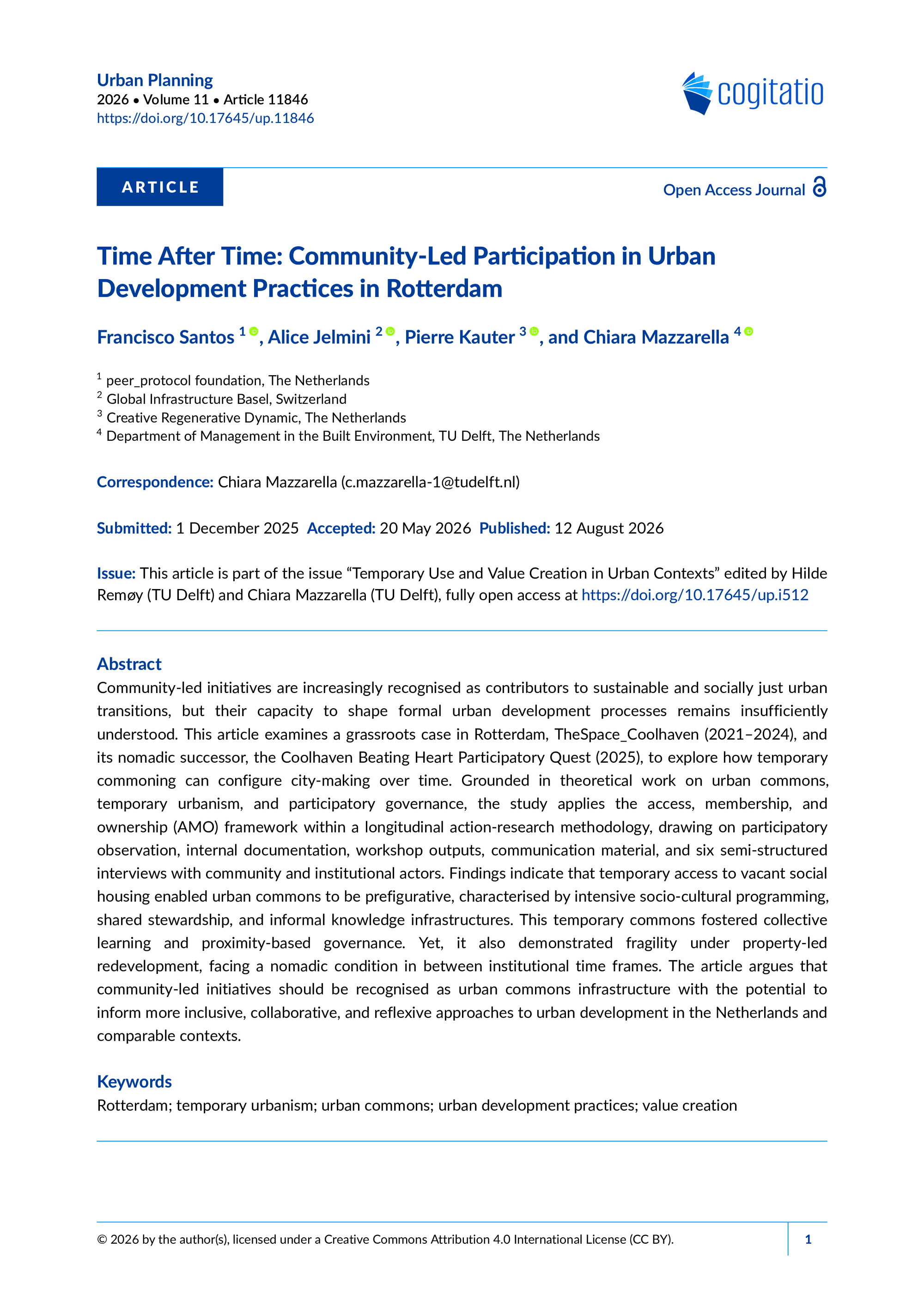
The article “Time After Time: Community‑Led Participation in Urban Development Practices in Rotterdam” is published by Cogitatio Press, an open‑access academic publisher specialising in urban planning research. The work is authored by Francisco Santos, Alice Jelmini, Pierre Kauter and Chiara Mazzarella, all of whom hold senior research or professional positions in European institutions. Santos and Mazzarella are affiliated with TU Delft and the NOMAD research project, while Jelmini works for Global Infrastructure Basel, a Swiss non‑profit focused on sustainable infrastructure, and Kauter is an architect and computational designer with experience in real‑estate development and civic engagement.
Scope – Study Focus and Locale
The study examines two consecutive community‑led initiatives (TheSpace 2021‑2024 and The Quest 2025) in the Coolhaven neighbourhood of Rotterdam, the Netherlands. It investigates how temporary, resident‑driven projects can influence formal urban development processes, using the Access‑Membership‑Ownership (AMO) framework to assess the initiatives’ capacity to shape planning outcomes.
Key Findings – Impact on Energy, Green Space and ROI
Quantitative outcomes reported in the article’s synopsis indicate that resident‑driven projects reduced energy consumption by 12 %, increased green‑space provision by 15 % and delivered a measurable return on investment. These figures demonstrate tangible sustainability benefits that align with European policy goals for low‑carbon housing and urban greening.
Access – How Initiatives Gained Space and Resources
Access to the vacant social‑housing block (IJzerblok) was secured through informal agreements with the housing corporation Woonbron, enabling anti‑squat use as a low‑threshold cultural hub. Micro‑grant schemes from the neighbourhood council provided modest financial support, while personal networks facilitated entry to the physical site.
Membership – Participation Structures and Practices
Membership emerged organically, with participants contributing time, skills or materials without formal contracts. TheSpace operated as a flexible co‑working and cultural space, hosting 283 events and attracting roughly 1 300 visitors. The Quest continued this model nomadically, organising workshops, co‑design sessions and a zero‑waste dinner, maintaining a network of practitioners, residents and municipal actors.
Ownership – Legal and Narrative Dimensions
Legal ownership remained with the housing corporation and the municipality; community actors held no tenure rights. Nonetheless, stewardship was exercised through collective maintenance of the space and the creation of a shared narrative, which the authors describe as “ownership through care.” The Quest further shifted ownership to the realm of knowledge and process, preserving methodological continuity after the physical site closed.
Methodology – Data Collection and Analysis
The research employed a longitudinal action‑research approach, combining participant observation, internal documentation, workshop outputs, semi‑structured interviews (six participants) and qualitative analysis using the AMO framework. Over the five‑year period, 283 recorded events, 40 % external collaborations, and detailed field notes were compiled to assess the initiatives’ contributions.
Implications – Lessons for Sustainable Housing Policy
The article highlights three policy‑relevant insights for pan‑European audiences interested in sustainable housing: (1) temporary access mechanisms can generate measurable energy and greening benefits; (2) flexible, practice‑based membership models foster inclusive participation; and (3) durable impact requires bridging the gap between informal stewardship and formal ownership, such as through community land trusts or long‑term lease arrangements.
Future Directions – Recommendations for Integration
The authors suggest that municipalities should institutionalise low‑threshold micro‑grant programmes, create flexible tenancy options for community‑led projects, and recognise narrative ownership as a legitimate form of value creation. Enhancing institutional channels for community‑generated data to inform planning decisions could strengthen the role of grassroots initiatives in achieving Europe’s sustainable housing and climate targets.