Overview of the Publication
The article, published by Landesspiegel—a leading Liechtenstein news outlet known for in‑depth regional reporting—examines Schaan’s approach to affordable housing as a tool for sustainable municipal development. It draws on a 2025 population survey that placed affordable housing among the top three future concerns for residents, and details a pilot study presented by the municipality in September 2026.
Affordable Housing as Development Policy
Schaan frames affordable housing not as a welfare benefit but as a strategic instrument to optimise land use, reduce traffic congestion and preserve village life. The municipality identified three core benefits: more efficient land consumption, lower commuting emissions by enabling people to live where they work, and the reinforcement of community cohesion.
Demographic Challenges Highlighted
The study notes a mismatch between household composition and housing stock: roughly one‑third of households consist of a single person and a further quarter of two‑person households, yet small‑size apartments are scarce. This shortage forces older residents to remain in larger homes, limiting availability for younger families and perpetuating the housing gap.
The Kaiserböhel Modelling Scenario
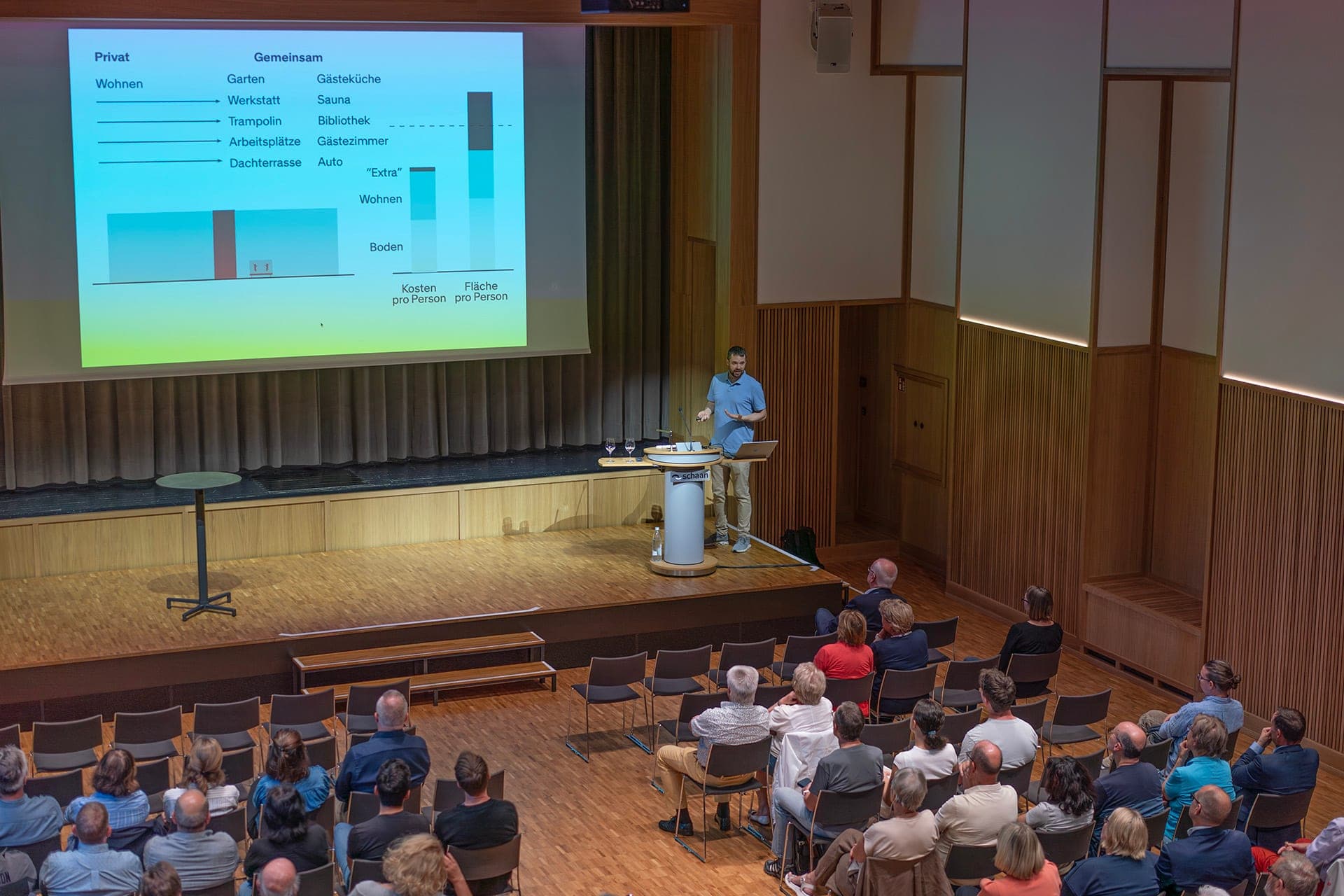
A fictitious quarter, “Kaiserböhel,” was used to illustrate potential outcomes. Designed for 300–400 inhabitants, the model places the centre within a seven‑minute walk, reducing the need for extensive parking. Compared with the existing low‑density single‑family layout (about 100 people), multi‑family constructions could double capacity, while larger blocks with shared spaces could further increase density and lower per‑capita land costs.
Five Levers for Sustainable Housing
The municipality tested five interventions: higher building density, repeatable construction methods, reduced parking and underground levels, shared facilities, and smaller per‑person living space. Liechtenstein’s average residential floor area per person is about 56 m² (approximately 45 m² in Switzerland). The study highlighted trade‑offs, such as two‑storey units with internal stairs cutting infrastructure costs by two‑thirds but sacrificing accessibility, and shared amenities requiring greater resident coordination.
Key Findings on Cost Savings
Doubling density and employing larger building footprints can significantly lower land prices per household. For example, shifting from detached houses to multi‑family units could halve the per‑capita land cost. Moreover, design choices that reduce external infrastructure—like fewer parking spaces—further contribute to affordability while supporting sustainable mobility.
Community Engagement and Next Steps
The presentation was primarily informational, with extensive public listening sessions in the venue’s foyer and subsequent discussion tables. Feedback gathered will feed into a final report, which aims to outline a flexible framework for developers rather than prescribe specific projects. The municipality emphasises that any affordable housing model must maintain quality of life standards.
Relevance for Pan‑European Sustainable Housing
Schaan’s initiative exemplifies how small municipalities can integrate affordable housing into broader sustainability goals, balancing land efficiency, transport emissions, and community vitality. The data‑driven approach, use of a realistic modelling scenario, and transparent public consultation provide a replicable template for other European regions seeking to address housing shortages without compromising environmental objectives.