Overview of the Report and Its Origin
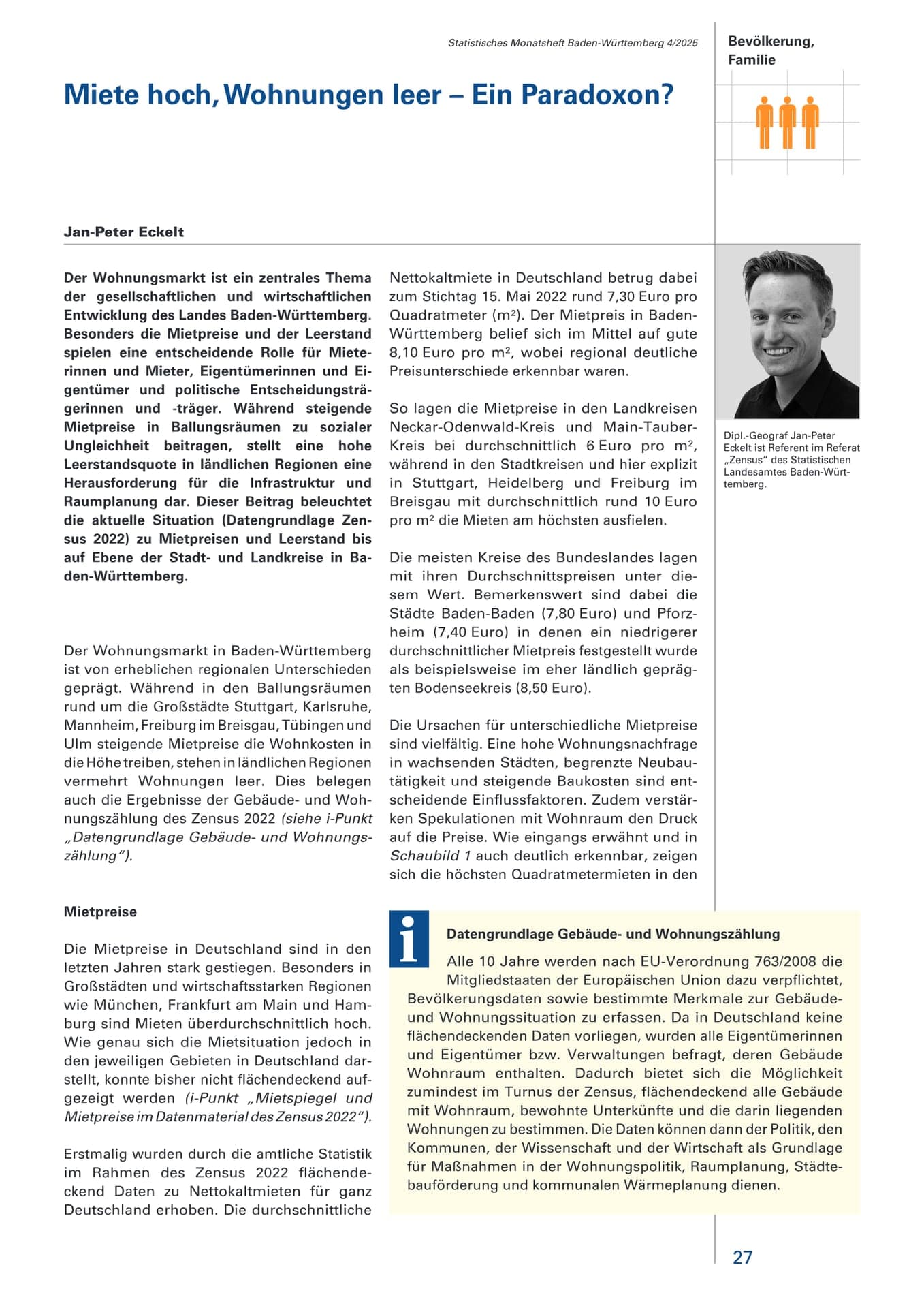
The publication “Miete hoch, Wohnungen leer – Ein Paradoxon?” is a statistical monthly report (Statistisches Monatsheft Baden‑Württemberg 4/2025) issued by the Statistisches Landesamt Baden‑Württemberg. It is authored by Jan‑Peter Eckelt, a geographer and referent in the Zensus department of the agency. The report analyses housing market dynamics in Baden‑Württemberg, focusing on rent levels and vacancy rates based on data from the 2022 Census (Zensus).
Regional Rent Landscape in Baden‑Württemberg
Average net cold rent across Germany in May 2022 was €7.30 /m²; Baden‑Württemberg’s average was higher at €8.10 /m². Significant regional variation exists: rural districts such as Neckar‑Odenwald and Main‑Tauber report rents around €6 /m², while urban districts – especially Stuttgart, Heidelberg and Freiburg – reach approximately €10 /m², with Heidelberg at €10 /m² and Stuttgart at €10.4 /m². Some cities show slightly lower figures, e.g., Baden‑Baden (€7.80 /m²) and Pforzheim (€7.40 /m²).
New‑Build Influence on Rent Levels
The report highlights that newly built apartments (construction year 2010 or later) command higher rents than older stock from the 1960s‑1970s. In metropolitan areas such as Stuttgart, Heidelberg and Freiburg, average rents for new builds exceed €13 /m², markedly above the overall regional average. This suggests that supply‑side factors, particularly the pace of new construction, intensify price differentials.
Vacancy Rates and Market‑Active Empty Units
Overall vacancy in Baden‑Württemberg mirrors the national figure at 4.3 % (≈1.9 million units). However, the market‑active vacancy – apartments that could be re‑let within three months – is much lower, at about 1.3 % for the state, compared with the national 1.7 %. Urban districts exhibit higher market‑active vacancy (e.g., Baden‑Baden 1.9 %) while rural districts such as Emmendingen and Ravensburg are around 1.0 %. More than half of the vacant units have been empty for over a year, indicating structural rather than short‑term turnover issues.
Drivers Behind the Paradox of High Rents and Empty Homes
The analysis distinguishes three types of vacancy: structural (population decline), speculative (owners keeping units empty to await higher rents) and renovation‑related. High rents are linked to strong demand, limited new supply and speculative holding, especially in major cities. Conversely, low rents and higher vacancy are typical of rural areas with weaker demand. The report notes that despite a substantial number of empty dwellings, the limited pool of market‑active units constrains affordable housing availability.
Implications for Sustainable Housing Policy
The findings underscore the need for balanced housing strategies that promote sustainable construction, increase affordable new‑build supply, and address speculative vacancy. Policies such as the rent‑control “Mietpreisbremse” are mentioned, but the report stresses that expanding the overall housing stock—particularly energy‑efficient, smaller units in high‑demand regions—remains crucial for long‑term sustainability.
Key Statistics at a Glance
- Average net cold rent Baden‑Württemberg: €8.10 /m²
- Highest urban rents: Stuttgart €10.4 /m², Heidelberg €10 /m², Freiburg €9.7 /m²
- Rural rent lows: Neckar‑Odenwald and Main‑Tauber €6 /m²
- State‑wide vacancy: 4.3 % (total), 1.3 % market‑active
- New‑build average rent in metros: > €13 /m² These figures provide a factual basis for pan‑European audiences interested in the interplay between rent pressures and vacancy, and the sustainability challenges they pose in the German context.