Resource context
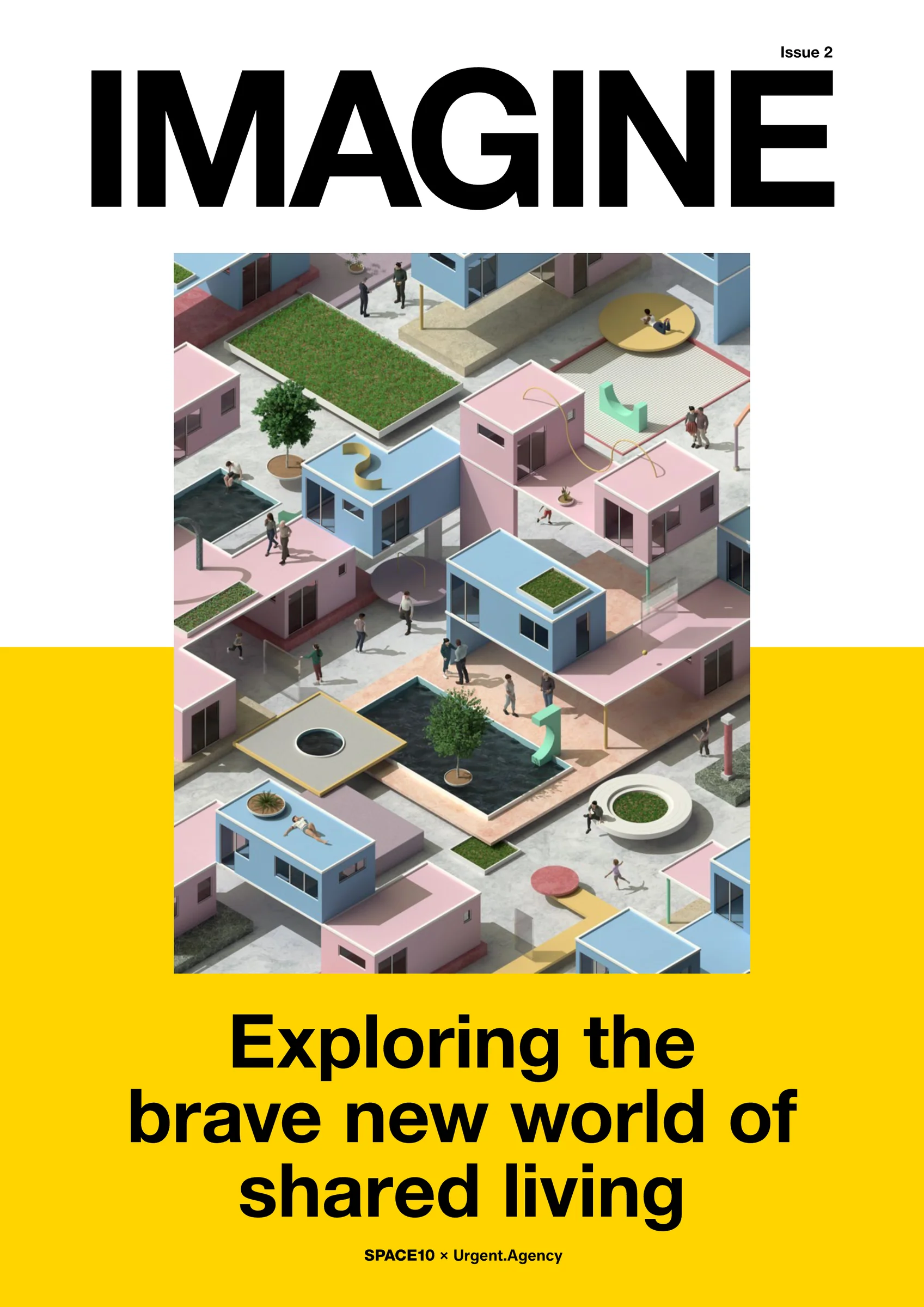
IMAGINE – Exploring the Brave New World of Shared Living is a publication produced by SPACE10 (the IKEA-funded “future living lab” in Copenhagen) with contributions from authors including Jan Gehl, Grace Kim, Laura Juvik, Meik Wiking and Matthias Hollwich. The issue compiles articles, interviews and case studies on how shared living (co-living and co-housing) can respond to urbanisation, affordability pressures, social isolation and sustainability challenges, with most examples and references centred on northwestern Europe, Japan and North America.
Urbanisation, affordability and the case for sharing
The publication frames shared living as a response to rapid urban growth and constrained urban housing supply. It cites the growth of the global urban population from 751 million (1950) to 4.2 billion (2018) and references UN projections of around 2.5 billion additional city residents by 2050—nearly 7 in 10 people living in urban areas. It argues that housing debates focused only on building more homes miss opportunities to re-think living patterns and to use space more efficiently through shared facilities.
What “shared living” means in practice
Shared living is described as private living space combined with access to communal facilities (e.g., kitchens, laundries, workspaces, dining areas). By sharing amenities and services, private units can be smaller while maintaining overall access to more functional space. The text highlights cost and resource benefits such as bulk purchasing, shared mobility and shared tools (e.g., replacing many seldom-used household tools with communal access), positioning this as both affordability support and a way to reduce material consumption.
Health, loneliness and intergenerational models
Beyond costs, the publication links shared living to social capital and well-being. It references UK evidence on loneliness (including figures such as nine million people in Britain often or always feeling lonely) and argues that community-based living can support healthier, more connected lives. It also discusses demographic ageing: UN projections cited include growth of the global population over 60 from about 1 billion to 2.1 billion by 2050, with 22% of the world over 60, and a rise in the over‑80 population from 137 million to 425 million. Intergenerational models are presented as a way to combine mutual support and daily interaction.
Examples, markets and barriers to scaling
Case studies include community-led and cooperative approaches such as baugruppen in Germany (community-financed and community-designed multi-family housing) and European intergenerational initiatives (e.g., Humanitas in Deventer, where students live alongside older residents in exchange for volunteer hours). The publication also notes commercial co-living (e.g., WeLive and The Collective) and contrasts top-down service models with bottom-up, resident-driven development. Key barriers highlighted include planning and regulatory constraints, financing risk, conservative investor preferences, and difficulties accessing land—challenges that can make community-led projects slow to realise.
Digital tools and new organisational infrastructure
Technology is presented as an enabler rather than a standalone solution: platforms for community matchmaking, communication and governance, and experiments with blockchain-based ownership and smart contracts are discussed as ways to reduce transaction costs and increase transparency. The publication also points to changing design/production tools (e.g., VR/AR, digital fabrication, open-source construction approaches) as potential supports for more diverse, lower-impact housing models.