
Resource overview
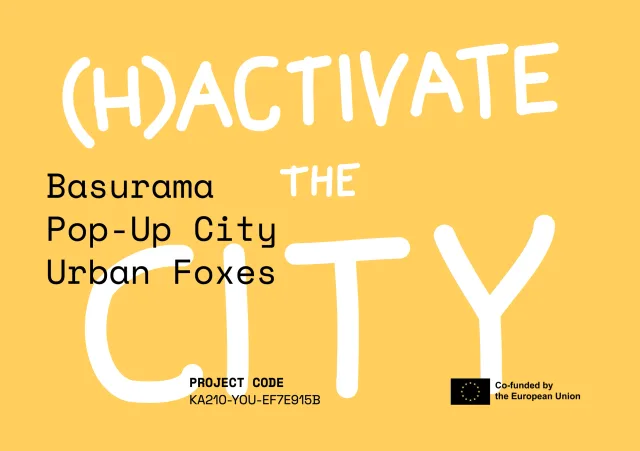
(H)Activate the City is a practical handbook produced by three urban collectives—Basurama (Madrid), Pop-Up City (Amsterdam), and Urban Foxes (Brussels)—with contributions by Jeroen Beekmans, Joop de Boer, Laura Fernández de Moya, Mónica Gutierrez Herrero, and Bram Dewolfs. It was developed within the (H)Activate the City project (project code KA210-YOU-EF7E915B), co-funded by the European Union through the Erasmus+ programme, and released under a CC BY-NC-SA 4.0 license.
Purpose and audience
The handbook targets young people and those who support youth participation (e.g., youth workers and community organisers). Its central proposition is “urban (h)acktivism”: combining hacking (tweaking the existing city without waiting for formal permission) with activism (taking a stand for what matters locally). The text frames cities as constantly changing environments and positions residents—especially younger residents—as legitimate agents who can improve streets, parks, squares, and everyday public spaces through small, visible interventions.
Urban hacking in context
The publication situates urban hacking in a longer tradition of citizen-led city-making, referencing street art and graffiti since the 1970s and examples such as Banksy as part of a wider culture of informal, often unofficial, urban interventions. It also links the rise of urban hacking to early-21st-century economic crises that left vacant buildings and underused sites, creating space for experimentation and pop-up reuses. The guide highlights how social media accelerated the spread of DIY ideas, and how planners increasingly noticed that residents can identify needs and workable solutions in their own neighbourhoods.
Key principles of “urban (h)acktivism”
The handbook describes several recurring traits: pop-up approaches that can start temporarily before becoming permanent; maker culture focused on building and testing in real conditions; involvement and collaboration that bring people together; and an explicit activist dimension oriented toward outcomes like more greenery, safer streets, and better places to gather. It emphasises learning-by-doing, including the reality that weather, low footfall, or damage can affect interventions and should inform iteration.
Nine tools and hands-on activities
A core feature is a set of nine tools that range from observation methods to concrete builds. Early tools focus on diagnosing places—such as a youth “city expedition” (requiring items like chalk, blindfolds, playing cards, a smartphone camera, and €5–10 per group) and a “place evaluation” activity that replaces expert checklists with criteria chosen and negotiated by participants. Other tools guide rapid prototyping of public-space changes, including “heaven or hell” redesign exercises (analogue collage or digital tools).
Materials, sustainability, and examples
Many interventions rely on low-cost, reused materials, aligning with a sustainability and circular-economy mindset. The handbook provides step-by-step builds such as converting a tree stump into a seat using a salvaged chair top, drills, and screws; turning overgrown plots into “Pioneer Parks” by mowing paths and installing simple signage; and creating seats from two old car tyres with bolts and washers plus drainage holes for rainwater. It also includes playful, low-cost examples like a pop-up crosswalk made from a recycled carpet for about €10, and lighting adjustments using red plastic to create wildlife-friendly crossings.
Overall message
Across its tools and case examples, (H)Activate the City presents urban hacking as a structured but flexible practice: start small, test ideas publicly, use humour and games to engage others, and combine creativity with practical construction to improve everyday urban environments.