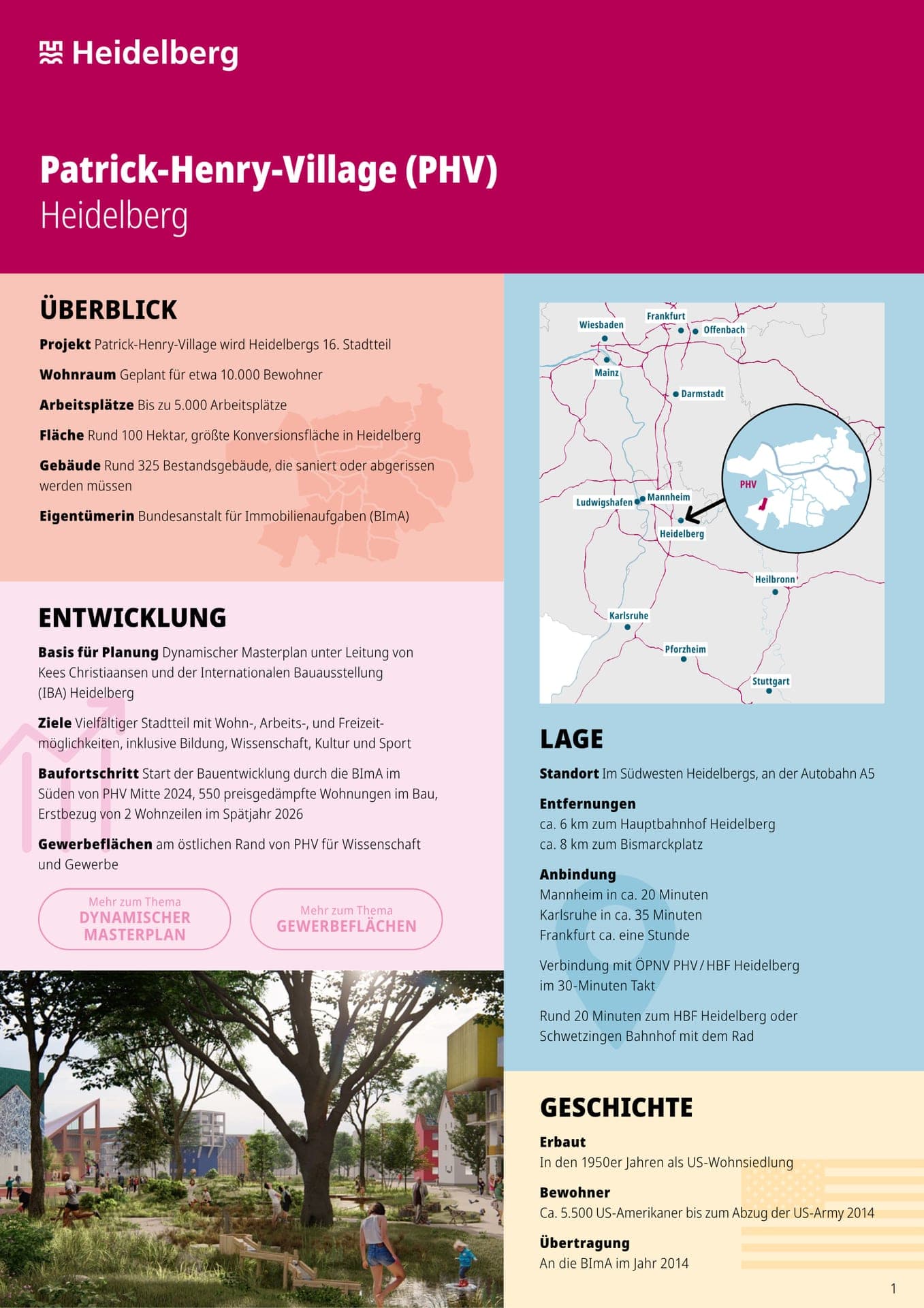
Overview of the Patrick‑Henry‑Village Project
The factsheet, published by the city of Heidelberg, presents the ambitious development of the Patrick‑Henry‑Village (PHV) in Heidelberg’s 16th district. It is a public, AI‑generated report detailing the scale, objectives and sustainability measures of the new urban quarter, overseen by the Federal Agency for Real Estate (BImA) and coordinated by architect Kees Christiaansen under the International Building Exhibition framework.
Housing Provision and Affordability
PHV plans roughly 5 000 new residential units, split evenly between ownership and rental. Half of the rental stock is earmarked for the lower‑price segment, addressing affordable housing needs. The development also includes diverse dwelling types, from student apartments to co‑housing projects, aiming to accommodate a broad demographic.
Employment and Economic Activity
The project anticipates up to 5 000 jobs, supported by commercial zones, especially on the eastern edge where spaces are designated for science and business activities. This mixed‑use approach seeks to create a self‑sustaining neighbourhood where residents can live, work and study locally.
Sustainable Design and Urban Mining
PHV incorporates extensive green infrastructure: “green fingers” and large parks provide fresh air corridors, while buildings feature vegetated façades and photovoltaic installations. The plan embraces urban mining, reusing materials from the 325 existing structures slated for renovation or demolition, thereby reducing construction waste and embodied carbon.
Climate‑Neutral Energy Systems
A climate‑neutral energy concept is central to PHV, featuring a warm‑water district heating network and renewable energy generation. Rainwater management is implemented through a “sponge city” model, enhancing resilience to climate change and reducing reliance on conventional water infrastructure.
Mobility and Low‑Carbon Transport
The neighbourhood is designed as a car‑light district, with underground parking, dedicated bicycle streets and a central Parkway that integrates pedestrian, cycling and public‑transport routes. A multi‑house will serve as a mobility hub, offering local retail, sports facilities and connections to the wider city’s transport network, including frequent tram services to Heidelberg HBF and regional rail links.
Location and Connectivity
Situated in southwestern Heidelberg near the A5 motorway, PHV lies approximately 6 km from the main train station and 8 km from the city centre. It offers rapid access to Mannheim (≈20 min), Karlsruhe (≈35 min) and Frankfurt (≈1 hour) by road, and is well‑served by public transport with 30‑minute tram intervals.
Development Timeline and Governance
Construction began in mid‑2024 with the delivery of 550 affordable apartments. The first residential blocks are scheduled for occupation in late 2026. The project is part of Heidelberg’s dynamic masterplan, aiming to create a vibrant, mixed‑use district for an estimated 10 000 inhabitants and a substantial workforce.