
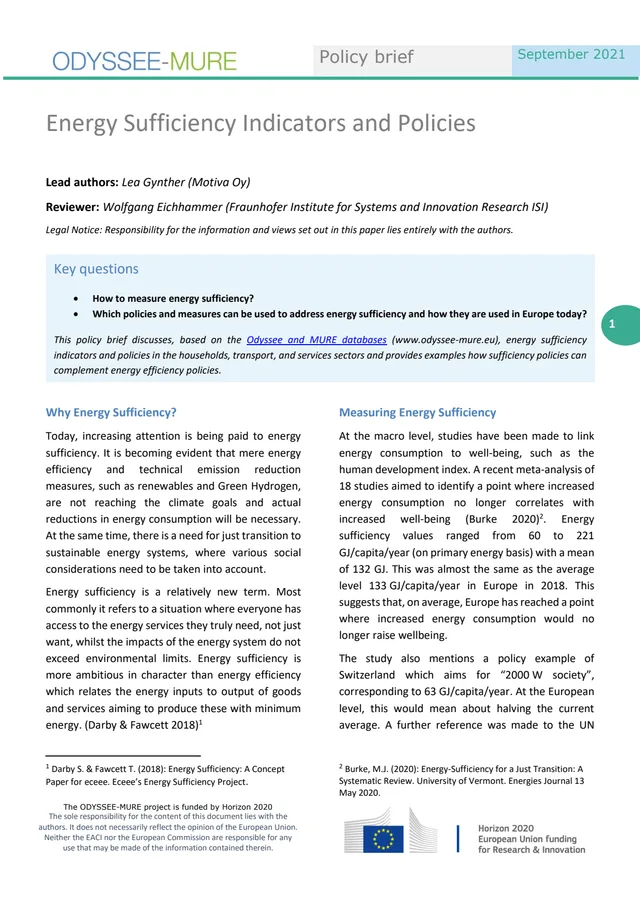
Overview of European Energy‑Sufficiency Landscape
The policy brief “Energy sufficiency indicators and policies” is published by ODYSSEE‑MURE, a European research platform that supports the transition to sustainable energy use across member states. Authored by L. Gynther, a specialist in energy policy analysis, the document synthesises recent developments in energy‑sufficiency metrics and legislative frameworks. It aims to provide decision‑makers, practitioners and scholars with a coherent set of indicators that can be applied to assess and promote energy‑sufficient practices in the built environment, particularly housing.
Core Energy‑Sufficiency Indicators
The brief outlines a suite of quantitative and qualitative indicators designed to capture the extent to which households reduce absolute energy demand. Key metrics include:
- Primary energy demand per dwelling (kWh m⁻² yr⁻¹) – benchmarked against EU averages.
- Energy‑efficiency retrofit rate – proportion of residential stock upgraded to at least near‑Zero‑Energy Building (nZEB) standards.
- Behavioural sufficiency score – derived from surveys on occupant energy‑saving habits (e.g., thermostat settings, appliance use).
- Material‑efficiency ratio – amount of embodied energy saved through circular construction practices. The brief provides baseline values for 2020, showing that the average EU dwelling consumes roughly 150 kWh m⁻² yr⁻¹, while high‑performing member states such as Germany and Sweden are already below 100 kWh m⁻² yr⁻¹.
Policy Instruments and Housing Applications
Gynther identifies three principal policy levers to foster sufficiency in residential buildings:
- Regulatory standards – tightening the Energy Performance of Buildings Directive (EPBD) to require deeper retrofits and limit floor‑area‑based energy intensity.
- Financial incentives – targeted grants and low‑interest loans for deep‑renovation projects that achieve a minimum 30 % reduction in primary energy use.
- Information campaigns – European‑wide awareness programmes that promote low‑energy lifestyles and provide tools for occupants to monitor consumption. Case studies from Denmark, Austria and the Netherlands illustrate how combined regulatory and fiscal measures have accelerated the adoption of heat‑pump systems and high‑performance insulation, achieving up to a 40 % drop in household energy demand.
Methodological Approach and Data Sources
The brief employs a mixed‑methods approach, integrating statistical analysis of Eurostat energy consumption data with expert interviews across 15 EU countries. It also draws on the European Building Stock Observatory for material‑flow statistics and on the European Survey on Energy Consumption Behaviour (ESECB) for occupant‑level insights. The methodology ensures that the indicators are comparable across national contexts while remaining sensitive to local building typologies.
Findings on Sustainable Housing Trends
Key findings relevant to sustainable housing include:
- Retrofit potential – approximately 55 % of the EU residential stock can achieve a 30 % energy‑demand reduction with cost‑effective measures.
- Heat‑pump penetration – by 2025, heat‑pump installations are projected to cover 25 % of new heating systems, driven by subsidies and phase‑out of fossil‑fuel boilers.
- Embodied‑energy savings – circular construction practices, such as re‑using timber frames, can cut the embodied energy of new builds by up to 20 %.
- Behavioural impact – modest changes in occupant behaviour (e.g., lowering thermostat set‑points by 1 °C) can yield an additional 5‑7 % reduction in primary energy demand.
Implications for Pan‑European Sustainable Housing
The brief concludes that achieving energy sufficiency in housing requires coordinated action across policy levels, finance mechanisms and citizen engagement. By adopting the presented indicators, EU Member States can monitor progress, benchmark best practices and adjust policies to close the gap between current performance and the EU’s 2030 climate targets. The evidence suggests that a combination of stringent building codes, supportive financing and targeted behavioural programmes can deliver substantial energy savings while enhancing comfort and affordability for residents across Europe.