Overview of the Resource
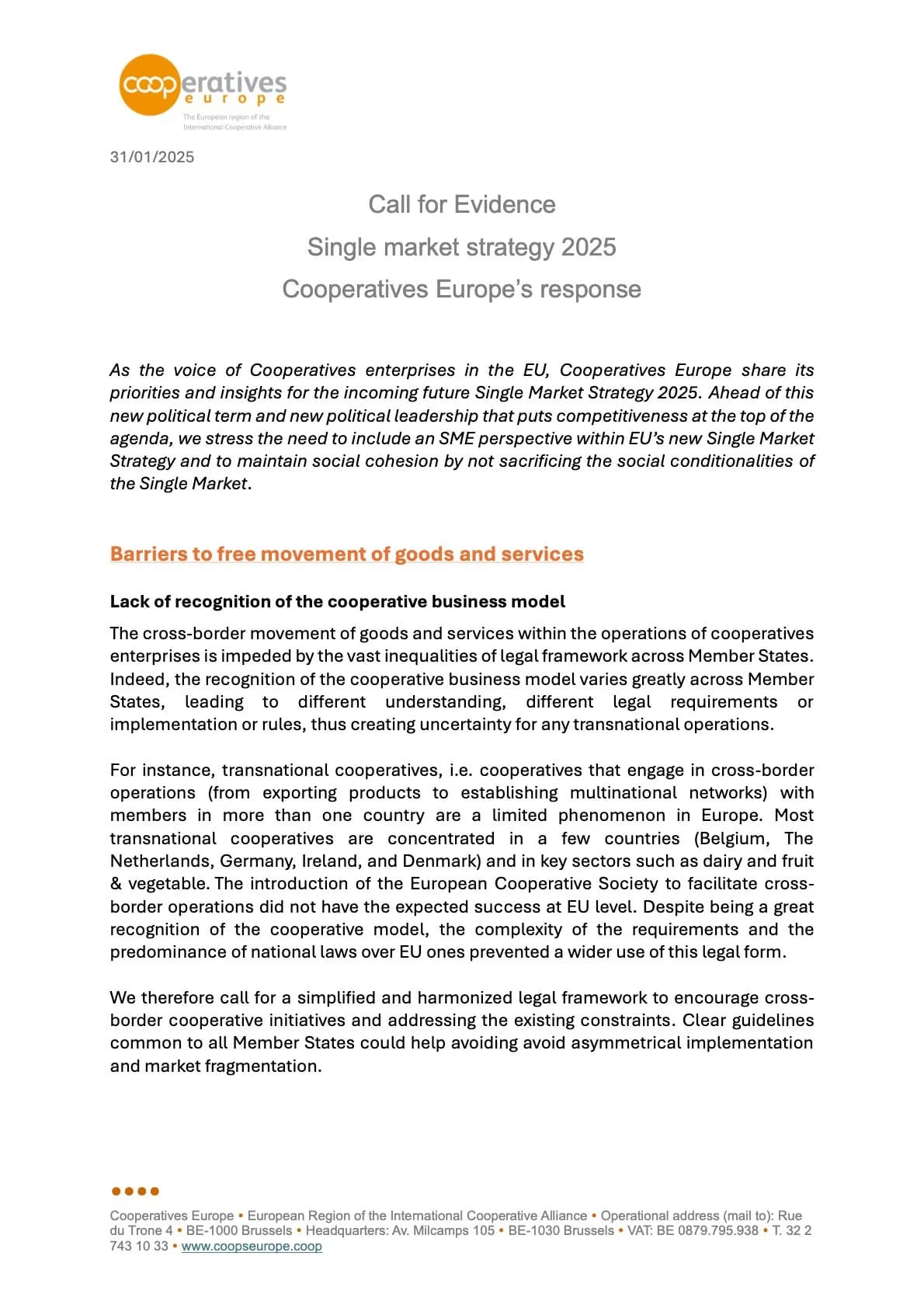
The document titled “Call for Evidence Single Market Strategy 2025 Cooperatives Europe position” is a policy response prepared by Cooperatives Europe, the European regional body of the International Cooperative Alliance. As the representative voice of cooperative enterprises across the EU, Cooperatives Europe brings together a network of member cooperatives, experts, and sectoral representatives to influence EU policy. The position paper was submitted as part of the European Commission’s evidence‑gathering process for the upcoming Single Market Strategy 2025.
Publisher and Stakeholder Background
Cooperatives Europe is headquartered in Brussels and operates under the legal framework of the European Cooperative Society. Its members span a wide range of sectors, including housing, energy, agriculture, and social services. By advocating for a cooperative‑centric approach, the organization seeks to ensure that the EU’s single market supports inclusive growth, social cohesion, and environmental sustainability—core principles that align with the interests of sustainable‑housing advocates.
Key Barriers for Cooperative Housing Projects
The position highlights three main obstacles that limit the cross‑border development of cooperative housing:
- Legal fragmentation – Recognition of the cooperative model varies significantly among Member States, creating uncertainty for transnational housing cooperatives.
- Regulatory complexity – Existing EU and national reporting requirements generate double‑reporting and administrative costs, discouraging cooperative ventures that aim to deliver affordable, energy‑efficient homes.
- Limited access to finance – Cooperatives often rely on capital‑patient financing, yet they face difficulties obtaining funding beyond traditional banking channels, restricting large‑scale sustainable‑housing initiatives.
Funding and Financial Instruments
Cooperatives Europe calls for enhanced access to capital markets for SMEs and cooperatives, urging the Commission to reform public‑procurement rules to include social clauses that favor cooperative housing developers. The paper references tools such as the Public Procurement Data Space (PPDS) as potential facilitators, provided they receive wider promotion and awareness. Strengthening these mechanisms would enable cooperative housing projects to secure the liquidity needed for energy‑retrofit programmes and the construction of net‑zero residential units.
Regulatory Simplification Proposals
To reduce administrative burdens, the position supports the “one‑in‑one‑out” principle and the Better Regulation guidelines, emphasizing the need for a dedicated SME test. It also recommends reviving the Fit‑for‑Future Platform—a multi‑stakeholder expert group that previously assisted in regulatory simplification. Additionally, the paper urges the Commission to embed Voluntary SME reporting standards (VSMEs) within the Corporate Sustainability Reporting Directive (CSRD) to cap the data‑request load on cooperative housing operators.
The Omnibus Package and Its Implications
The upcoming Omnibus Package aims to harmonise reporting obligations under the CSRD and CS3D. While the initiative could alleviate some compliance pressures, Cooperatives Europe warns that insufficient clarity may generate confusion for cooperatives engaged in sustainable‑housing projects. The organization stresses that any delay in implementing coherent reporting standards could impede the scaling of eco‑friendly housing models across Europe.
Social Cohesion and Sustainable Housing Goals
A central theme is the preservation of social conditionalities within the Single Market. Cooperatives Europe argues that competitiveness must not come at the expense of the EU’s social model, which includes affordable, community‑oriented housing. By integrating cooperative principles—democratic governance, community benefit, and environmental stewardship—into the Single Market Strategy, the EU can promote resilient, low‑carbon residential neighbourhoods that align with the European Pillar of Social Rights.
Strategic Outlook for the Next Multi‑annual Financial Framework
Looking ahead to the next Multi‑annual Financial Framework (MFF), the position advocates for dedicated SME funding streams such as the SME Window within InvestEU. Targeted investments in cooperative housing can drive the deployment of renewable energy systems, energy‑efficient retrofits, and circular‑economy construction practices, thereby contributing to the EU’s climate‑neutrality targets.
Concluding Facts for Sustainable‑Housing Stakeholders
- Publisher: Cooperatives Europe (Brussels)
- Submission date: 8 December 2025 (evidence‑gathering phase)
- Core demands: legal harmonisation, simplified reporting, enhanced financing, inclusion of social clauses in procurement
- Relevance to housing: removal of legal barriers and financial constraints will enable cooperative models to deliver affordable, energy‑efficient homes at a pan‑European scale. These factual points provide a concise yet comprehensive snapshot of how the Cooperatives Europe position seeks to shape the Single Market Strategy 2025 in ways that directly support sustainable‑housing initiatives across Europe.