Resource context and source
This resource is an article/report-style overview published by Tomorrow.Building World Congress, drawing on figures from sources including Eurostat, the European Commission, and other referenced datasets. The author is not named in the record. It describes housing affordability pressures across Europe and compares national approaches to social and cooperative housing, with examples from the Netherlands, Switzerland, Austria, Norway, Denmark, Spain, and several Central/Eastern European countries.
Europe’s housing affordability pressures
The text frames housing as a major European challenge, particularly for younger people, as wages struggle to keep pace with housing and rent costs. It reports that housing prices rose by an average of 48% over the past decade (Eurostat). It also notes an 18% increase in rental prices between 2010 and 2022, linked in part to the growth of short-term rental contracts. Alongside these cost trends, declining housing construction is described as worsening the imbalance between demand and supply, contributing to rising prices and reduced access to housing.
Policy responses and EU-level initiatives
Across countries, the article lists multiple policy levers used to improve access to affordable homes: homebuying assistance, social housing programmes, and rental price regulation. It also highlights the European Commission’s European Affordable Housing Initiative as an effort to address the issue at EU level. In general, the article describes social housing systems as mostly rental-based, with income thresholds commonly applied—while noting that some programmes can also support middle-income households. Norway is presented as an exception where social housing access is more ownership-oriented than in many rental-centred models.
How much social housing: leaders and the EU average
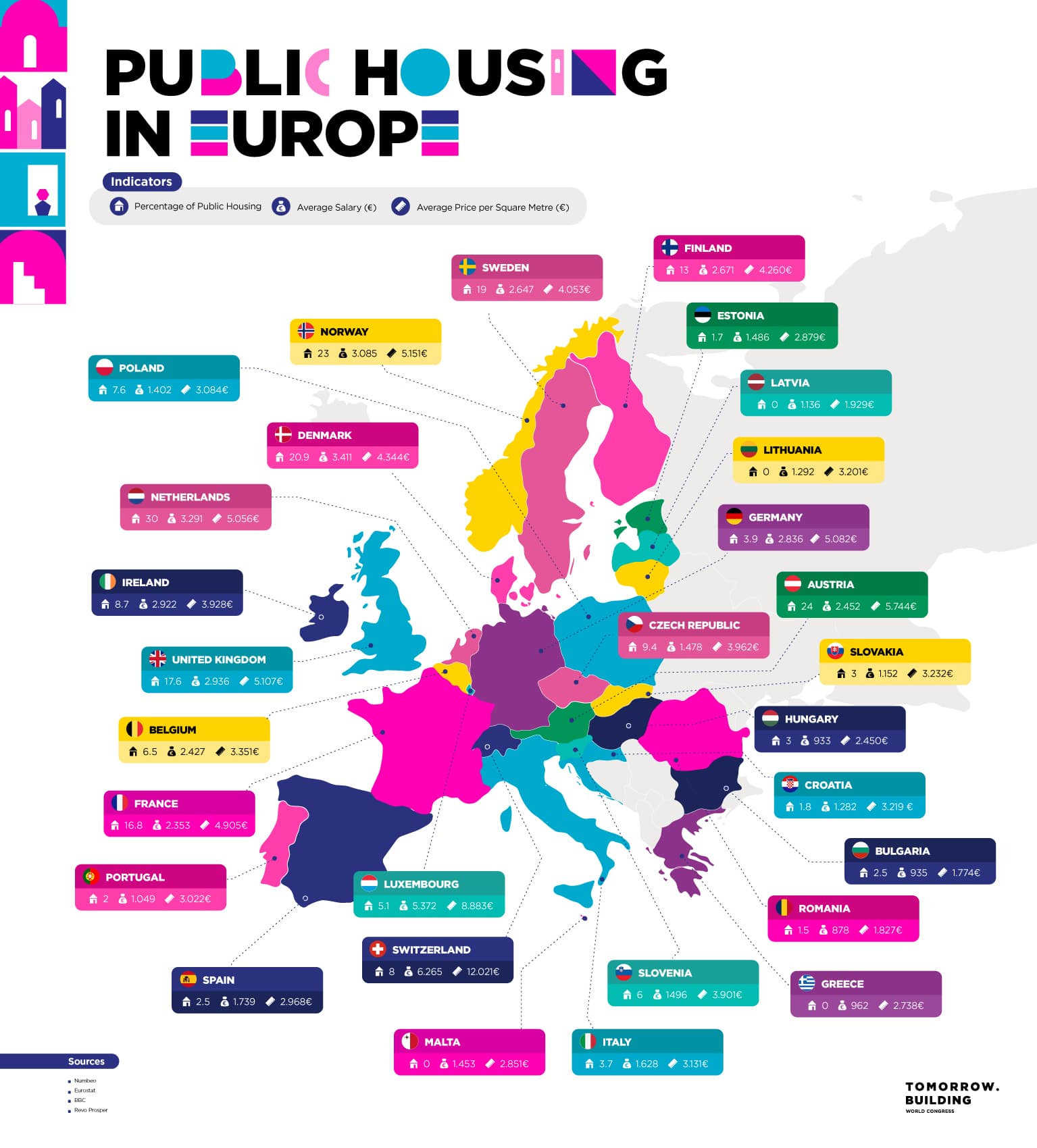
The overview compares national shares of public/social housing and states an EU average of 9.3%. It identifies the Netherlands (30%), Austria (24%), Norway (23%), and Denmark (20%) as the highest among the countries highlighted. These shares are used to illustrate how policy design, land strategies, and non-profit or cooperative management structures can scale affordability-oriented housing provision, while still facing constraints such as eligibility rules, waiting lists, and broader market price levels.
Netherlands: housing associations at scale
The Netherlands is described as having Europe’s highest social-housing share (30%). The article attributes this to municipal land actions and the transfer of management and maintenance to non-profit housing associations in the 1990s, with profits reinvested into social housing. It reports more than 280 non-profit organisations managing around 2.3 million properties. Access is described as restricted by criteria including income thresholds and citizenship, and a key bottleneck is a waiting list that can reach 10 years. The text also cites high market prices, with an average home price above €5,000 per square metre.
Switzerland and Austria: cooperatives and city-led social housing
Switzerland is presented as a country with high renting (57.8%) and a cooperative sector owning about 8% of the real-estate stock, with more than 1,500 cooperatives managing over 160,000 homes. Cooperative rents are described as about 20% lower than market rates, and Zurich is cited as having 25% of its housing stock managed by non-profit cooperatives. Austria’s social-housing share is given as 24%, with Vienna highlighted for city council management of 50% of homes. Vienna’s stock is described as expanding from 64,000 to 220,000 city-managed homes, plus around 200,000 cooperative flats, backed by long-running public funding and annual spending of over €400 million; eligibility includes EU citizenship, residency requirements, and income caps.
Nordics, Spain, and lower-share countries
Norway is described as having around 80% homeownership, with cooperative associations managing 23% of housing stock and municipal housing acting as temporary support for low-income households (typically 3–5 year rental periods). Denmark’s public housing is described as over half a million units (20% of stock), generally rental-based with a deposit of 2% of the purchase price and no income restrictions; a cited study reports 60% of tenants pay under 5,000 kroner (€669) per month and around half receive assistance. Spain is reported at 2.5% social housing, linked to a model of protected housing later sold on the free market and a halt in protected construction since 2013; the text cites an average salary of about €1,700 and a plan to allocate 2 million m² of land to build publicly owned affordable rental homes. Romania (1.5%), Estonia (1.7%), Croatia (1.8%), and Portugal (2%) are cited as below Spain, alongside notes on high homeownership and wage–cost gaps in those contexts.