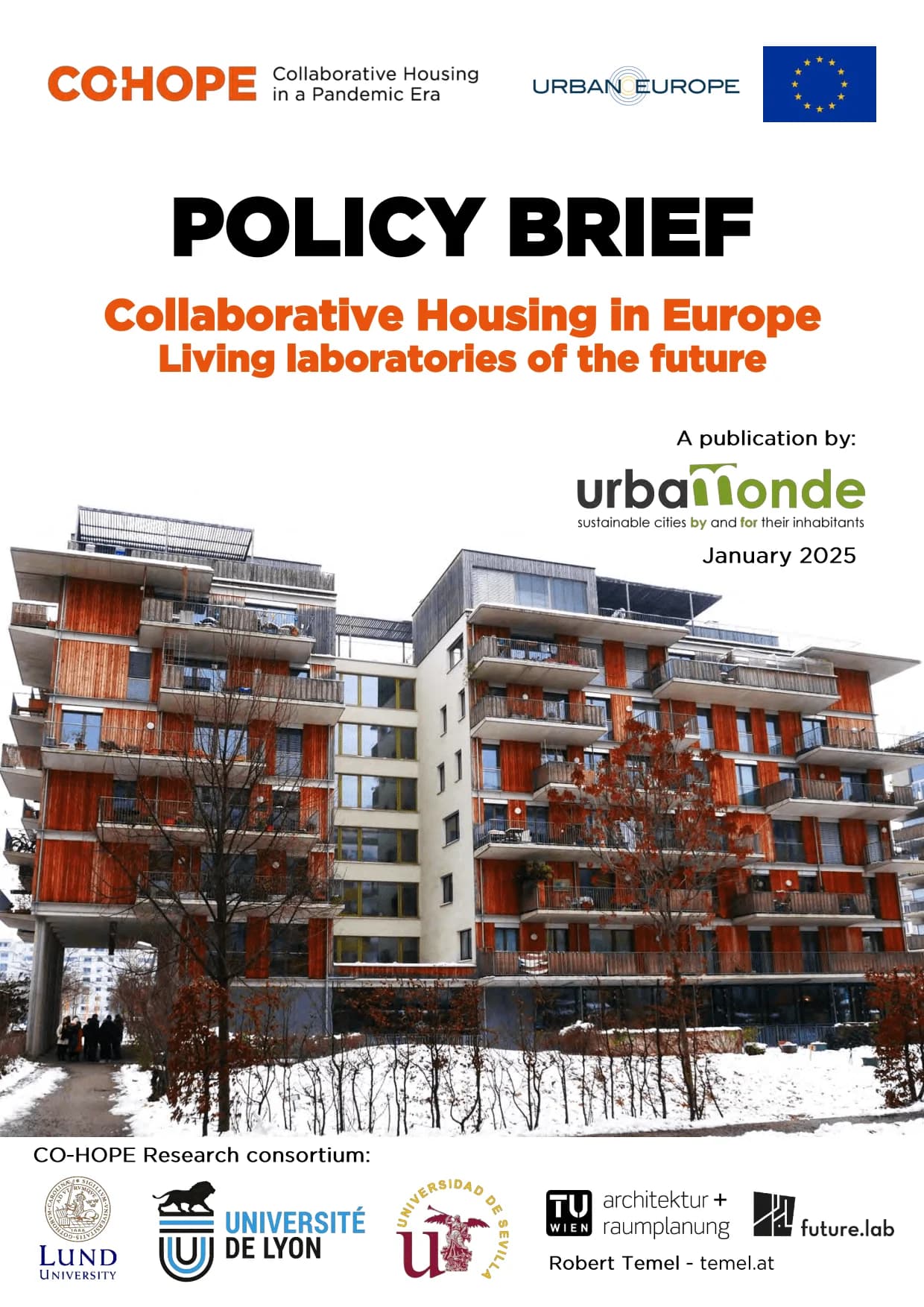
Resource overview (publisher and authors)
The policy brief “Collaborative Housing in Europe: Living laboratories of the future” is published by Urbamonde and presents evidence and policy takeaways on collaborative housing across Europe. The authors are not named in the document. It is positioned as a practical resource for policymakers, city administrations, housing actors and other stakeholders interested in sustainable and socially supportive housing models, drawing on insights connected to the CO-HOPE initiative and its learning from the COVID-19 period.
What “collaborative housing” covers
The brief frames collaborative housing as a diverse family of housing and living arrangements that combine private dwellings with shared spaces and collective practices. Across different legal and cultural contexts, these models emphasize cooperation between residents and often incorporate common facilities and shared services. The document highlights that this diversity makes collaborative housing adaptable to many European settings, while still sharing core features such as community-oriented design, co-management, and intentional support for social interaction.
CO-HOPE as a learning base
A central reference point is CO-HOPE, described as an interdisciplinary research effort linked to an “Urban Living Lab” approach. The brief points to case-study-based learning undertaken during 2022–2024, using collaborative housing projects as “living laboratories” to understand how residents and communities respond to shocks and long-term challenges. The pandemic context is used to illustrate how the organisation of everyday life, shared spaces and mutual support can influence well-being and resilience.
Key results highlighted in the brief
The document features headline indicators intended to summarise outcomes observed in the CO-HOPE learning. It reports that 96% of participants (in the collaborative housing context presented) relate collaborative housing to key elements associated with positive outcomes. It also reports “collective resilience” at 87%, and includes further percentage figures connected to health and well-being as well as living together across the life course. A specific statement included is “Living well together at any age,” accompanied by figures such as 71% and 79%, underlining an emphasis on intergenerational or age-inclusive living.
Barriers to wider take-up in Europe
Alongside positive signals, the brief explicitly raises the question: “Why aren’t there more Collaborative Housing projects in Europe?” It highlights political will as a central issue, suggesting that scaling depends not only on community interest but also on public leadership, administrative capacity and enabling frameworks. The document implies that without supportive governance conditions, collaborative housing remains harder to develop even when benefits are demonstrated.
Policy areas and recommendations
The policy recommendations are organised under four recurring themes. First, improving knowledge about collaborative housing—so that public authorities, professionals and communities can better understand models, processes and impacts. Second, strengthening legal frameworks that clarify how collaborative housing can be established and governed. Third, improving access to land and funding, which the brief presents as a key prerequisite for making projects feasible. Fourth, ensuring finance for common spaces and for process facilitation, recognising that shared areas and the coordination work behind collective living require resources beyond standard housing finance.
Relevance for sustainable and inclusive housing agendas
Across its structure, the brief links collaborative housing to resilience, health, and the organisation of supportive communities—topics that intersect with Europe-wide debates on affordability, inclusion and sustainability. By presenting collaborative housing as a “living laboratory,” it frames these projects as sites for testing practices that can inform broader policy approaches, while stressing that enabling conditions—especially political support, land access, and appropriate funding—shape whether such models can expand.