Loading...

🇬🇧Country profile
UK
Four decades of Right to Buy made Britain a nation of homeowners that can no longer house its own. With £39bn now on the table, can a country built around ownership build for everyone else?
Read the profile
Loading...
The United Kingdom built its housing politics around ownership. The post-war council estates, then four decades of Right to Buy, turned the home into the principal store of household wealth and the principal dividing line in British life. That inheritance is why the housing argument here runs through prices and tenure security far more than through who builds and governs — and why a cooperative sector that never grew large has stayed at the edge of the national story. The pressure now is a familiar British paradox: a country that owns a great deal of property, and cannot house its own people.
The tenure mix carries the rest of the story. About 36.2% of UK residents are tenants and 63.8% are owner-occupiers — still a homeowner nation, though ownership has slipped for the young. Within the rental base, the private-rented sector has swollen to 27.4% of stock, now larger than the social-rented sector that once defined British housing. Non-profit and public landlords together hold 8% — council housing plus the housing associations that now dominate it, around 4.0 million units. The cooperative slice is just 0.9%: roughly 250,000 homes across some 1,700 societies, and about 0.9% of Britons live in one. The non-market tier — cooperative plus social — is real but thin, and unusually small for a country of this size.
Social rent is the regulated layer that sits across that pie rather than beside it. Council and housing-association homes — about 17.1% of all dwellings — are let well below market rent and policed by the Regulator of Social Housing, which sets rent formulae and, since the Grenfell Tower fire, consumer standards. But the stock has shrunk for forty years while need has risen. Around 45% of UK households would now qualify for a social tenancy on income grounds, far more than the available homes can house, which is why the waiting lists run into the millions.
The rent ladder shows what that scarcity costs. Social rent runs at about €7.80 per square metre a month, cooperative rent at €12.50, the all-stock average at €17.80, a new private letting at €22.50, and furnished or serviced lets at €26.00 all-in. A new private tenancy costs nearly three times social rent — the gap that drives the affordability crisis. The British anomaly is the cooperative tier itself: at €12.50 it sits well above social rent, because the co-op sector is too small and too reliant on older, higher-cost stock to act as the cheap cost-rent floor it provides in Vienna or Zürich.
Net monthly rent per m² by tier (national average; furnished is gross, all-in). Social rent sits at less than a third of a new private letting — but the UK cooperative floor is unusually high for a cost-rent tier, because the sector is too small and too old-stock to discipline the wider market the way Vienna or Zürich co-ops do.
Empty space sits awkwardly against the shortage. Residential vacancy is low at 2.6% nationally, much of it churn rather than abandonment, while office vacancy has climbed to 9.5% — roughly 8.74 million square metres of empty floor, concentrated in the same expensive cities where homes are scarcest. Short-term lets add their own pressure: a conservative lower-bound estimate counts about 23,501 full-time-equivalent units removed from the long-term market across just four UK cities tracked by Inside Airbnb, with the true national figure far higher in tourist hotspots. The mismatch — vacant offices in the costliest cities, holiday lets hollowing out long-term supply — is the puzzle the conversion and licensing debates keep circling.
On the demand side the UK absorbs about 906,000 inbound international moves a year against only 175,000 residential building permits, across a total stock of 28.6 million dwellings whose average age — around 70 years — is the oldest in Europe. Supply has lagged demand for a generation, and the gap is widest in exactly the cities drawing the most people.
The burden no longer stops at the poorest. On any given night roughly 309,000 people in the UK are homeless or in temporary accommodation, and court-ordered evictions are running near 22,000 a year as Section 21 is phased out. Energy poverty reaches 12.6% of households — high for a wealthy economy, and a direct consequence of that ageing, leaky stock. But the squeeze has climbed the income ladder: a generation of graduates on professional salaries is now locked out of ownership and into long-term renting, and home ownership among under-35s has roughly halved since the early 2000s. A study of what is actually driving the affordability crisis traces it to property’s capture by finance and the mortgage-credit cycle rather than to any simple shortage of bricks; a parallel argument for the private rented sector makes the case for a warmer, fairer settlement for England and Wales’ eleven million private tenants. The result is a housing question that the polling consistently ranks among Britons’ top domestic concerns, alongside the cost of living and the health service.
The British housing cooperative is a cost-rent, not an equity, form. Most are fully mutual societies — every tenant is a member, every member a tenant, with no outside shareholders and, crucially, no Right to Buy. Members pay a rent set to cover costs rather than to chase the market, govern on one-member-one-vote, and hold no individual stake to sell on. The model is the cooperative principle applied to housing: collective ownership, democratic control, security of tenure. Around 0.9% of Britons live in one — a far smaller share than in Sweden, Germany or Austria, but on a long and distinctive lineage.
That lineage starts with the Rochdale Pioneers, the weavers whose 1844 co-operative founded the global movement and built the first co-operative housing on Spotland Road in 1861. The Edwardian co-partnership movement — Ealing Tenants Ltd in 1901 — raised garden-suburb housing owned jointly by its residents. The 1960s co-ownership wave, government-backed, built over 40,000 homes before most dissolved into individual ownership. The continuity is real but interrupted: unlike the unbroken German or Scandinavian federations, the British co-op story is a series of waves, each partly undone before the next began. The Housing Europe survey of European cooperative housing situates the UK as the resilient-but-marginal case — a sector that adapts and survives without ever reaching continental scale.
Today the sector resolves into several distinct families, mapped by Cooperative Housing International’s country profile. The largest by homes managed are the Tenant Management Organisations — council tenants who, under 1994 legislation, run their own estates under a management agreement; around 230 of them manage roughly 87,000 homes. Alongside sit the fully-mutual ownership cooperatives, a couple of hundred registered with the Regulator of Social Housing; the short-life co-ops that bring empty property back into use; and a newer cohort of Mutual Home Ownership Societies and Community Land Trusts that lock affordability into the land or a collective equity pool rather than into rent alone. Counting all of these together, the sector holds close to 250,000 homes across roughly 1,700 organisations.
The federating layer is thinner than the continent’s but it exists. The Confederation of Co-operative Housing (CCH), founded in 1993, is the national voice for housing co-ops; CDS Co-operatives provides development support and co-authored the Mutual Home Ownership model; Cwmpas plays the equivalent enabling role in Wales; and the wider community-led sector — Community Land Trusts, cohousing groups, development trusts — has its own support bodies. World Habitat, based in Leicester, carries the UK examples into the global conversation through its awards. The catalogue of models is genuinely diverse — fully mutual co-ops, co-partnership societies, almshouses, TMOs, MHOS, CLTs and cohousing — but each family is small, and none has the scale to discipline the market on its own.
Legally, the British co-op is most often a registered society under co-operative and community-benefit-society law, sometimes a company limited by guarantee, and the fully-mutual ones are exempt from the Right to Buy that emptied the council stock. What the sector lacks is the bespoke legal tenure and the patient, low-cost capital that the German Wohnungsbaugenossenschaften or the Danish almene sector take for granted — which is exactly what the CCH’s 2024 manifesto asks the government to create: a dedicated Co-operative Housing Act, a presumption that surplus public land transfers to co-ops, and a financial intermediary to lend the sector cheap, long-term money. The comparative picture is well documented — the global survey Profiles of a Movement sets the small British sector against the large continental and North American ones, and the question of whether limited-equity co-ops and Community Land Trusts can be married into a single permanently-affordable form is an open one the research is actively testing.
UK housing policy turns on a single political wager: build at scale and the prices will follow. The Labour government elected in July 2024 set a target of 1.5 million new homes over the parliament and, at the June 2025 Spending Review, committed £39bn over ten years to a new Affordable Homes Programme — the largest such commitment in half a century, and weighted, the Chancellor was explicit, toward social rent rather than the cheaper ‘affordable rent’ of the previous decade. The programme is paired with a ten-year social-housing rent settlement at CPI+1% from 2026, giving councils and housing associations the income certainty to borrow against new building. Delivery runs largely through Homes England and the devolved governments rather than through any single national landlord.
I am proud to announce the biggest cash injection into social and affordable housing in 50 years.The other pillar is tenant security. The Renters’ Rights Act, which received Royal Assent in October 2025, is the biggest reform of the private rented sector since the 1980s. It abolishes assured shorthold tenancies and, from 1 May 2026, ends Section 21 ‘no-fault’ eviction — the single change tenant campaigners had pressed for over a decade. It moves all tenancies to rolling periodic terms, limits rent rises to once a year with a right to challenge, and extends a Decent Homes Standard into the private sector. The reform is a security settlement, not a supply one: it changes the terms on which eleven million private tenants hold their homes without itself adding a single dwelling.
Power over housing is split four ways, and that shapes what any national programme can do. Westminster legislates for England and holds the purse; the Greater London Authority and the combined authorities run their own affordable-housing pots and planning powers; local councils grant permission, hold what council stock survives, and run the homelessness duty; and Scotland, Wales and Northern Ireland set their own housing law entirely — Scotland never sold its stock as hard and retains a larger social sector, Wales backs community-led housing through Cwmpas. A pound committed in a Westminster spending review only becomes a social home once a devolved government or a combined authority has matched and sited it, which is why the same programme lands very differently from Glasgow to Greater Manchester.
For cooperatives and community-led housing specifically, the support is improving but still modest. The Affordable Homes Programme and Homes England now recognise community-led housing as an eligible delivery route, and the community-led sector has its own enabling hubs and a national programme behind Community Land Trusts and cohousing. But there is no dedicated cooperative tenure, no automatic claim on public land, and no low-cost capital channel of the kind the CCH manifesto demands — so the sector still assembles each scheme deal by deal. The research base argues the case for community stewardship of place, and the practical question is whether the £39bn programme will route any meaningful share through co-ops and CLTs or default, as before, to the large housing associations.
Climate increasingly sets the terms. The UK has the oldest housing stock in Europe — average age around 70 years — and energy poverty at 12.6%, so retrofit is as much a social as an environmental project. The Warm Homes Plan targets all rented homes reaching Energy Performance Certificate band C by 2030, against a renovation rate of barely 0.8% of stock a year that would take a century to clear the backlog. The macroeconomic case for a national retrofit push is well argued; cooperative and community-led landlords, with their long horizons and no resale pressure, are well placed to deliver it on the stock they hold — but only at the scale their thin balance sheets allow.
Underneath the programmes runs an unresolved argument about what the crisis even is. One camp — the government’s, and most of the housebuilding industry’s — treats it as a supply problem: build the 1.5 million homes, free up the planning system, and prices and rents will ease. The other camp, drawn from tenant unions, the social-housing sector and a strand of housing economics, argues that the binding constraint is not bricks but finance — that property has been captured as an asset class, that what is missing specifically is non-market, permanently-affordable housing, and that without a large social and cooperative build the new private supply will simply be absorbed by investors. The Renters’ Rights Act is read by the first camp as a risk to landlord supply and by the second as the floor of basic security every tenant should have had decades ago. Both want more homes; they disagree about whose homes, and on what terms, the new money should build.
A weavers’ co-operative opens its Toad Lane store in Rochdale, founding the modern co-operative movement; the first co-operative housing follows on Spotland Road in 1861.
Ealing Tenants Ltd launches the Edwardian co-partnership movement, building garden-suburb housing owned jointly by resident-shareholders — the form’s first mass wave.
Government-backed co-ownership societies build over 40,000 homes, the largest single expansion of UK co-operative housing — most later dissolved into individual ownership.
The Housing Act gives council tenants the right to buy their homes at a discount; over two million are sold, and the social-rented share falls for four decades.
The first modern UK student housing co-operative opens; LILAC in Leeds (2013) and New Ground in Barnet (2016) revive the cohousing and mutual-home-ownership models.
The Renters’ Rights Act receives Royal Assent (Oct 2025), abolishing assured shorthold tenancies and Section 21 ‘no-fault’ eviction; the same year the Spending Review commits £39bn over ten years to a new Affordable Homes Programme, weighted toward social rent.
The first phase of the Renters’ Rights Act takes effect (Section 21 abolition from 1 May 2026); a ten-year social-housing rent settlement at CPI+1% begins, giving landlords the income certainty to borrow against new build.
Government policy targets all rented homes reaching Energy Performance Certificate band C by 2030 — the retrofit horizon for the UK’s ageing stock, whose average age is around 70 years, the oldest in Europe.
The ten-year £39bn programme runs to the mid-2030s, with annual affordable-housing investment almost doubling to about £3.9bn a year — the date by which the supply push is meant to have eased the affordability squeeze.
From the Rochdale Pioneers and the 1960s co-ownership wave through Right to Buy, the abolition of Section 21 and the £39bn Affordable Homes Programme, to the 2030 warm-homes target and the 2035 close of the ten-year programme.
The case for the British model is easier to see in a handful of buildings than in the national figures. The sector is small, but it has produced demonstrators that punch far above their unit count — each one a working answer to the question of how a non-market home can be built and held in a country organised around ownership. A short tour of the schemes the sector itself keeps pointing to is the clearest account of what is actually possible.
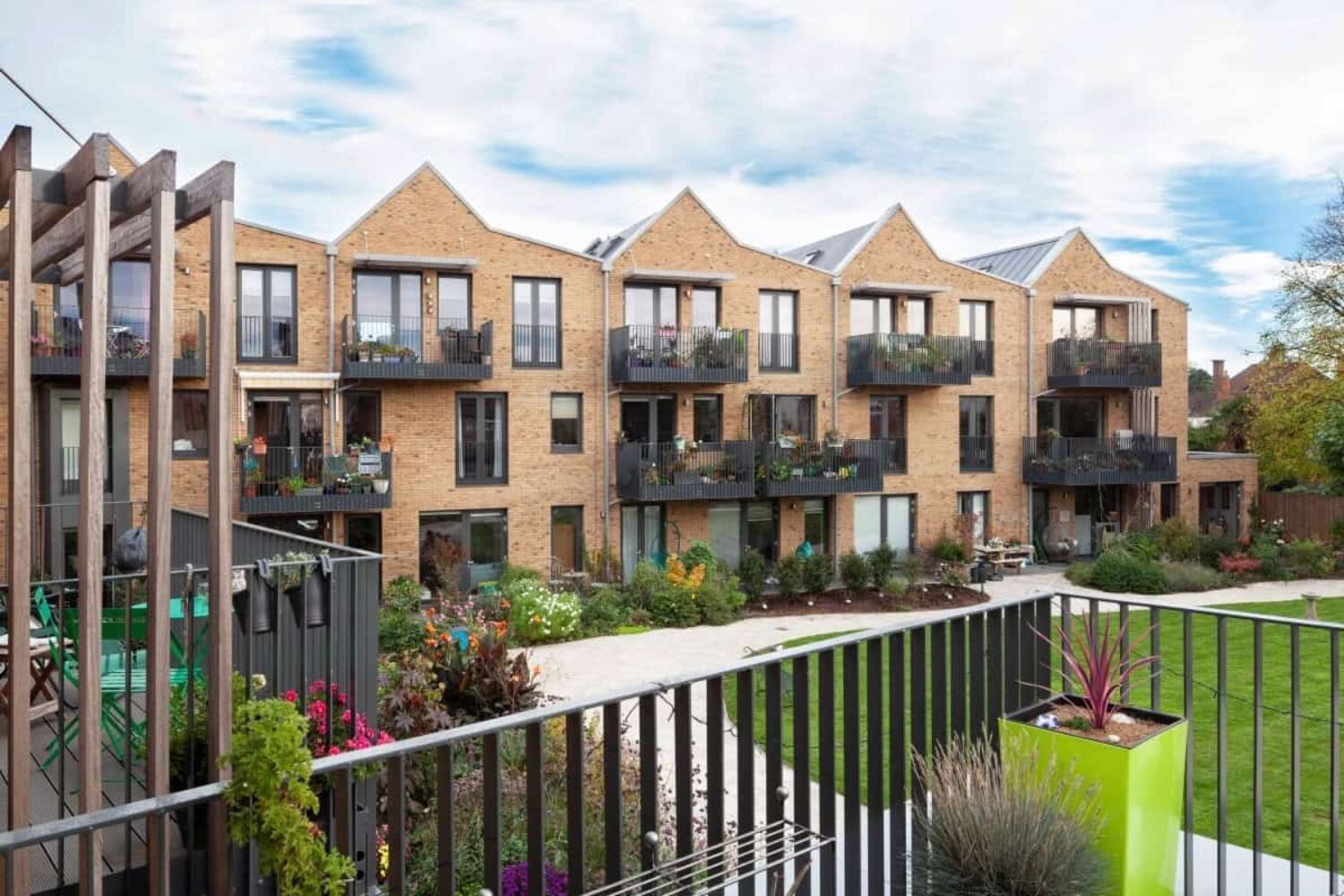
Lilac in Leeds is the one most often invoked: twenty straw-bale-built households in Bramley, set up in 2013 as the UK’s first Mutual Home Ownership Society, where members pay a collective mortgage pegged to about 35% of their income and the land and homes are owned by the society, not the individual. New Ground in High Barnet answered a different need — the country’s first senior cohousing scheme, twenty-five flats for older women who spent two decades organising it, eight of them socially rented. Marmalade Lane in Cambridge brought cohousing to a mainstream new-build street of forty-two homes around a shared garden, and Copper Lane in north London was the capital’s first purpose-built cohousing community.
Coin Street Community Builders is the scale demonstrator. Since 1984 the social enterprise has turned a derelict stretch of London’s South Bank into a neighbourhood owned by the community, setting up four fully-mutual housing co-operatives — Mulberry, Palm, Redwood and Iroko — that between them hold more than 200 affordable homes whose tenants run them on one-member-one-vote, with no right to buy. Hastings Commons shows the same logic applied to a left-behind seaside town, knitting derelict buildings back into a community-owned quarter; and A House for Artists in Barking, designed with the collective Assemble, builds genuinely affordable studio-homes for artists in exchange for public cultural programming.
Behind the schemes sits the connective tissue that lets them repeat. The London Community Land Trust takes land permanently off the speculative market and sells homes at prices linked to local incomes rather than the open market, the CLT model the sector is betting will scale. Places for People shows what happens when a community-rooted body grows into one of the country’s largest housing groups, while the Nationwide Foundation funds the patient early-stage work that community-led schemes need before any home is built. The pattern the comparative research keeps identifying — patient capital, plus secured land, plus a federating body — is exactly what the British sector has only in fragments, which is why each of these buildings reads as an achievement rather than a routine.
What Lilac’s collective mortgage, Coin Street’s mutual co-ops and the London CLT’s income-linked sales each demonstrate is a single proposition: that even in the most ownership-minded large economy in Europe, a home can be built and held permanently outside the speculative market, at a rent or price its residents can actually meet. The British sector has proved the proposition many times over. What it has never had is the scale, the tenure and the capital to make it ordinary.