Overview of the Briefing Paper
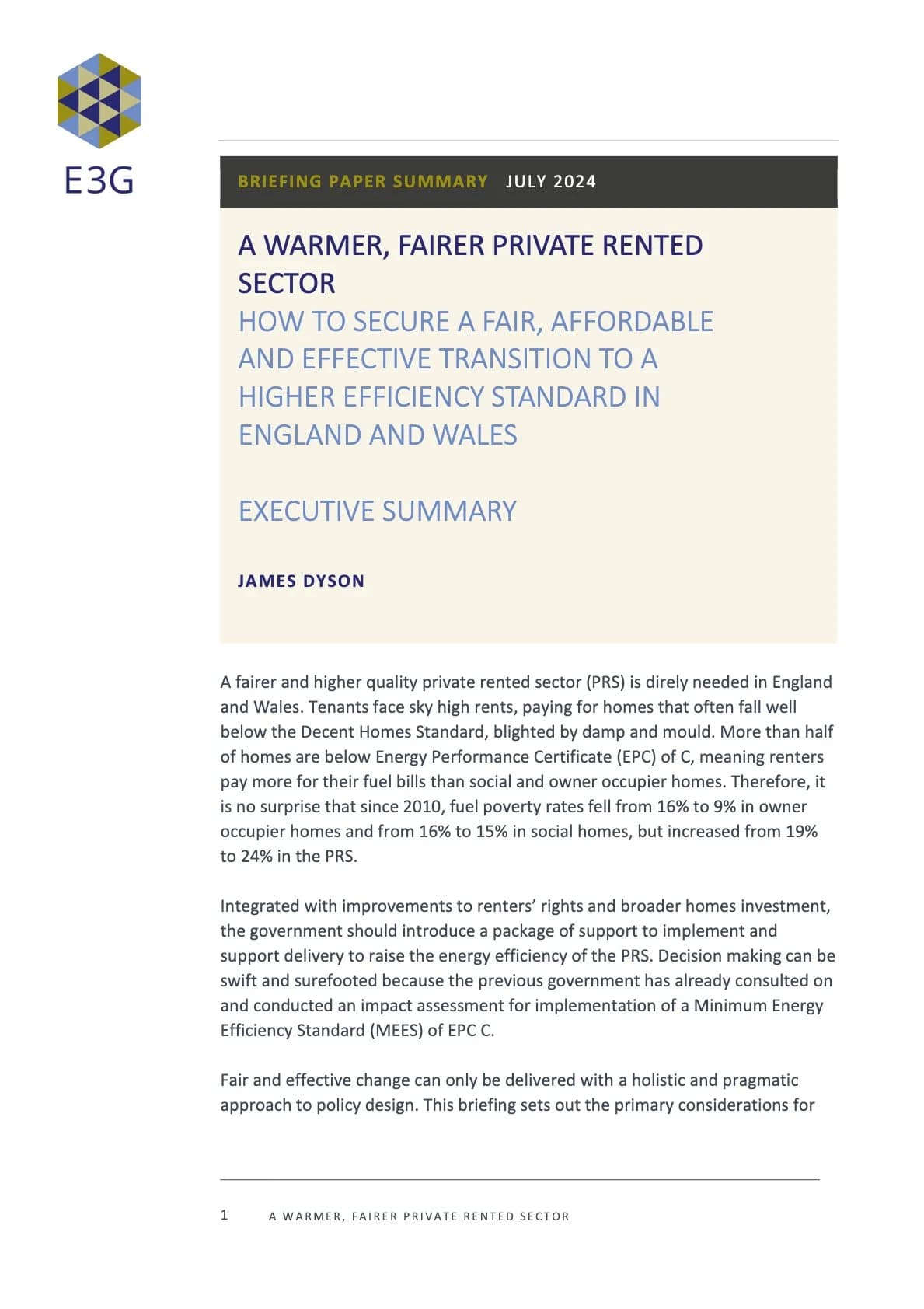
The document is a briefing paper titled “A warmer, fairer, private rented sector (for England and Wales)” produced by the climate‑change think‑tank E3G. It is authored by James Dyson, a researcher at E3G, and published under the organization’s name. The paper analyses the current challenges in the private rented sector (PRS) of England and Wales, focusing on energy efficiency, fuel poverty, and tenants’ rights, and proposes a set of policy levers to achieve a fairer, warmer housing market.
Energy‑Efficiency Situation in the PRS
More than half of PRS homes fall below an Energy Performance Certificate (EPC) rating of C, meaning renters pay higher fuel bills than owners or social‑housing tenants. Since 2010, fuel‑poverty rates have decreased in owner‑occupied (16 % → 9 %) and social housing (16 % → 15 %) but increased in the PRS (19 % → 24 %). The government already consulted on a Minimum Energy Efficiency Standard (MEES) of EPC C, but implementation support is lacking.
Tenants’ Rights and Security Concerns
The briefing highlights the precarious nature of private renting, where an imbalance between renters’ rights and landlords’ powers leads to insecurity. It recommends strengthening the 2023 Renters Reform Bill by adding efficiency standards, securing tenure, ensuring fair rent increases tied to EPC improvements, and extending the Decent Homes Standard (DHS) to the PRS. Eight key reform areas are identified, including ending no‑fault evictions, fair rent mechanisms, and better landlord‑tenant dispute resolution through a PRS Ombudsman.
Financial Support Packages for Upgrades
To enable landlords to meet higher efficiency standards, the paper calls for a mix of grants, low‑interest concessional loans, and tax incentives. It notes that PRS homes, despite representing 20 % of UK households, receive only 14 % of upgrades under existing fuel‑poverty programmes. Targeted financial tools would help low‑income tenants and landlords undertake insulation and other retrofit works without excessive upfront costs.
Policy Levers for Effective Implementation
Four main levers are outlined:
- Timeline & Scope – a phased delivery schedule balancing economic pressures and supply‑chain capacity, aiming to reduce the number of homes needing upgrades by 2030.
- Safety Net – regional coordination to protect vulnerable markets from adverse effects of new regulations.
- Enforcement – improving compliance with MEES EPC E and future standards through stronger inspection regimes and incentives for tenant reporting.
- Cost Controls – revisiting the £10,000 cost cap per home, considering inflation and post‑pandemic cost changes, and setting clear exemption criteria.
Evidence on Landlord Behaviour
Research cited from the National Residential Landlord Association shows 72 % of landlords not planning upgrades would reconsider if tax deductibility rules were adjusted. International examples, such as France’s €21,400 yr tax deduction for energy‑efficiency costs, illustrate how fiscal measures can drive investment.
Wider Climate and Social Impact
Improving PRS energy performance aligns with the UK’s broader climate‑change mitigation goals and reduces fuel‑poverty disparities. Warmer, more efficient homes also protect health by reducing damp and mould, contributing to public‑health outcomes.
Conclusion and Recommendations
The briefing concludes that a holistic, pragmatic approach—combining strengthened renters’ rights, comprehensive financial support, clear timelines, robust enforcement, and targeted tax incentives—is essential to transition the private rented sector toward a fair, affordable, and high‑efficiency standard. Implementing these measures would help close the EPC gap, lower fuel costs for tenants, and support the UK’s climate objectives while ensuring a stable, equitable housing market for renters across England and Wales.