Loading...

🇸🇪Country profile
Sweden
Sweden negotiates its rents instead of pricing them and holds a fifth of its homes as cooperatives. So why can a newcomer to Stockholm wait years for a flat?
Read the profile
Loading...
Sweden built its housing settlement on an idea the country still calls the Folkhem — the people's home — in which the state guaranteed that a decent dwelling was a right of citizenship, not a reward for wealth. The cooperative movement was woven into that promise from the start. Saver-members pooled money through HSB and Riksbyggen and built flats they could occupy for life. That is why the question here is rarely framed as renting versus owning. It is framed as how a household secures a stable home inside a system that was designed to give everyone one.
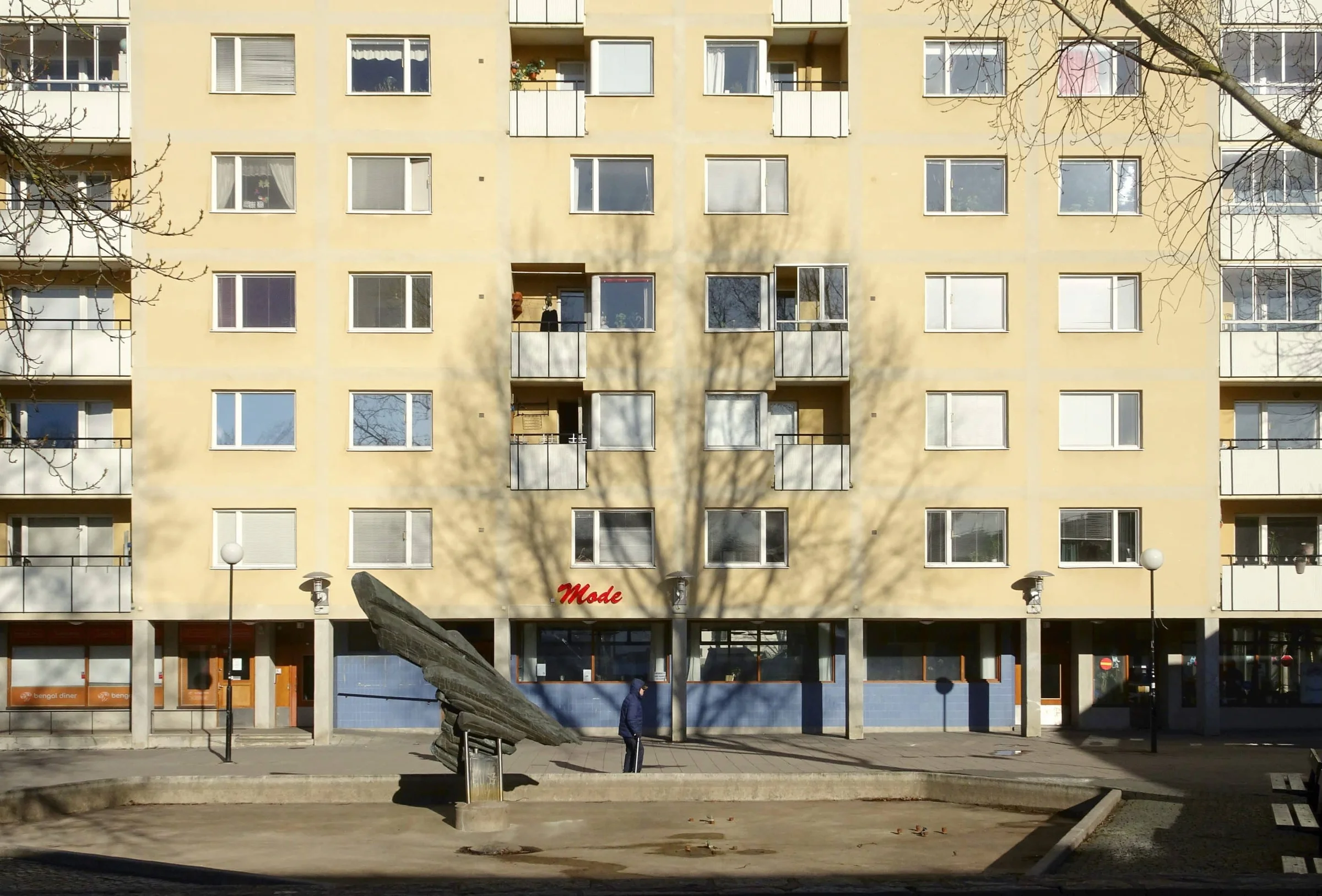
The tenure mix still carries that design. About 64% of Swedish residents are owner-occupiers and 36% are tenants. Inside the owning side sits the country's distinctive cooperative tier: 22% of all dwellings are bostadsrätter — roughly 1,030,000 cooperative flats held through some 28,000 bostadsrättsföreningar — making Sweden's cooperative share one of the largest in Europe. About 22% of Swedes live in a cooperative home. The public allmännytta — municipally-owned, open to anyone — accounts for another 20%, and that non-market public tier sits alongside roughly 16% private rental. The cooperative plus public non-market segment together comes to a large slice of the stock, but the two halves work very differently: one is owned equity, the other is rented.
There is no means-tested social-housing category to point to, because Sweden chose not to build one. Its model is universal: the allmännytta lets to anyone on a first-come waiting list rather than to a qualifying income band, so the public tier counted at 20% is open to the whole population, not reserved for the poorest. The flip side is a queue. In Stockholm the municipal wait for a first-hand contract now stretches to many years, which pushes newcomers into the second-hand market the rest of this section turns to.
Rents are not set by a market but negotiated. Under the bruksvärdessystemet — the use-value system — rents track an apartment's size, standard and location rather than what scarcity would bear, and they are bargained collectively through the förhandlingsordningen between landlords and the tenants' union. The result is a tight ladder. Cooperative rental runs around €3.8 per square metre a month, public allmännytta rents at €8.7, the all-stock median at €9.1, and a newly-signed first-hand contract at €10.5. Only the furnished or private second-hand sublet breaks out of the band, at around €25 — the unregulated corner where the shortage actually shows up as price.
Net monthly rent per m² by tier (national figures; furnished is gross, second-hand). The collectively-negotiated bruksvärde tiers — the allmännytta and the all-stock median — cluster tightly, because the same negotiation sets them; the gap only opens on the unregulated furnished sublet, the corner of the market the 2026 private-rental reform is aimed at.
Because the price barely moves, the shortage shows up as scarcity instead. National residential vacancy sits at just 2.1%, and the rental vacancy rate at 1.2% — among the lowest in Europe, with effectively no immediately available flats in Stockholm, Gothenburg or Malmö. Short-term lets add a thin extra squeeze in the tourist core: Inside Airbnb counts at least 1,148 full-time-equivalent entire-home listings across the covered cities, a lower bound rather than a national rate, but one concentrated in exactly the central districts where the first-hand queue is longest.
Demand keeps building against that wall. Sweden takes in roughly 134,400 in-migrants a year and issues about 35,000 residential building permits, spread across a total stock of 4,856,000 dwellings — and construction has fallen well below what the country needs. After a decade of building 38,000–59,000 homes a year, output collapsed: only around 20,000 homes were forecast to complete in 2024, against the 67,300 a year Boverket says are required to clear demand.
When a market cannot clear on price, it rations by access — and the rationing falls hardest on whoever has no contract yet. The shortage is no longer a big-city quirk: 255 of Sweden's 290 municipalities reported a housing deficit in Boverket's 2025 survey, the broadest reading on record. The squeeze reaches well past the poorest: a young professional or a newly-arrived family with no place in the queue competes for the same scarce second-hand sublets as a low-income household, and pays the unregulated €25-per-square-metre rate to do so. Researchers tracking the gap warn that a growing group of households falls through both the market and the municipalities' social services, and an illegal black market in first-hand contracts has grown in the gap. Roughly 27,000 people are counted as homeless, and around 5,500 court-ordered evictions are recorded a year — modest by European standards, but rising in a country that built its self-image on housing everyone.
The Swedish cooperative is, unusually for Europe, an ownership form rather than a cost-rent one. A household buys a bostadsrätt — literally a 'housing right' — which is a transferable share in a bostadsrättsförening, the cooperative association that owns the building and the land collectively. The member owns the right to occupy a specific flat and can sell it on the open market, but the association owns the bricks. The Housing Europe survey of European cooperative housing dates the form to the 1920s, when Swedish so-called tenant-ownership cooperatives emerged as a response to extreme housing shortages and severe speculation — the same two pressures the country faces again now.
What makes the system reproduce itself is a development model the sector calls 'mother and daughter'. The large regional cooperative associations — the 'mother' — work with a newly-formed local cooperative, the 'daughter', handling all the technical side of a project and acting as guarantor for the first construction loan. Around two months before the members move in, the daughter refinances that loan through a new mortgage of its own and stands on its own feet. Ownership of a finished project splits roughly 75% to the individual tenant-owners and 25% to the cooperative as a collective, and both halves of the structure are non-profit, with any surplus retained inside the cooperative system. Cooperative savings schemes — special accounts paying attractive interest to members saving toward a first home — feed the next round of projects.
Two federations carry almost the whole of it, and between them they define the sector. HSB, founded in 1923 by tenant savings societies, is a saver-member federation: by 2021 it counted around 670,000 members plus roughly 120,000 home-savers, some 346,000 cooperative units and 4,100 affiliated cooperatives across 25 regional associations. Riksbyggen, founded in 1940 by the construction unions, federates about 1,750 housing cooperatives through its regional bodies. Both have repeatedly been named the most sustainable company in Sweden, and both are the Swedish members of the European cooperative-housing federation. Alongside them sits SKB (Stockholms Kooperativa Bostadsförening), which runs a rarer variant — the kooperativ hyresrätt, a cooperative rental tenure where members hold a stake but pay rent rather than buy equity, the tier whose €3.8-per-square-metre rents anchor the bottom of the rent ladder.
The model carries a deliberate brake on speculation, which is the part most often misread from outside. When a tenant-owner wants to leave, they may sell their share on the open market — but in most cooperatives the purchaser must be approved by the remaining members, and the flat is meant to be a primary home rather than a held asset. Subletting is allowed only with permission and only in defined circumstances. So while the bostadsrätt is technically tradable equity, the social design pulls the other way: these are intended to be homes for the people who live in them, not investments to park capital in. The independent research literature reads the same tension — the Swedish profile in the housing-regime study traces how the cooperatives have drifted between that social-housing role and a more market-facing one across a century of policy shifts.
Honesty about scale cuts both ways. By count this is one of Europe's deepest cooperative sectors — a fifth of all homes, a hundred years of continuity, two federations with national reach. But its present challenge is sharp. High inflation, rapidly rising interest rates and high construction costs hit new cooperative construction hard from 2023, and the federations expect the numbers to fall further. The answer the sector itself proposes is structural rather than charitable: HSB and Riksbyggen are pressing the government to introduce a state-guaranteed loan for first-time buyers, the missing rung that would let younger households enter the ownership model the way an earlier generation did through the savings schemes. An American study of the Swedish model argues exactly this is what makes it worth copying — that the saver-cooperative route is a proven way to house moderate-income families that the United States lacks.
Swedish housing policy turns on a question most of Europe settled long ago: should rents be negotiated or priced? The centre-right government that took office in 2022, with Andreas Carlson as the minister responsible for housing, has chosen to loosen the edges of the system rather than dismantle its core. It phased out the previous investment subsidy for rental construction, approved the last grants for blocks permitted before 2023, and turned instead to supply-side measures — releasing state land for housing and easing the rules on who may build and sublet. The bet is that more building and a freer second-hand market will clear the shortage without touching the first-hand bruksvärde rents that most Swedes pay.
Two concrete reforms are in motion, and both stop short of market rents. A government inquiry on presumtionshyra — presumptive rents for newly-built rental housing — reached draft-bill stage in 2025 with the Council on Legislation raising essentially no objection; it would roughly double the permitted ceiling for new-build lets, to just under SEK 6,000 a year per the price-base formula. A second, broader inquiry on private subletting closed its consultation in September 2025, with a bill expected in spring 2026 and a planned start of 1 July 2026: the aim is to make it easier and more profitable for individuals to rent out their own homes, loosening the second-hand bottleneck without rewriting the collective-bargaining frame.
For the cooperative sector specifically, the asks are concrete instruments rather than rhetoric. The first is the state-guaranteed first-time-buyer loan that HSB and Riksbyggen have put at the top of their list — the topplån-style rung that would let a young household reach the insats, the cash stake, a bostadsrätt requires. The second already exists in private form: HSB Dela, a shared-equity product aimed at 18-to-29-year-olds in which HSB buys half of a cooperative flat and the young buyer the other half, with a ten-year window to buy out the rest. The third is access to the public land and patient finance that any new cooperative project needs upfront — the same constraint the savings schemes were invented to solve.
Sustainability is now braided through all of it. Since 1 January 2022 every new building must file a climate declaration of its embodied carbon, and from 2027 the requirement extends to refurbishment — a change that puts the ageing cooperative and Million-Programme stock squarely in scope. Boverket has already proposed accelerating mandatory limit values for buildings' climate impact. HSB and Riksbyggen have both set SBTi-validated decarbonisation targets and frame a fossil-free building stock by 2050 as the shared destination, with climate-risk mapping and biodiversity now entering the picture because banks and insurers are starting to price them into whether a building can be financed or insured at all.
Tenant savings-and-building societies found HSB (Hyresgästernas Sparkasse- och Byggnadsförening) in Stockholm — the original cooperative federation, built on a saver-member model that still runs today.
Construction trade unions establish Riksbyggen to keep building during the war downturn — the second great cooperative developer, organised through local tenant-owner associations.
Sweden's post-war housing committee sets the principle that rental, cooperative and owned tenures all receive equal public subsidy — the Folkhem settlement that let the bostadsrätt grow alongside the public allmännytta.
The state commits to building one million dwellings in ten years; HSB and Riksbyggen deliver a large cooperative share of it, and the programme ends the acute post-war shortage by 1974.
Deregulation lets municipal allmännytta tenants convert blocks into bostadsrättsföreningar; over the following decades the conversions lift cooperative tenure toward today's roughly one-fifth share, concentrated in the big cities.
A reform requires municipal housing companies to operate on commercial principles, ending their formal rent-leading role while the collectively-negotiated bruksvärde system stays in place.
From 1 January every new building must file a climate declaration of its embodied carbon — the rule HSB and Riksbyggen had pushed for, and the lever the sector now builds its retrofit case on.
A government inquiry on presumtionshyra (presumptive rents) and private subletting reaches draft-bill stage; the Council on Legislation raises essentially no objection, and presumptive-rent ceilings are set to roughly double.
A law making it easier and more profitable for individuals to sublet their homes is expected to take effect on 1 July, the government betting it will loosen the second-hand bottleneck without touching first-hand bruksvärde rents.
The shared Swedish goal — endorsed by HSB and Riksbyggen with SBTi-validated pathways — is a fossil-free building stock by 2050; from 2027 the climate declaration extends to refurbishment, putting the cooperatives’ ageing stock at the centre of it.
From the 1923 founding of HSB through the Folkhem and Million Programme, the 1990s bostadsrätt privatisation wave and the 2025 rent-reform inquiries to the 2026 private-rental law and the 2050 fossil-free-buildings target.
The unresolved argument is the one underneath the reforms: how far to let the market in. On one side, the OECD and much of the governing coalition read Sweden's frozen rental market as the cause of the shortage — the national housing agency has estimated the country would have tens of thousands more homes without the rent controls, and the case is that negotiated rents starve new supply and trap people in the second-hand queue. On the other side stands Hyresgästföreningen, the Swedish Union of Tenants, which negotiates rents for roughly three million tenants and treats the bruksvärde system as the thing that keeps housing affordable at all; its ten-point programme is explicitly built to stop market rents, warning that in tight areas they could lift rents by up to 50%. The cooperative federations sit oddly across the line — sympathetic to anything that gets more built, wary of anything that prices their members' children out of the model their grandparents saved into. The question of whether Sweden negotiates or prices its homes is still open, and every reform above is a move made without answering it.
For the vast majority of people, market rents would mean a much higher rent. In some areas, rents could rise by up to 50 percent. Together we can stop market rents.The strongest case for the Swedish model is not in its rent tables but in what the federations are building with their hundred-year balance sheets. The clearest demonstrators cluster in Gothenburg and Stockholm, where the cooperatives are using their long horizons to test what a low-carbon, shared-life version of the bostadsrätt looks like.
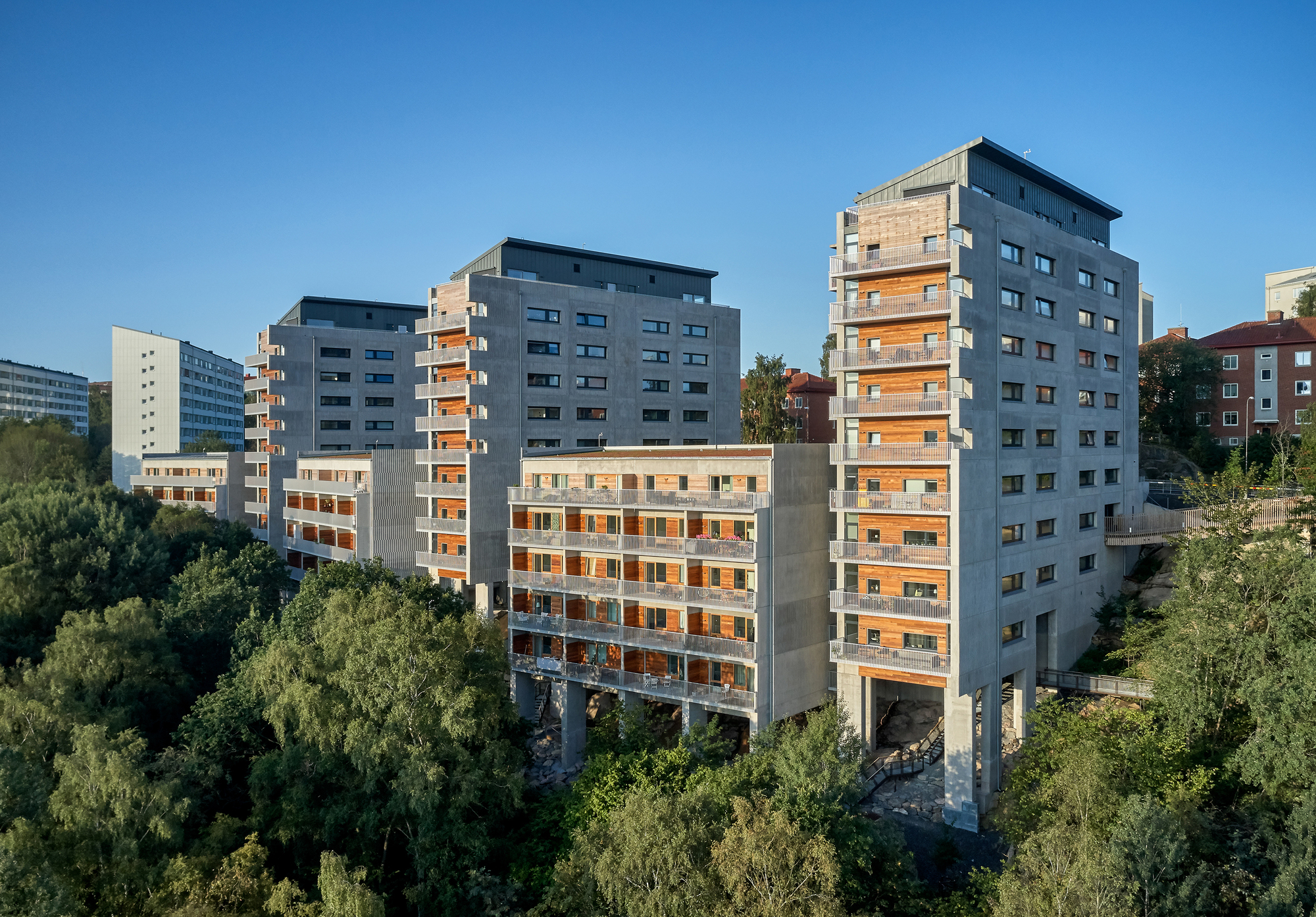
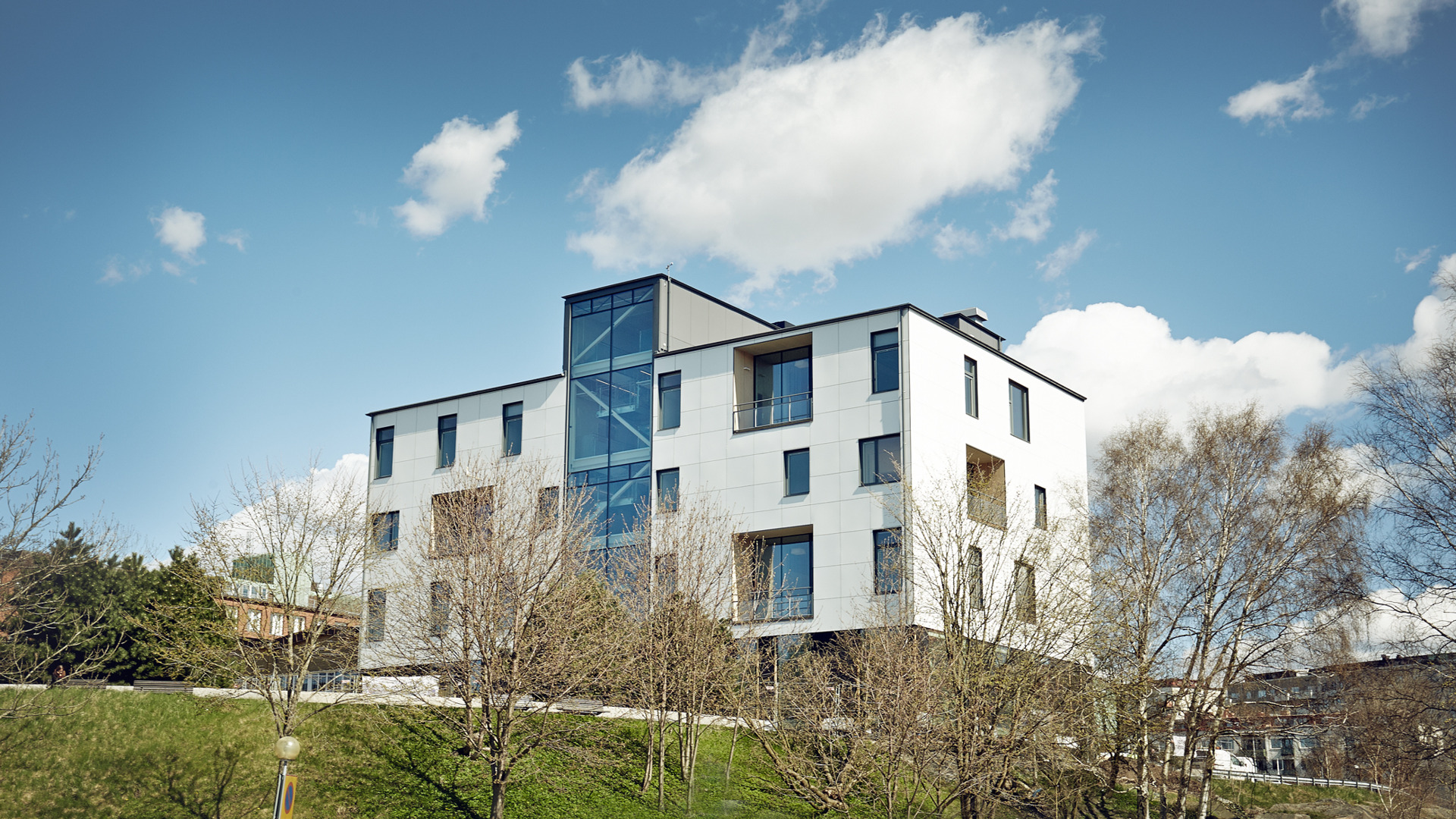
Brf Viva, in the Guldheden district of Gothenburg, is the one the sector points to first: 132 cooperative apartments built by Riksbyggen as a living research platform with Chalmers University, RISE and the city. It used a concrete mix with roughly 30% lower embodied carbon, stores solar power in recycled bus batteries, and runs car- and bike-sharing in place of a parking garage — the climate-declaration logic made physical, and an Environmental Gold-certified answer to the embodied-carbon question the 2022 rules pose. A few districts away, HSB Living Lab is a movable research building on the Chalmers campus where HSB, the university and partners test materials, energy systems and ways of living in real occupied flats before they reach the wider cooperative stock.
The collective-living strand runs older and is being rediscovered. Kollektivhuset Färdknäppen in Stockholm is a long-running 'second-half-of-life' cohousing house where residents over forty share kitchens, meals and workspace inside a cooperative frame, and Blåsut Kollektivhus carries the same self-organised collective-house tradition into a newer generation of residents. K9 extends the experiment into student and young-adult cohousing — proof that the cooperative form bends to who needs it, from first home to last.
Behind the buildings sits the design and delivery layer that makes them repeatable. White Arkitekter, Sweden's largest architecture practice, and studios like Kjellander Sjöberg, Belatchew Arkitekter, Kanozi Arkitekter and Kamikaze Arkitekter work the cooperative and timber briefs; the engineering house Sweco carries the technical side; Coompanion advises new cooperatives on how to form; and the federations HSB and Riksbyggen remain the patient developers that turn a savings scheme into a finished block. The connective tissue the rest of Europe is trying to assemble — a federating body, patient member capital, public land and a research pipeline — Sweden has run as a working machine for a century. The open question is whether it can build at that scale again with interest rates and construction costs where they now are.