Norway turned a nation of tenants into owners through the cooperative — then deregulated away the discount that made it work. Can the borettslag find a second purpose before the young are priced out for good?
Read the profile
The renters the cooperative model leaves behind
Norway built one of Europe's deepest homeownership cultures on purpose, and it used the cooperative to do it. After the war the state set out to give every household a home it could own rather than rent, and it reached that goal largely through cooperatives financed by a public bank. The result is a country where owning is the default and renting is treated, quietly, as a stage you pass through. That choice shapes everything that follows — including who the market now leaves stranded.
The tenure mix shows how far that went. About 80% of Norwegians are owner-occupiers and only 20% rent. Within the housing stock, 13.7% is cooperative — roughly 370,000 borettslag dwellings — while municipal social housing covers just 4%, and the residual private-rental tier is a thin 3%. The non-market segment, cooperative plus municipal, comes to 4% of all dwellings. The striking feature is what is missing: almost no separate social-rental sector exists, because the post-war state poured its effort into spreading ownership instead of building a public landlord.
Norway's national tenure mix
Cooperative members effectively own their unit, so cooperatives are grouped with owner-occupiers in national statistics.
Owners
Owner-occupier66.3%
Cooperative13.7%
Renters
Public & non-profit rental4.0%
Private rental16.0%
The cooperative slice shown here is the borettslag (co-operative share-ownership) tenure: members own a transferable andel (share) in a boligbyggelag-managed cooperative, not a freehold flat. Norway has almost no separate social-rental tier — municipal kommunale boliger (council housing) account for only about 4% of stock and are allocated to refugees, people with disabilities and others who cannot enter the ownership market.
Share of national dwellings by tenure, resolved live from the geographic catalogue. Norway is among the most owner-occupied societies in Europe — and most of that ownership was built, deliberately, through the cooperative form rather than around it.
What passes for social housing is small and tightly targeted. The 110,000 or so kommunale boliger (municipal dwellings) are allocated by local councils to refugees, people with disabilities and households that cannot otherwise enter the market; only about 5% of households qualify on need grounds. There is no broad, rent-regulated public tier of the kind Vienna or Amsterdam rely on. The Norwegian instrument is not a public landlord but a public lender — the State Housing Bank, Husbanken — pushing people into ownership with subsidised loans rather than housing them in perpetuity.
The cost of renting, when you cannot buy, is steep. A borettslag member's monthly common charge runs around €6.80 per square metre, and municipal rents about €8.50. But the open market is another world: the all-stock median rent is €15.20 per square metre, a newly-signed contract €17.90, and a furnished serviced let €28 all-in. A new private lease costs more than double a cooperative member's monthly charge — and the renter, unlike the member, builds no equity from it.
The national rent ladder in Norway
Cooperative (felleskostnader)
Municipal (kommunale boliger)
All-stock median
New contracts
Furnished / serviced (gross)
Monthly housing cost per m² by tier (cooperative shows felleskostnader — the monthly common charge a borettslag member pays, the nearest analogue to rent; market tiers are net rent, furnished is gross). The cooperative charge sits at well under half the all-stock median — but a borettslag member also holds equity, so the ladder understates how much cheaper the cooperative entry point really is.
Slack in the system is scarce. Residential vacancy sits at about 3.2% nationally and the rental-vacancy rate at just 2.5% — tight, especially in Oslo, Bergen and Trondheim where demand concentrates. Short-stay platform listings drain a further sliver of the long-term pool: Inside Airbnb counts at least 2,994 full-time-equivalent short-let units across the covered cities, a conservative lower bound rather than a national total. In a stock with so little spare capacity, even a small diversion to tourists tightens the squeeze on people trying to find a home.
On the demand side, Norway takes in roughly 85,600 immigrants a year against about 23,000 residential building permits, spread across a total stock of some 2,770,000 dwellings. Construction is expensive — building costs run near €3,700 per square metre — and high interest rates plus a 15%-deposit mortgage rule have pushed first-time ownership further out of reach.
The pain of this model falls almost entirely on the people outside it. For owners, decades of rising prices and generous mortgage-interest tax relief have built wealth; the OECD warns those same tax advantages inflate prices and widen the gap between owners and the rest. The locked-out are the young, the recently divorced and lower-income newcomers, who face both the deposit wall and the thinnest, costliest rental market in Scandinavia. NBBL's own figures sharpen the point: in some municipalities only 2–3% of homes are affordable to a first-time buyer, and a typical first-timer can afford barely 3.5% of homes in Oslo or Bærum. The squeeze is not a poverty problem at the margins — it is a structural barrier to entry that even middle-earning young Norwegians now hit. Housing affordability has become one of the country's loudest domestic arguments, fought over deposits and rent rather than homelessness, which at roughly 3,300 people remains comparatively low.
Borettslag: ownership built cooperatively, then sold to the market
The Norwegian cooperative is not the cost-rent form found in Vienna or Zürich. It is an ownership form, organised in two tiers. A household buys an andel — a transferable share — in a borettslag (a housing cooperative), which owns the building; membership of the borettslag is held through a boligbyggelag (a cooperative housing association) that develops and manages it. Members vote one-per-head regardless of share size, hold a forkjøpsrett (pre-emption right) when a neighbour sells, and pay a monthly felleskostnader charge for shared costs. Around 18% of Norwegians live in a cooperative home on this basis. The form was the vehicle through which the post-war state turned a nation of tenants into a nation of owners.
The scale is built on a long, unbroken line. OBOS, founded in Oslo in 1929, pioneered the build-and-save cooperative and is now Norway's largest, with more than 500,000 members. Its national federation, NBBL — the Co-operative Housing Federation of Norway, the country's third-largest membership organisation — today binds together 39 cooperative housing associations carrying well over 1.2 million individual members, by far the densest cooperative membership base in Europe relative to population. The Housing Europe survey of European cooperative housing, Housing Cooperatives in Europe - Resilience and Adaption to Changing Need, places the Norwegian sector among the most successful cooperative-ownership movements in the world. At the national level there are some 370,000 cooperative dwellings, about 14% of the total housing stock, across 39 federated associations.
From the 1930s the movement was an arm of social policy. The intention, after the Second World War, was to provide good housing for all by stimulating homeownership in a non-speculative form — and the state equipped it with affordable building plots, subsidised Husbanken loans and grants. For three decades cooperative resales were price-regulated, so a borettslag flat changed hands well below the open market and stayed within reach of ordinary wage-earners. The cooperative was, in effect, Norway's social-housing system, run not by councils but by member-owned associations.
Then the model was let go. From the early 1980s a liberal turn abolished the price regulation, wound back the subsidised loans and grants, and stopped municipalities reserving building plots for the sector. By the mid-1980s cooperatives had adapted to a free-market economy; today a borettslag share sells at full market value, with the existing members' forkjøpsright exercised at the market price rather than a regulated one. Public financial support now reaches only about 5% of new homes, concentrated on disadvantaged groups. The cooperative kept its democratic governance and its scale — in Oslo it still accounts for around a third of the housing market — but lost the affordability discount that once defined it. That is the sector's central tension: it remains huge and well-governed, yet entry now costs what any other flat costs.
Counted by the associations rather than the dwelling type, the footprint is larger still: the boligbyggelag manage some 615,000 homes in all — borettslag flats, condominiums and rental units — through roughly 25,000 elected representatives, a member-democracy machine with few equals in Europe. What is genuinely new is the federations' attempt to rebuild an affordable entry route from inside the market. NBBL and its associations have developed leie til eie (rent-to-own) and shared-ownership schemes — buy 50% or more of a flat at a fixed price and rent the rest, or rent first with an option to buy within five years — aimed at the young, divorced and equity-poor the OBOS-era ownership ladder no longer reaches. The honest reading is that the sector is improvising a substitute for the affordability it gave away in 1982, this time without the price regulation that made the original work.
Bustadmeldinga, the deposit wall, and the fight over whom housing is for
Norwegian housing policy is set nationally and delivered locally, and the current government has staked its answer on a single white paper. Meld. St. 13 (2024–2025), the Bustadmeldinga (the housing report), restates homeownership as the foundation of Norwegian housing policy and proposes amending the housing laws to widen the routes into it. Its headline instruments are leie til eie (rent-to-own) and shared-ownership models, to be made more accessible and consumer-friendly so that the young, the divorced and the equity-poor can step onto the ladder. The policy bet is unambiguous: the cure for an ownership society's affordability crisis is more, and easier, ownership.
Three levels share the work. The Storting (parliament) and the ministry write the laws and set the framework; the state lender Husbanken supplies the financial tools — subsidised startlån (start-up loans) and housing allowances; and the kommuner (municipalities) allocate plots, run the small kommunale-bolig stock, and distribute the loans on the ground. A Husbanken pilot for 2026 puts NOK 2 billion behind startlån for first-time buyers who can muster only 5% equity rather than the 15% the mortgage rule normally demands — a direct attempt to lower the deposit wall that keeps young Norwegians renting. Husbanken's leie før eie (rent-before-buy) schemes let households try-before-they-buy a municipal flat with a purchase option.
For cooperatives specifically, the support is thinner than the sector's size would suggest. The current cooperative model draws no general government financial assistance — the regulated, subsidised era ended in the 1980s — except when a borettslag houses people with disabilities, refugees or other defined groups. Local authorities retain a right to buy up to 10% of the flats in a new cooperative development, a residual social lever from the old settlement. The leie til eie and shared-ownership innovations the federations are pushing are precisely an attempt to win back, through the market, the affordability that public policy withdrew.
The tenancy side is being reopened too. The 2024 NOU 2024:19 review of the husleieloven (Tenancy Act) proposes lifting the minimum fixed-term lease from three years to five, giving tenants a new right to extend, allowing them to alter their homes more freely, and replacing the contested gjengs leie (prevailing-rent) adjustment with a simpler market-rent rule. For a country that has long treated renting as a way-station, codifying longer, more secure tenancies is a quiet admission that not everyone will own — and that the thin rental market needs rules fit for people who stay.
Two camps argue over what all this should achieve. The government's line, in the Bustadmeldinga, is that the route out of the crisis is to widen ownership: more leie til eie, easier first loans, homeownership defended as the social good it has always been in Norway. Against it stands the cooperative-and-construction camp, led by NBBL, which argues the white paper ducks the urban crisis and that the binding constraint is simply too little building. Bård Folke Fredriksen, NBBL's director, says the government's proposed tax on housing construction will mean fewer homes built — "this gives fewer homes to ordinary people" — and the federation has published its own recipe for getting construction moving. The disagreement is not really about whether ownership is good; both sides take that for granted. It is about whether you fix an ownership crisis by financing more buyers or by building far more homes — and who pays when supply stays short.
Oslo Bolig- og Sparelag (OBOS) is founded as a cooperative building-and-savings society; it grows into Norway's largest housing cooperative, today with more than 500,000 members.
The post-war State Housing Bank is created to finance housing for all through subsidised loans; for three decades it funds the great majority of new homes and underwrites the cooperative expansion.
The Housing Cooperatives Act and Housing Construction Cooperatives Act give the borettslag / boligbyggelag two-tier model its durable legal shape — share-ownership, member pre-emption, democratic governance.
Market liberalisation lifts the price controls on cooperative resales; borettslag shares begin to trade at full market value, ending the era of below-market cooperative entry and tying the sector to the wider housing-price cycle.
Husbanken now finances only about 5% of new dwellings — down from the great majority until the late 1970s — with public support concentrated on disadvantaged groups, refugees and rural areas.
Meld. St. 13 (2024–2025), the Bustadmeldinga, restates homeownership as the foundation of Norwegian housing policy and proposes amending the housing laws to widen leie til eie (rent-to-own) and shared-ownership routes for those locked out of the market.
A Husbanken pilot allocates NOK 2 billion to startlån (start-up loans) for first-time buyers with only 5% equity, targeting younger and lower-income households shut out by the 15%-deposit mortgage rule.
The 2024 NOU 2024:19 tenancy-law review proposes lifting the minimum fixed-term lease from three to five years and giving tenants stronger extension rights; alongside it, the cooperative federations expect rising energy-efficiency requirements to push deep retrofit of the ageing borettslag stock up the agenda this decade.
From the 1929 founding of OBOS through the post-war homeownership-for-all project, the 1980s deregulation, and the 2025 Bustadmeldinga housing white paper to the 2026 Husbanken first-buyer pilot and the proposed five-year tenancy floor ahead.
Wood, sharing and plus-energy: where the next Norwegian model is being tested
If the cooperative's affordability discount is gone, its most interesting recent work has moved to a different frontier: how people share space, and how low-carbon a home can be. The clearest arguments are no longer about price regulation but about timber, shared rooms and near-zero energy — and they are being built in Oslo, Stavanger and the cities where the squeeze bites hardest.
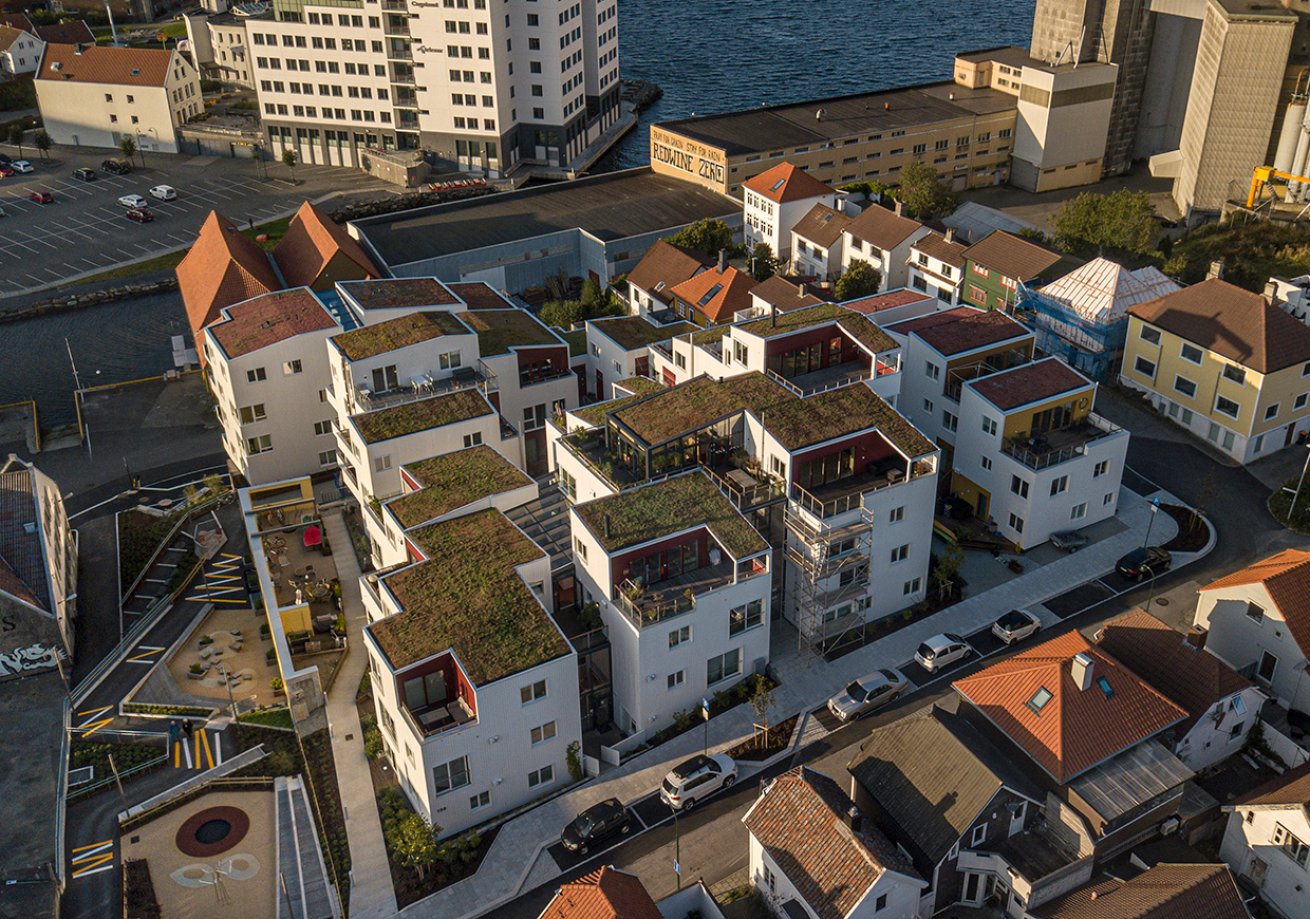
Vindmøllebakken in Stavanger is the one the sector points to. Designed by Helen & Hard entirely in wood, it gathers forty co-living units, four townhouses and ten apartments around 500 square metres of shared indoor commons and a planted courtyard. Its "Gaining by Sharing" model — residents own less private space but gain access to far more shared space — is a deliberate answer to the cost of building, and it won DOGA's national award for universal design. It is the cooperative idea pushed past tenure into everyday sharing.
Fyrstikkbakken 14 in Oslo carries the low-carbon strand. Built in mass timber and low-carbon concrete across four blocks of 163 apartments, it is a FutureBuilt flagship that cut greenhouse-gas emissions by 53% and runs at near-zero operational energy with rooftop solar. Its delemeter ("shared square metre") concept hands residents commons they own and govern together — car-free, with shared bikes and electric vehicles instead of resident parking. FutureBuilt itself, the Oslo-region programme curating these demonstrators, sets the emissions and quality bar the rest of the market is measured against.
Behind the buildings sits a thin but capable institutional layer. OBOS, the 500,000-member Oslo cooperative, is now as much a large-scale developer as a member society, building plus-energy and timber pilots at volume. Cultura Bank, Norway's small ethical-finance cooperative, supplies patient capital to projects the mainstream banks treat as marginal. The studios that shape the work — Snøhetta, Helen & Hard, Nordic Office of Architecture, DARK Architects, MAD architects — and the furniture-maker Vestre give the Norwegian model an unusually design-led, low-carbon signature. The ENHR Annual Conference 2026, hosted in Oslo, brings Europe's housing researchers to examine exactly this question: whether an ownership society can keep building homes that are both affordable and green.
What these projects test is whether the Norwegian cooperative still has a second act. The first act — using member-owned associations to turn a nation of tenants into owners — succeeded so completely that it worked itself out of a job once price regulation went. The open question is whether sharing, timber and plus-energy construction can give the borettslag a new purpose, and whether a country that solved affordability by spreading ownership can now solve it again for the people that ownership left outside.