
A nation of corporation housing, short 400,000 homes
The Netherlands solved its housing question once, a century ago, and is now living with the second half of that solution. The 1901 Woningwet built a vast non-profit rental sector run by foundations — the woningcorporaties — rather than by tenants or the market. That choice gave the country the deepest social-rental stock in the European Union, and it is the institutional backdrop against which a sharp new shortage is now playing out: roughly 400,000 homes missing nationally, and a build rate that keeps falling short of the political targets set to close the gap.
The tenure mix shows the corporate imprint. About 57% of Dutch residents are owner-occupiers — a majority built up over decades of mortgage-interest relief — leaving 43% in rental. Within that rental base sits the country's defining feature: roughly 2.3 million non-profit woningcorporatie dwellings, about 28% of all homes, the largest such share in the European Union. That leaves around 15% in private rental. The member cooperative, the form this profile follows, is almost invisible in these numbers — only about 0.05% of citizens live in one — because the 1901 law routed the social mission through corporations instead.
- Owners
- Owner-occupier57.0%
- Renters
- Public & non-profit rental28.0%
- Cooperative0.05%
- Private rental15.0%
What makes the Dutch model unusual is how wide its affordable tier reaches. Social rent is not a residual safety net here but the mainstream rental product, bound by the puntenstelsel — a national points system that ties the legal maximum rent to a dwelling's size, energy label and amenities. Around 92.5% of households qualify for a regulated dwelling on income grounds, far more than the stock can house, which is why the waiting lists in the big cities now run into many years rather than months.
The rent ladder is shaped by that regulation. Social woningcorporatie rents average about €7.60 per square metre, the all-stock median sits at €7.80, and the thin cooperative tier runs higher at €9.50. A new private contract, by contrast, averages €17.30, and a furnished expat let €22.50 — more than double the regulated floor. The unusual feature is that here the cheapest tier is corporate-run, and the small member-cooperative segment sits above the regulated social rent rather than beneath the market, the reverse of the Austrian or Swiss pattern.
- Social rent (woningcorporatie)
- All-stock median
- Cooperative (wooncoöperatie)
- New private contracts
- Furnished / expat (gross)
Net monthly rent per m² by tier (national median; furnished is gross, all-in). The social-rent floor sits at less than half a new private contract — but unlike Vienna or Zürich the affordable tier here is corporate-run, not member-owned, and the thin cooperative tier sits ABOVE the regulated social floor rather than beneath it.
Underused space is real but modest. Residential vacancy runs at about 2.6% nationally, much of it frictional turnover rather than genuine slack in the tight Randstad cities. Office vacancy is far higher at 7.9% — some 4.2 million square metres of empty floor — and Dutch policy has long treated office-to-home conversion as a supply source. Short-term lets add their own pressure: across the three Dutch cities covered by listing data, at least 2,147 dwellings appear to operate effectively full-time as holiday rentals, a lower-bound sum that Amsterdam's own registration crackdown has been trying to claw back.
Demand keeps building faster than supply. The Netherlands absorbs about 316,000 inbound migrants a year against roughly 75,000 residential building permits, spread across a stock of some 8.3 million dwellings — a gap that has widened since 2022 and that no recent year of construction has closed.
We are still not building the number of homes that is needed, and the housing shortage remains severe.The squeeze lands hardest on the people the regulated system was built to protect, and on the young who can no longer reach it. Around 32,000 people are counted as homeless, and roughly 5,500 court-ordered evictions proceed in a typical year. Energy poverty touches about 4.7% of households, concentrated in the worst-insulated corners of the older stock. But the sharpest pain now is access rather than displacement: a generation of middle-income earners sits in a gap between social rent they cannot get onto and a private market they cannot afford, with waiting lists in Amsterdam and Utrecht stretching past a decade. One essay on the capital, Amsterdam Is Becoming a Dystopia, traces how that access squeeze has hollowed the city for ordinary residents. The OECD's 2025 survey of the Netherlands reaches the same conclusion in drier terms, naming the shortage as the country's central structural economic risk.

The wooncoöperatie: a 1901 casualty, re-legalised in 2015
The Dutch cooperative story is, unusually for Europe, a story of near-absence followed by revival. Member cooperatives emerged in the late nineteenth century as a response to the slums of the industrialising cities. But the 1901 Woningwet directed the new public money toward non-profit foundations rather than member-based societies, and the woningcorporatie — corporate, professionally run, not tenant-governed — became the vehicle of Dutch volkshuisvesting (public housing provision). As Cooperative Housing International records, the member cooperative had all but disappeared from the national landscape by the mid-twentieth century.
The revival is recent and deliberate. A 2015 revision of the Woningwet defined the wooncoöperatie in law for the first time in over a century, in two forms: an ownership cooperative, where residents collectively own the building, and a beheercoöperatie (management cooperative), where the corporatie keeps ownership but residents take over day-to-day management and set rents on a cost basis. The model in both cases is a use-right one — members pay a monthly fee for secure, long-term tenure rather than buying an individual flat — which keeps the home out of the speculative market the way the Austrian or German cost-rent cooperatives do, but on a far thinner base.
That base is genuinely small, and honesty about scale is part of the picture. Roughly 0.05% of Dutch citizens live in a wooncoöperatie — on the order of a hundred formal cooperatives nationally, concentrated in Amsterdam, Utrecht and Rotterdam where municipal action plans have made tendered land and bridging finance available. The Housing Europe survey of European cooperative housing, Housing Cooperatives in Europe - Resilience and Adaption to Changing Need, places the Netherlands among the systems where the member-cooperative form is being rebuilt almost from scratch rather than inherited at scale, and a dedicated study, The demand for housing cooperatives in the Netherlands, finds latent appetite well in excess of the handful of projects so far delivered.

The sector is held together by a thin but committed support layer. Cooplink runs as the national knowledge network — case studies, courses and clinics on finance, governance and legal structure for groups trying to get a project off the ground. wooncoop carries the practical development and membership side, and in Rotterdam the RoCoCo - Rotterdamse Coalitie voor WoonCoöperaties coordinates the city's cooperative initiatives into a single voice toward the municipality. These bodies do the work that a century-old federation does elsewhere: they translate scattered resident enthusiasm into projects that banks and gemeenten can actually finance.
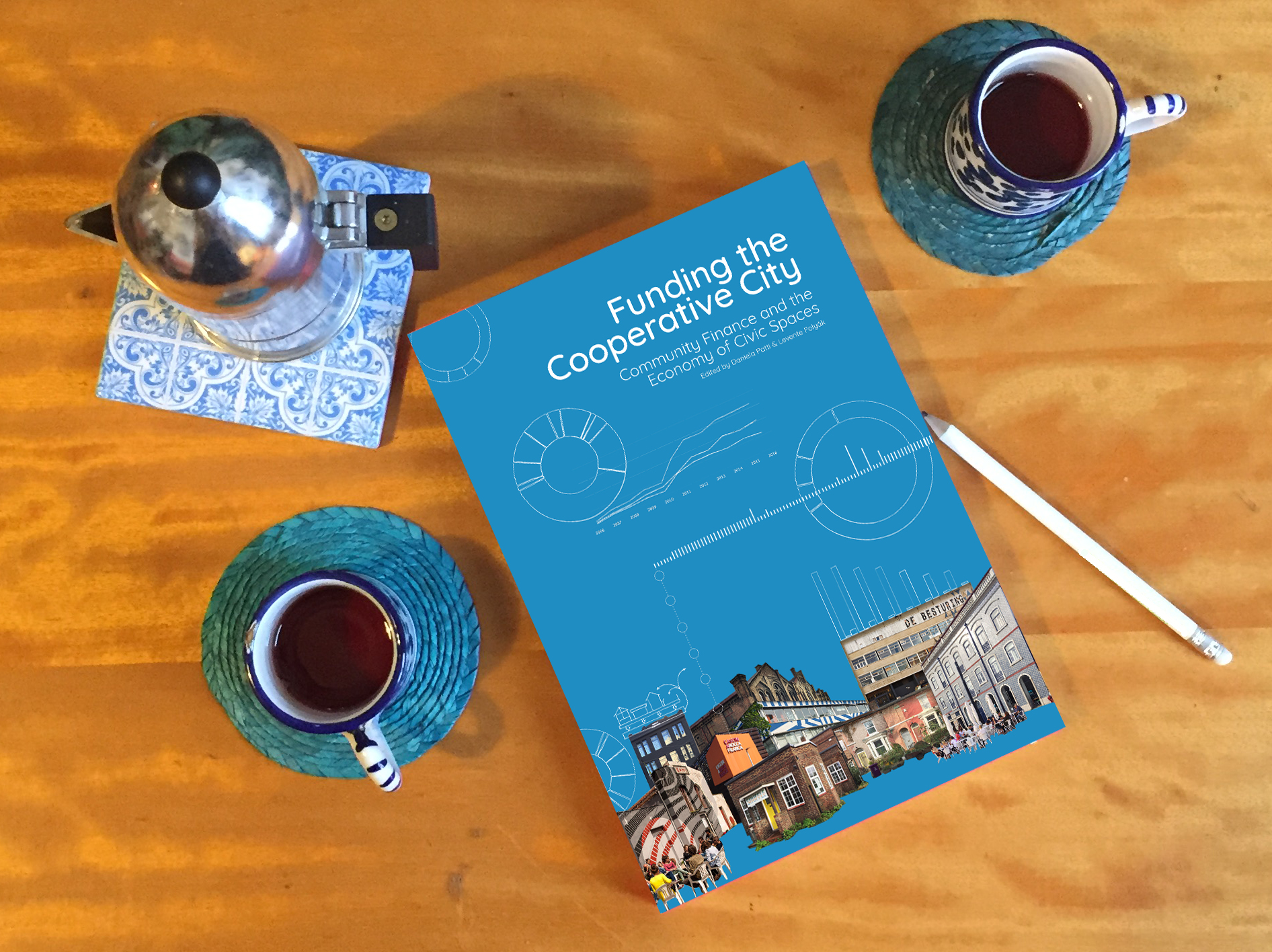
Legally the wooncoöperatie is a coöperatie under the Dutch civil code with a statutory hook in the Woningwet, which lets corporations transfer or co-manage stock with resident groups. Its binding constraints are the two the support bodies exist to crack: access to urban land, usually via municipal erfpacht (ground lease) tenders judged on the proposal rather than the price, and access to patient upfront capital, which is exactly what the 2025 Fonds Coöperatief Wonen is meant to supply. The wider lesson on how those instruments work is set out in Funding the Cooperative City, which maps the patient-capital-plus-public-land recipe across Europe — the recipe the Dutch sector is now assembling piece by piece rather than drawing on a settled tradition.
Targets the country keeps missing, and a fund for the few
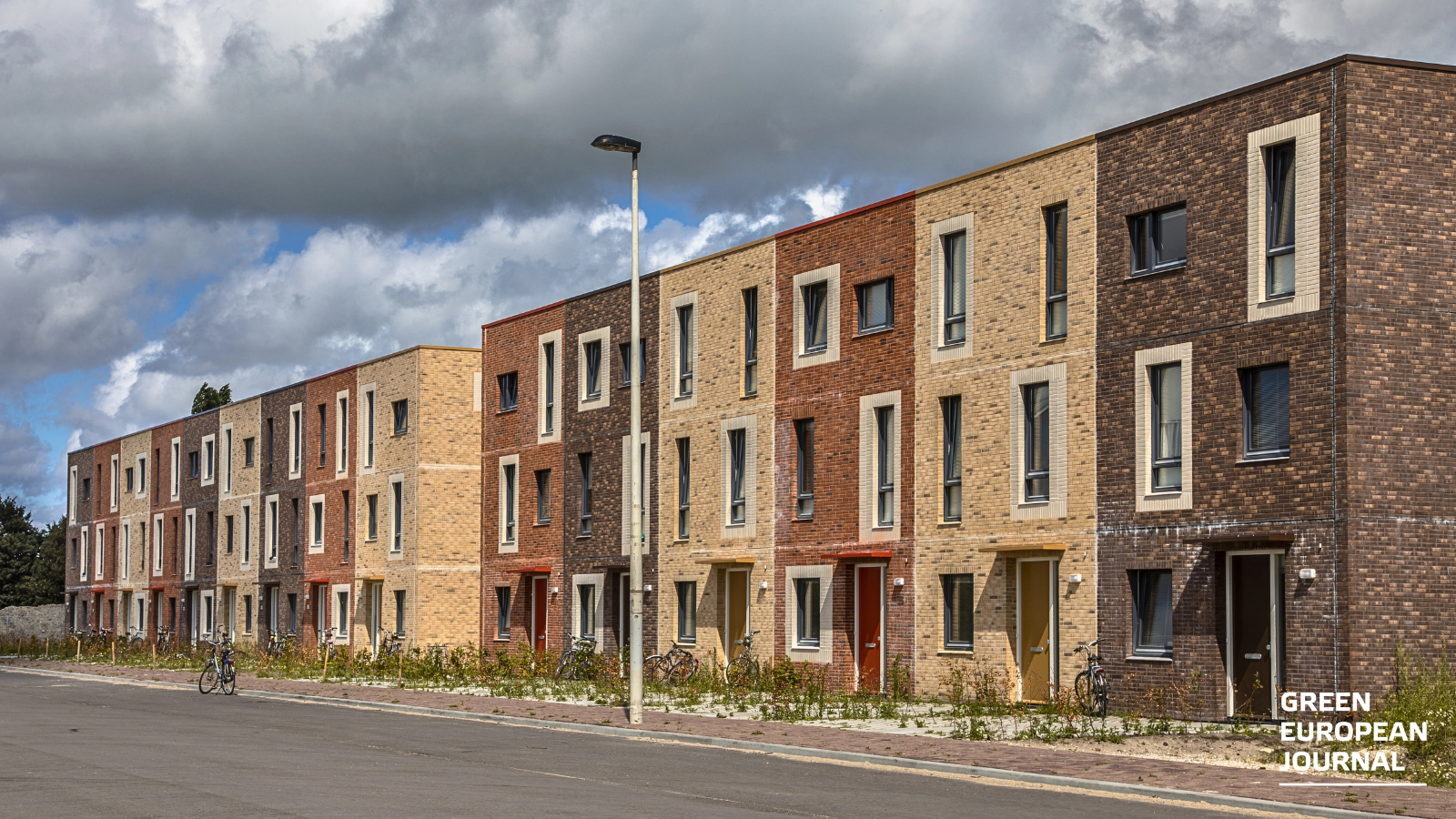
Dutch housing policy in the 2020s rests on a single claim — that the shortage is a building problem the state can plan its way out of — and the evidence keeps testing it. The Rijk (the national government), together with the provinces and gemeenten, committed to 900,000 new homes by 2030, two-thirds of them affordable. To get there, caretaker Housing Minister Mona Keijzer designated 24 doorbraaklocaties (breakthrough sites) earmarked for at least 100,000 homes between them, and from 2026 the Realisatiestimulans pays a gemeente €7,000 for every affordable home whose construction starts, with €2.5bn budgeted through 2030. Yet completions have run behind target every year, leaving the structural shortage near 400,000 homes.
On rent, the headline instrument is the Wet betaalbare huur (the Affordable Rent Act). From July 2024 it extended the puntenstelsel rent cap upward into the mid-market segment, regulating rents that had previously floated free. Its effect has been contested almost from the start: private landlords have been selling regulated flats into owner-occupation rather than letting them at the capped rent, thinning the very rental supply the law meant to protect. Holding the social side together are the Nationale Prestatieafspraken 2025–2035, signed in December 2024 by the Rijk, the corporation federation Aedes and the municipalities, which commit the woningcorporaties to 30,000 new social rentals a year from 2029 and bind them to renovate the ageing stock.
For cooperatives specifically, support has finally moved from rhetoric to a line in the budget. In October 2025 the cabinet earmarked €60.6m to launch a Fonds Coöperatief Wonen, run through the Stimuleringsfonds Volkshuisvesting Nederlandse gemeenten (SVn, the municipal housing-stimulus fund), to lend to wooncoöperaties and related CPO (collective private commissioning) initiatives for new affordable rental homes. It is expected to back only around a thousand units — small against the national target — but it is the first national money aimed squarely at the member-cooperative form. Beneath it, gemeenten do the heavy lifting: Amsterdam's action plan reserves erfpacht plots for cooperatives with the stated ambition of a tenth of its stock under cooperative tenure within a generation, and Utrecht began issuing its first cooperative plots in 2025.
Where the levers sit explains why the same national plan produces such uneven results. The Rijk writes the tenancy framework and sets the headline target; the twelve provinces translate it into regional housing deals; and the gemeenten hold the operational levers — they zone the land, run the erfpacht tenders, and own the relationship with the local corporations. A study of land policy in two Dutch cities shows how decisively that municipal land-pricing choice shapes what actually gets built, and how affordably. A national euro only becomes a home once a province has agreed a target and a city has found and priced the site.
Two camps now argue over the same numbers. The corporation side, led by Aedes, holds that the regulated sector must be allowed and funded to build at scale — and warns that the abolition of the corporation landlord tax has only just restored the financial room to do so. The market-liberal camp, prominent in the caretaker coalition, argues that rent regulation and the two-thirds-affordable rule are themselves deterring the private investment new supply needs, pointing to the post-2024 sell-off of regulated flats as proof. The cross-country comparison cuts toward the corporation side: as one analysis of European social housing notes, the richest European countries tend to be the ones with the most social housing, not the least — a finding the Dutch model, for all its current strain, still embodies more fully than almost any other.
- 1901[source]
Woningwet (Housing Act)
The Housing Act channels public subsidy to non-profit foundations — the woningcorporaties — rather than member cooperatives, setting the Netherlands on a corporate, not cooperative, social-housing path. By mid-century the member cooperative had all but vanished from the national landscape.
- 1995[source]
Bruteringsoperatie
The corporations are financially cut loose from the state: outstanding subsidies and loans are netted off, making the woningcorporaties independent non-profit landlords that fund new building from their own rent income and asset base.
- 2015[source]
Woningwet reform re-legalises the wooncoöperatie
A revision of the Housing Act formally defines the wooncoöperatie for the first time in over a century, in two variants — an ownership cooperative and a beheercoöperatie (a management cooperative that leaves the corporatie as owner) — reopening the door to the member-cooperative form.
- 2022[source]
Ministry of Housing restored; national targets set
A dedicated housing ministry returns after nearly a decade, and the Rijk agrees with provinces and gemeenten that 900,000 new homes are to be built by 2030, two-thirds of them affordable.
- 2024[source]
Wet betaalbare huur + Nationale Prestatieafspraken
The Affordable Rent Act extends the points-based rent cap into the mid-market segment from July 2024; in December, the Rijk, Aedes and the municipalities sign the Nationale Prestatieafspraken 2025–2035, committing corporations to 30,000 new social rentals a year from 2029.
- 2025[source]
Fonds Coöperatief Wonen + Realisatiestimulans
The cabinet earmarks €60.6m to launch a Fonds Coöperatief Wonen — loans for wooncoöperaties run by the SVn fund — and from 2026 pays gemeenten €7,000 for every affordable home whose construction starts, with €2.5bn budgeted through 2030.
- 2030[source]
900,000-home target
The national programme aims for 900,000 additional homes by 2030, two-thirds affordable — a target every quarterly construction figure has so far run behind, with the structural shortage still around 400,000 homes.
- 2035[source]
Prestatieafspraken delivery horizon
The 2025–2035 performance agreements run to 2035, the horizon by which the corporations are to have lifted social-rental output to a structural 30,000 homes a year and renovated the bulk of their ageing stock.
From the 1901 Woningwet that built the corporatie model — and pushed the member cooperative aside — through the 2015 re-legalisation of the wooncoöperatie and the 2024 Wet betaalbare huur to the 2030 build-out target and the 2035 social-rental delivery horizon.
De Warren, de Nieuwe Meent, and the floating houses of Schoonschip
The clearest sign that the Dutch cooperative revival is real sits not in the statute but on a handful of reclaimed islands and brownfield plots, most of them in Amsterdam, where the municipal land programme has let resident groups actually build. A short tour of the demonstrators the sector itself keeps pointing to is the best account of what the re-legalised form can do.
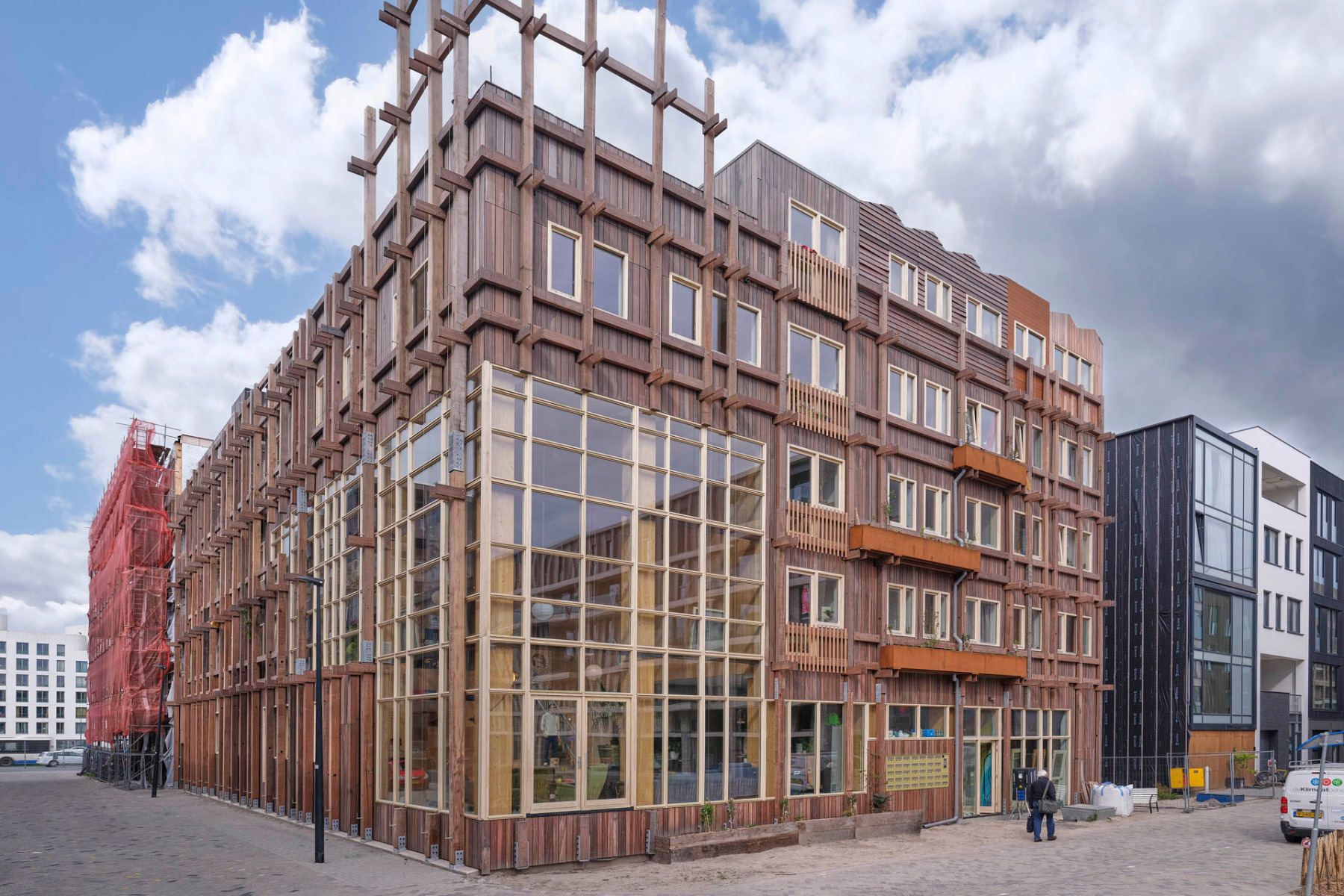
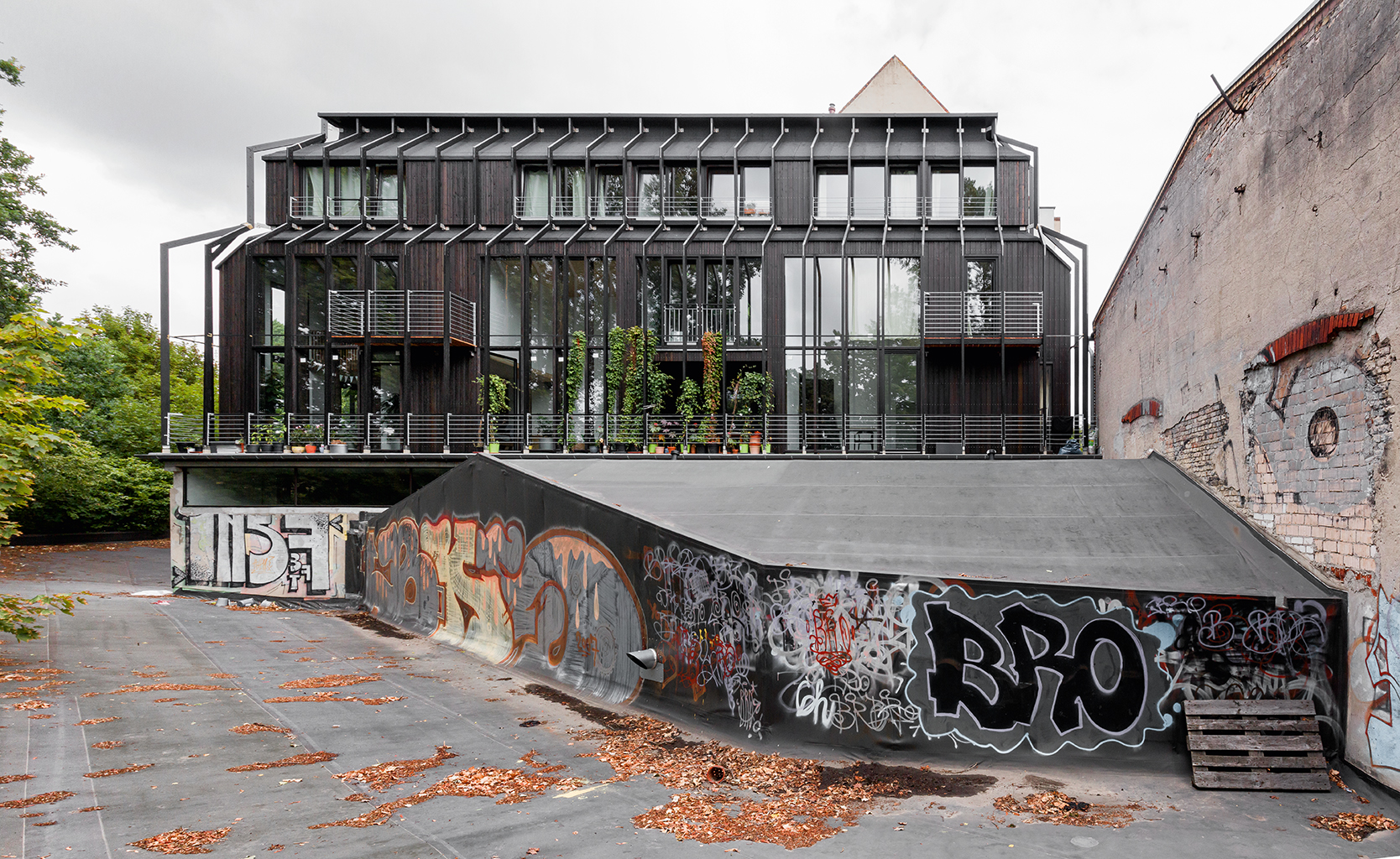
De Warren, on Amsterdam's Centrumeiland, is the one most often held up as proof the form works: the city's first resident-built housing cooperative, 36 social and mid-market rental homes in an energy-positive timber building where roughly 30% of the floor area — some 800 square metres — is shared, from an auditorium to a rooftop greenhouse. It was nominated for the EU's Mies van der Rohe Award. de Nieuwe Meent, a seven-storey timber complex in Amsterdam's Watergraafsmeer, houses around fifty people on commoning principles, with shared care and a solidarity-economy ground floor, and is rooted explicitly in the housing-rights movement.

The water is part of the Dutch repertoire. Schoonschip in Amsterdam-Noord is a floating neighbourhood of roughly thirty households on a self-managed jetty, designed as one of Europe's most sustainable water-based communities, with shared solar, heat pumps and a smart grid the residents own collectively. Vrijburcht, on Amsterdam's IJburg, is an earlier collective-commissioning block that folds a theatre, a café, a daycare and a marina into a single resident-built complex — a CPO project that predates the 2015 law and showed the model was viable before it had a legal name.
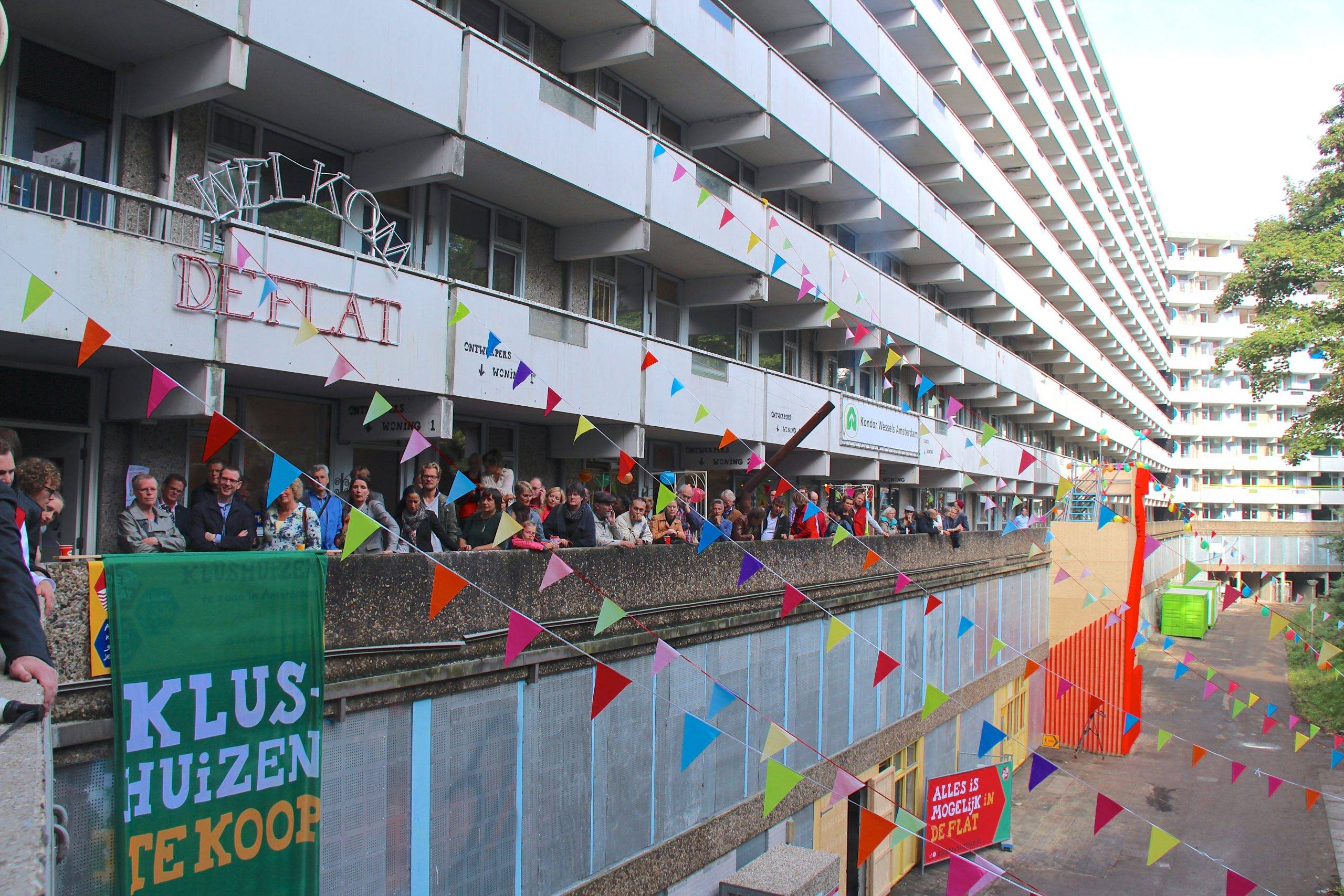
Reuse runs alongside new build. DeFlat Kleiburg in Amsterdam's Bijlmer turned a vast, half-derelict 1960s slab — once slated for demolition — into 500 self-finished 'kluswoningen' sold as bare shells for residents to complete, a renovation that won the EU Mies van der Rohe Award in 2017 and became the reference case for keeping rather than demolishing the post-war stock. moos in Utrecht carries the model into the social-and-care register, combining cooperative housing with collective amenities for a mixed community.
Behind the buildings sits the connective tissue the sector is still assembling. Cooplink federates the knowledge, wooncoop the development capacity, and the Rotterdamse Coalitie voor WoonCoöperaties the local advocacy; the municipal erfpacht tenders supply the land, and the new Fonds Coöperatief Wonen the patient capital. None of it yet adds up to the dense, century-old federation a German or Danish cooperator would take for granted — but the pieces of that recipe, the one Funding the Cooperative City documents across Europe, are now visibly being laid in Dutch ground for the first time since 1901.
What these projects have in common is that each one is a deliberate act of reinvention, not the continuation of a living tradition. The Netherlands built the most comprehensive social-rental system in Europe and, in doing so, let the member cooperative lapse for a century. Whether the thin new layer of wooncoöperaties can grow into something structural — or stays a celebrated niche on a few Amsterdam islands — is the open question the next decade of land tenders and fund disbursements will answer.
References
Statistics16Click on any number to see the source
Housing market
Tenure & affordability
Cooperative, social & public
Adaptive reuse & vacancy
Population & migration
From our library15
- Amsterdam Is Becoming a Dystopia — Knowledge
- Housing Cooperatives in Europe - Resilience and Adaption to Changing Need — Knowledge
- The demand for housing cooperatives in the Netherlands — Knowledge
- cooplink — Organisation
- wooncoop — Organisation
- RoCoCo - Rotterdamse Coalitie voor WoonCoöperaties — Organisation
- Funding the Cooperative City: Community Finance and the Economy of Civic Spaces — Knowledge
- Land Policy in Practice: A Tale of Two Dutch Cities — Knowledge
- The richest European countries have more social housing — Knowledge
- De Warren — Project
- de Nieuwe Meent — Project
- Schoonschip — Project
- Vrijburcht — Project
- DeFlat Kleiburg — Project
- moos — Project
Further sources16
- Rijksoverheid — Volkshuisvesting — Rijksoverheid
- Volkshuisvesting Nederland — Wooncoöperatie — Volkshuisvesting Nederland
- Nationale Prestatieafspraken 2025–2035 — Volkshuisvesting Nederland
- Wet betaalbare huur — Rijksoverheid
- Fonds Coöperatief Wonen van start — Gemeente.nu
- Realisatiestimulans — €7,000 per affordable home — NL Times
- Netherlands needs 1.2m homes by 2040 (900k by 2030) — NL Times
- Housing shortage remains severe (Keijzer, Dec 2025) — DutchNews
- Housing shortage remains 400,000 — DutchNews
- OECD Economic Surveys: Netherlands 2025 — OECD
- Cooperative Housing International — Netherlands — Cooperative Housing International
- Cooplink — national cooperative-housing network — Cooplink
- Aedes — federation of housing corporations — Aedes
- De Warren — Wooncoöperatie De Warren
- de Nieuwe Meent — de Nieuwe Meent
- CBS — Statistics Netherlands — CBS