Loading...
🇵🇱Country profile
Poland
Poland sold its citizens their flats at 80–90% discounts and became a nation of owners. Who builds the affordable homes the next generation cannot buy?
Read the profile
Loading...
Poland is one of Europe’s deepest owner-occupier societies, and it got there by deliberate policy. When communism ended, the state did not keep its housing stock as a permanent public sector. It sold it. Members of the giant socialist-era housing cooperatives were offered their flats at 80–90% discounts, and most took the deal. The result is a country where owning is the norm, renting is treated as a way-station, and the institutions that once built homes at scale have been left without a clear role. That history is why the housing argument here is about the missing rungs between ownership and the street, not about a large rental sector that needs reforming.
The tenure mix carries the legacy in numbers. Around 84.2% of Poles are owner-occupiers and 15.8% are tenants — close to the inverse of Germany or Austria. Within the stock, 19.4% is cooperative: about 2,672,000 dwellings across roughly 3,500 społdzielnie mieszkaniowe (housing cooperatives), the bulk of which are now ownership-form rather than tenancy-form. Public municipal housing accounts for about 5% — roughly 760,000 council flats. The rest, around 10.8%, is private rental, much of it informal. Counted together the genuinely non-market segment — public plus social-rented — comes to about 5% of all dwellings, a thin tier by Western European standards.
There is almost no social-rented tier sitting above that pie. By the OECD’s measure about 6.2% of households reach below-market social housing, and roughly 30% would qualify on income — a wide gap between need and supply. Poland never built the permanent affordability covenant that Vienna or the Netherlands rely on; what it has instead is a stock of municipal flats let at administrative rents, and the new social-housing programme is an attempt to grow that thin tier rather than reform an existing one.
The rent ladder shows what little cushioning remains. A cooperative member pays a maintenance charge of about €1.80 per square metre a month — a cost-recovery figure, not a market rent. Municipal flats run near €2.00. But the open market sits far above: the all-stock median is €8.20, new private contracts €9.80, and furnished serviced lets €12.50. The cooperative and municipal tiers are not cheap rentals so much as a different financial logic — you pay for upkeep, not for the use of someone’s capital — which is exactly what a Pole entering the market for the first time cannot find.
Monthly housing charge per m² by tier (national median; furnished is gross, all-in). The cooperative maintenance charge is a cost-recovery figure, not a market rent — which is why the gap to a new private contract is so wide. The point is the structure: a Polish cooperative member pays for upkeep, not for the use of capital.
Empty space coexists with the squeeze. Residential vacancy runs at about 12.5% on the 2021 census measure — much of it depopulating rural and post-industrial regions rather than the booming cities. Office vacancy has climbed to 17.5%, some 2.36 million square metres of empty floor concentrated in Warsaw and the regional hubs. Short-term lets add a quieter pressure on top: across the cities the platform sweep tracks, at least 4,034 dwellings sit in full-time short-stay use — a floor, not a ceiling, since it sums only the covered cities. The mismatch between where the emptiness sits and where the demand is the puzzle the policy debate keeps returning to.
On the demand side Poland has shifted from an emigration country to an immigration one. It now absorbs around 485,000 inbound moves a year — sharply up since the 2022 arrival of Ukrainian refugees — against roughly 195,000 residential building permits, spread across a total stock of about 15,300,000 dwellings.
Not a single zloty from this programme will go to developers.The squeeze concentrates on the people locked out of ownership. Rents have risen 62% since 2015 — the fifth-fastest growth in the OECD — with the steepest jump after 2022, falling hardest on young Poles, newcomers and the Ukrainian arrivals who rent because they cannot buy. Overcrowding is among the worst in the EU, with about 30.9% of people living in too-tight homes, and roughly 80,000 people counted as homeless. Courts order around 28,000 residential evictions a year. The state’s own diagnosis, set out on the Ministry of Development and Technology’s housing-policy pages, frames the task as raising both availability and affordability at once. What Poland is short of is not owners — it has more than almost anyone — but the affordable, secure rungs that let a household reach ownership in the first place.
Poland’s housing cooperatives are older than the modern state. They appear in the 1890s, under partition, before independence is regained in 1918 — first as lokatorskie (lodger, rental) co-operatives and własnościowe (property, member-owned) co-operatives, the two forms that still shape how a Pole thinks about cooperative tenure. After the Second World War, under the Soviet planning model, the cooperatives became the main developer of the country’s housing, building and running an enormous share of urban stock and, at their 1980 peak, producing around 80% of all new dwellings.
The continuity is real but the function has changed beyond recognition. At the 1989 transition Poland counted 4,021 housing cooperatives, 2,672,000 dwellings and 3,500,000 members — one of the largest cooperative housing sectors anywhere. The Housing Europe survey of European cooperative housing traces what happened next: through the 1990s the giant co-ops were split into smaller units and the state encouraged members to buy their flats outright, at discounts of 80–90% on the sale price. By 2001 roughly 67% of cooperative dwellings had been privatised. A 2001 Trybunał Konstytucyjny (Constitutional Tribunal) ruling, and amendments in 2007 and 2009, then effectively replaced the społdzielcze własnościowe prawo do lokalu (the cooperative ownership right) with a plain individual ownership right.
So the sector that remains is large but altered. It still holds about 2,672,000 dwellings — close to a fifth of the national stock — across roughly 3,500 społdzielnie mieszkaniowe, and around 18% of Poles live in a cooperative home. But by the Housing Europe count only about 10% of co-operatives now conduct any developer activity; the vast majority have become management bodies for stock their members already own. The honest description is that the Polish cooperative is today overwhelmingly an ownership co-operative — roughly 83% of its dwellings are owner-occupied and only about 17% remain rental — which is why the catalogue classifies it as ownership-aligned rather than the cost-rent form found in Vienna or Zurich.
The federating layer is thinner than the German or Danish equivalent but it exists. The ZRSMRP — the Związek Rewizyjny Społdzielni Mieszkaniowych RP, the Auditing Union of Housing Co-operatives of Poland — was constituted in November 1992 and registered in February 1993, and remains the main national body; it federates several hundred of the roughly 3,500 societies and represents close to a million individual members, providing the statutory audit and legal support the ustawa o społdzielniach mieszkaniowych (the Housing Cooperatives Act) requires. Its 2025 commentary on that Act is the sector’s working reference for the contested questions of governance and member rights.
Two structural problems define the sector today, and both are honest about its weakness. The first is that new cooperatives cannot, in practice, be founded: the law as amended channels new development toward private limited companies and reserves public land for them, while the cooperative funds that would seed a new society are inaccessible. The second is demography and stock — much of the 2.67 million cooperative dwellings sit in 1960s–1980s blocks with an ageing membership and a heavy retrofit bill. The one bright opening is recent and narrow: a September 2023 amendment lets housing cooperatives act as civic energy communities (społdzielnie energetyczne), so urban co-ops can pool rooftop solar and shared generation — the first genuinely new statutory role the form has been handed in years.
Poland’s housing policy is now set firmly at the national level, and the government that took office in late 2023 has made it a signature theme. Its centrepiece is the Klucz do mieszkania (Key to Housing) programme, unveiled in 2025 by Krzysztof Paszyk, the Minister of Development and Technology at the Ministerstwo Rozwoju i Technologii. The claim is concrete: up to 45 billion zloty across 2025–2030 for social and municipal housing, with the annual ceiling rising toward 10 billion zloty and an annual target of 40,000 new social and municipal apartments by 2030. The first-year goal is 15,000 units — around 8,000 municipal flats and the rest social. Local authorities can draw non-repayable subsidies of up to 80% of an investment’s value to build new flats or bring vacant ones back into use.
The delivery runs through a specific institutional stack, and it is municipal more than cooperative. The Sejm (parliament) writes the framework and commits the money; the gminy (municipalities) apply for the subsidies, hold the land, and own the council stock outright; and the actual building is done largely through SIMs (Społeczna Inicjatywa Mieszkaniowa, the social housing initiative vehicles) and the older TBS (Towarzystwa Budownictwa Społecznego, limited-profit social housing societies). Housing cooperatives are eligible to take part as social investors, with their margins capped, but they are no longer the default builder they were before 1989 — the programme is built around the municipality, not the społdzielnia.
Where the cooperative sector wants to be foregrounded, it largely is not, and that is the sharp edge of its politics. As the Housing Europe survey puts it, the sector is “waiting for the amendments to the housing cooperative law that would enable them to build new flats for their members, including giving them land from the governments as private companies benefit.” That is the unanswered ask: parity of access to public land. The 2023 civic-energy opening aside, the dedicated cooperative-support instruments the German or Danish sectors take for granted — concept tenders, ground leases, a delivery quota — are absent. The cooperative’s claim is for a level field; the programme’s answer, so far, is to route the money around it.
The fiercest argument has been over whether to subsidise buyers or builders. The previous demand-side schemes — the Bezpieczny Kredyt (Safe Loan) interest subsidy and its planned successor Pierwsze Klucze (First Keys) — were widely blamed for pushing prices up by handing cash to purchasers in a supply-starved market. In June 2025 the government scrapped the First Keys mortgage-subsidy plan and redirected the money to municipalities for social housing instead — a decisive turn from helping people buy to helping the state build. Paszyk has drawn the line bluntly, insisting that not a single zloty of the new programme will reach developers; the property lobby reads the same shift as starving the market of the buyer demand that finances new construction.
We are aware of the housing needs of Poles and are meeting them. This year we want to allocate 2.5 billion zloty to directly subsidise municipalities.Sustainability is entering through the back door of the retrofit bill. Poland’s renovation rate runs at roughly 0.6% of stock a year and only about 12% of dwellings are energy-efficient — and the ageing cooperative blocks are exactly the buildings the national TERMO retrofit scheme, blending Polish and EU funds, is aimed at. The empty-office pool is a quieter opportunity: with 17.5% office vacancy concentrated in the big cities, conversion to housing is on the agenda, though Poland has been slower than Germany to treat it as supply. Energy poverty is comparatively low at 3.5%, but the carbon and cost case for deep retrofit of the cooperative stock is the climate frame that now shadows every housing decision.
Polish housing cooperatives appear before the country regains independence in 1918 — first as lodger co-operatives (rental) and property co-operatives (member-owned), the two forms that still frame the sector.
Under central planning the cooperatives become the main housing developer, producing around 80% of all newly-built dwellings at their peak and an average of roughly 68,000 units a year through the 1980s.
At the end of the communist period Poland counts 4,021 housing cooperatives holding 2,672,000 dwellings and 3,500,000 individual members — among the largest cooperative housing sectors in the world.
The Auditing Union of Housing Co-operatives of Poland (ZRSMRP) is constituted at a national congress in November 1992 and registered in February 1993 — still the main federating structure for the sector.
After a decade of splitting large co-ops into smaller units and selling members their flats at 80–90% discounts, roughly 67% of cooperative dwellings are privatised into individual ownership by 2001.
Following a 2001 Constitutional Tribunal ruling, amendments in 2007 and 2009 effectively replace the cooperative ownership right with an individual ownership right — and stop new cooperative housing being built, since the dedicated legislation now favours private developers.
A September 2023 amendment lets housing cooperatives act as civic energy communities, letting urban co-ops pool renewable generation — the first new statutory role the sector has gained in years.
A new social-housing programme commits up to 45 billion zloty for 2025–2030 and a 40,000-unit annual target by 2030, routed through municipalities, SIMs and TBS societies — with cooperatives eligible as social investors, though the long-sought right to build new member flats on public land is still unresolved.
The programme’s headline target year: 40,000 new social and municipal apartments a year, and a renovation push under the TERMO retrofit scheme aimed squarely at the ageing cooperative blocks that house a fifth of the country.
From the partition-era origins through the post-war peak, the 1990s privatisation, the 2000 Act and the constitutional fights, to the 2023 civic-energy opening and the 2030 Klucz do mieszkania horizon.
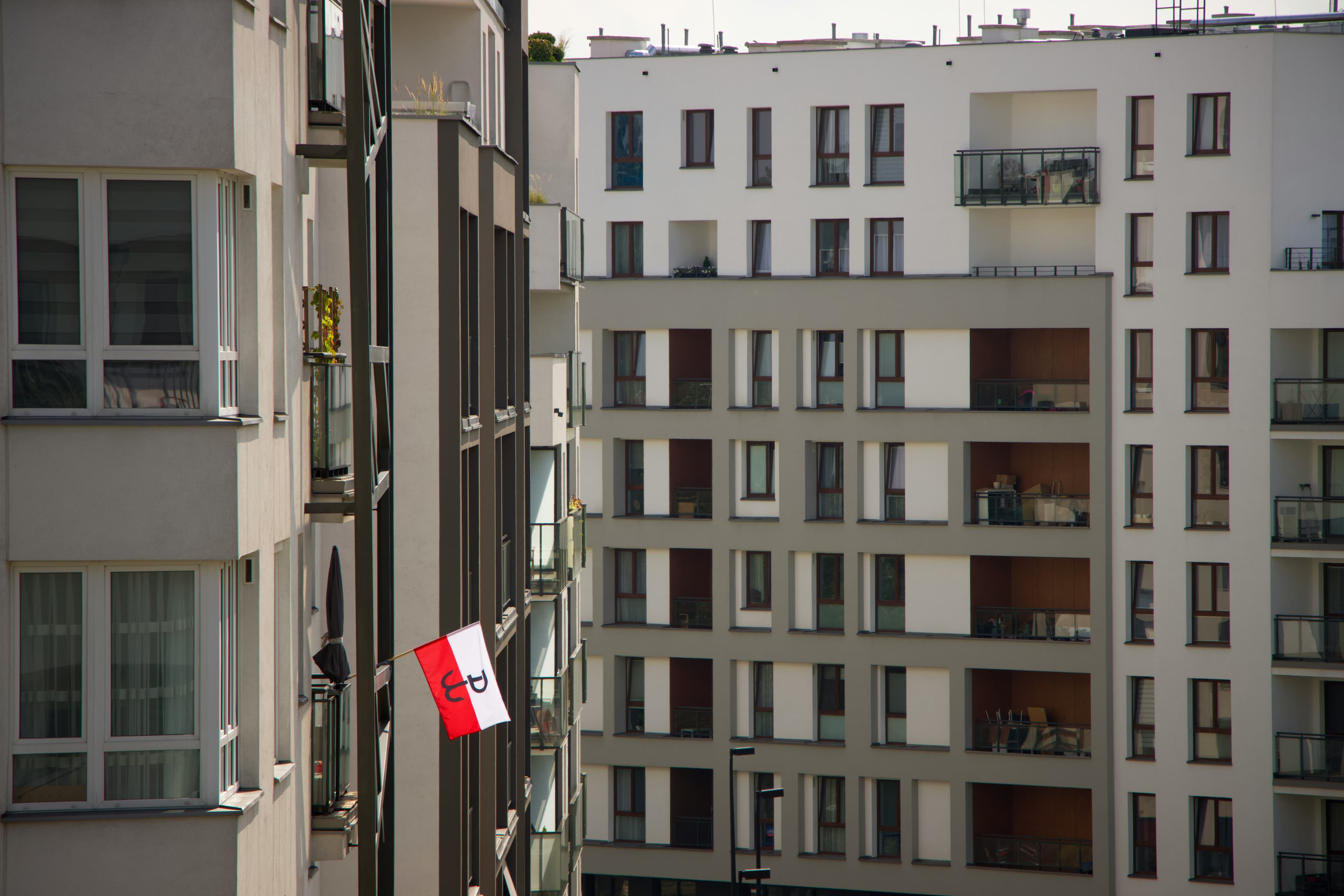
The clearest evidence of the Polish model is not a clutch of new demonstrators but the cities themselves. Walk through Warszawa (Warsaw), Kraków, Wrocław, Poznań, Gdańsk or Łódź and a large share of the post-war housing you pass was built and is still run by a społdzielnia mieszkaniowa. Warsaw’s Ursynów, Gocław and Bemowo districts, Kraków’s Nowa Huta, the great estates of Gdynia and Katowice — these are cooperative-built neighbourhoods housing hundreds of thousands of people, the physical inheritance of the sector’s post-war peak. The Polish lighthouse is not a single award-winning building; it is the fact that a fifth of the country still lives in homes a cooperative put up.
The new-build story is thinner, and honest accounts of it say so. Because the law has made founding new cooperatives almost impossible, the visible innovation now happens at the edges — the municipal SIM and TBS programmes building fresh social rental, the conversion and retrofit pilots, and the civic-energy projects that the 2023 amendment opened to urban co-ops. The cooperative sector’s own forward role is, for now, less about new estates than about keeping the existing two-million-flat stock affordable, warm and well-governed as its blocks and its membership age together.
The connective tissue that does exist is institutional rather than architectural. The ZRSMRP federates and audits the societies and carries the legal fight for the right to build again; its 2025 Act commentary is the reference text the sector argues from. Around it sit the broader civil-society actors that touch housing — the Stefan Batory Foundation on governance and public policy, and Habitat for Humanity Ukraine on the refugee-housing pressure that has reshaped the Polish rental market since 2022. The comparison the sector itself reaches for is its near neighbour: the parallel story of post-communist restitution and reform traced in the study of housing reforms in Czechia and Poland, where the same Soviet-model stock took two different routes out of central planning.
What the 1890s founders set in motion, the 1980s built at scale, and the 1990s sold off, the country now has to decide what to do with. Poland holds one of Europe’s largest cooperative housing stocks and, simultaneously, one of its most ownership-tilted housing systems — the two facts are the same fact, the product of the same privatisation. The open question is whether the form that once housed the nation gets handed back a building role, or whether it stays, as it is now, the manager of flats its members already own.