Loading...
🇨🇿Country profile
Czechia
Czechia privatised its way to one of Europe's highest ownership rates and still holds 480,000 cooperative flats — so why is buying a home now beyond reach for a fifth of the country?
Read the profile
Loading...
Czechia is, by tenure, a nation of owners — and that is itself a piece of recent history. The mass privatisation of the 1990s turned state and cooperative flats into private property on a scale few European countries matched, leaving a thin rental sector and almost no social-housing tradition to fall back on when prices climbed. The country reads its housing question through that legacy: not who can rent a subsidised flat, but who can still afford to buy into a market where ownership has always been the norm.
The tenure mix carries the story. Some 75.8% of Czechs are owner-occupiers and 24.2% are tenants. Within the ownership side sits the cooperative: 9% of all dwellings — about 480,000 družstevní byty (cooperative apartments) — held not as tenancies but as transferable membership shares. Public and non-profit rental is a thin 4.5%, leaving 19.7% in private rental. The non-market segment — cooperative plus public — comes to 4.5% of all dwellings, but almost all of that is the ownership-style cooperative rather than anything a low-income household could be allocated.
There is no large social-housing layer sitting on top of that pie. By the OECD's measure about 4.5% of the stock counts as social, and Czechia's municipal nájemné byty (rental flats) carry no income test to qualify — allocation is decided locally, town by town, rather than by a national entitlement. The new Housing Support Act is the first attempt to build a system around that gap rather than leave it to each municipality.
The rent ladder shows where the pressure bites. Municipal rental runs at about €3.20 per square metre a month, the cooperative tier at €8, the all-stock median at €8.50, and newly-signed private contracts at €12.80 — roughly four times the municipal floor. Furnished or serviced lets reach €16 gross. The cooperative tier does not undercut the market the way it does in Vienna or Zürich, because most družstevní byty are paid-off panelák flats whose low cost reflects an old loan long since repaid, not an ongoing subsidy.
Monthly rent per m² by tier (national; furnished is gross, all-in). The thin municipal-rental floor sits far below everything else — a newly-signed private lease runs roughly four times the municipal rate. The cooperative tier tracks the all-stock median rather than undercutting it, because most družstevní byty are paid-off panelák flats from the socialist era, not freshly subsidised new-build.
Underused space sits alongside the squeeze. The 2021 census counted residential vacancy at 14.2% — much of it second homes (the chata and chalupa cottage tradition) and depopulating rural districts rather than empty flats in the tight cities. Short-term letting tightens the urban core instead: across the cities Czechia tracks, at least 5,389 whole homes are listed full-time on short-stay platforms, almost all of them in central Prague, where they compete directly with long-term tenants. Office vacancy stands at 8.5%, about 323,000 square metres of empty floor.
On the demand side, Czechia took in roughly 127,000 people a year in net migration — swollen since 2022 by Ukrainian refugees, of whom the country hosts more per capita than almost any EU state — against about 38,000 residential building permits a year and a total stock of 5,100,000 dwellings. Supply has not kept pace with the people arriving.
The result has pushed homeownership — Czechia's default tenure — out of ordinary reach. An average Prague apartment now costs around fifteen gross annual salaries, and Deloitte has ranked Prague among the least affordable major cities in Europe for buying. Renting offers little relief: a standard 70-square-metre flat in Prague passed CZK 30,000 a month in 2025, with rents rising about 6.1% a year nationally. The government's own figures suggest up to two million people — a fifth of the population — could find adequate housing beyond their means. The Czech National Bank has repeatedly flagged the market as running in the upper, overvalued phase of its cycle. The squeeze lands hardest on the young: a generation that cannot inherit a paid-off panelák and cannot assemble a deposit for a mortgage at current prices.
The Czech cooperative is, in the catalogue's terms, an ownership-aligned form. A member of a bytové družstvo (housing cooperative) does not rent a flat — they buy a členský podíl (membership share) that carries the right to occupy a specific apartment, and that share can be sold or inherited. National statistics therefore count the družstevní byt on the owner side, which is why the cooperative wedge in the tenure pie is carved out of owner-occupation, not out of rental. Around 9% of Czechs live in a cooperative home on this basis.
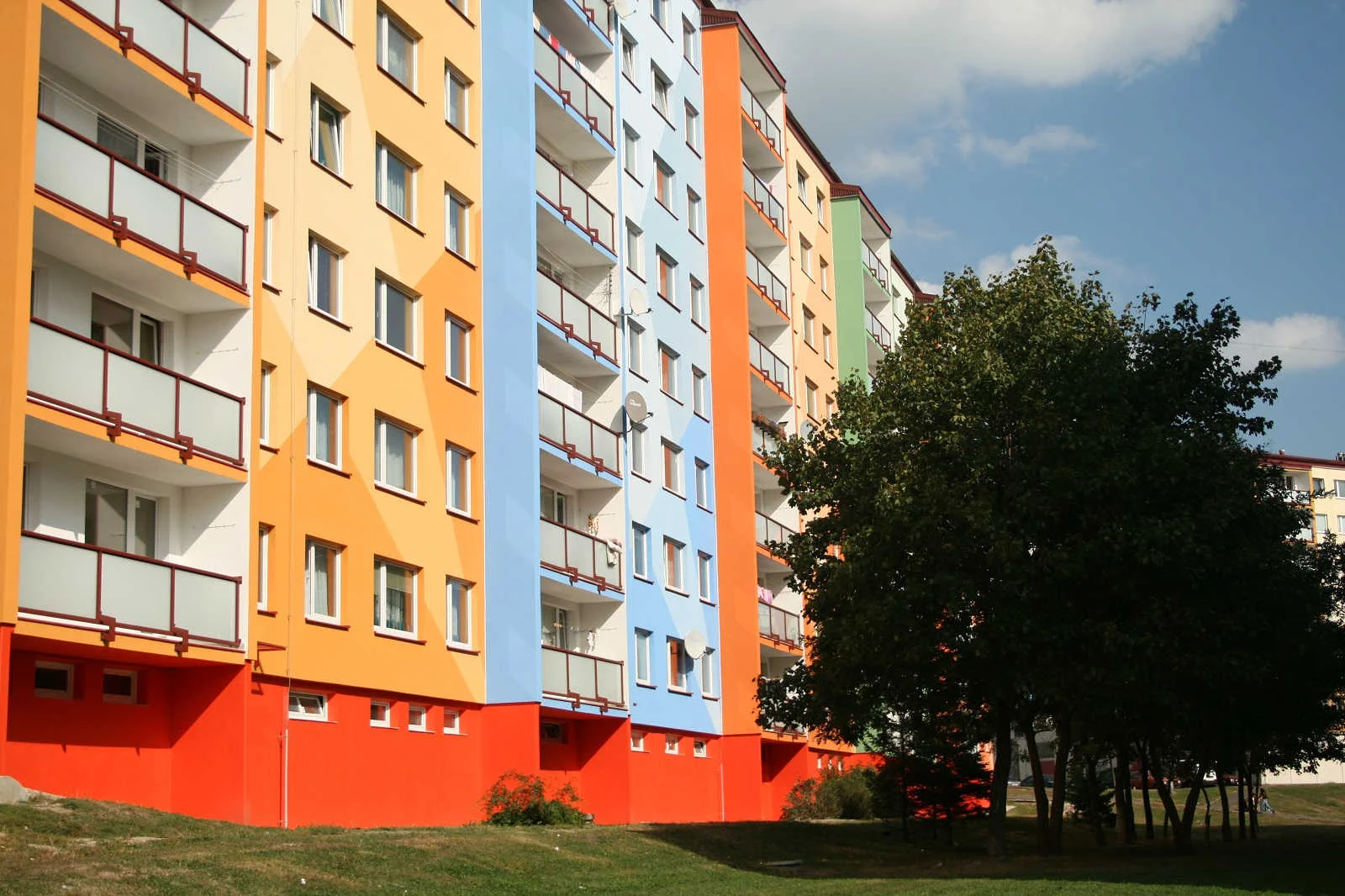
The form was built by the socialist state and then survived it. The 1959 Act on Cooperative Housing Construction made the stavební bytové družstvo (building housing cooperative) a mass instrument: members paid roughly 40% of construction cost and the state covered the rest, and by 1970 cooperative building accounted for 56% of all apartments completed in Czechoslovakia. Most of the panelák estates — the sídliště of prefabricated towers that still house a large share of the population — went up this way. The Housing Europe survey of European cooperative housing places Czechia among the continent's deepest cooperative traditions by sheer stock, even as the model's role has changed.
After 1989 the cooperative did not disappear; it converted. The post-communist law let members turn a družstevní byt into outright private ownership once the building's loan was repaid, and hundreds of thousands did — which is why the present stock of roughly 480,000 cooperative dwellings is smaller than the socialist-era peak. What remains is concentrated in older paneláky that were never fully privatised, plus a steady trickle of newly-built cooperative flats. The Union of Czech and Moravian Housing Cooperatives federates the bulk of it.
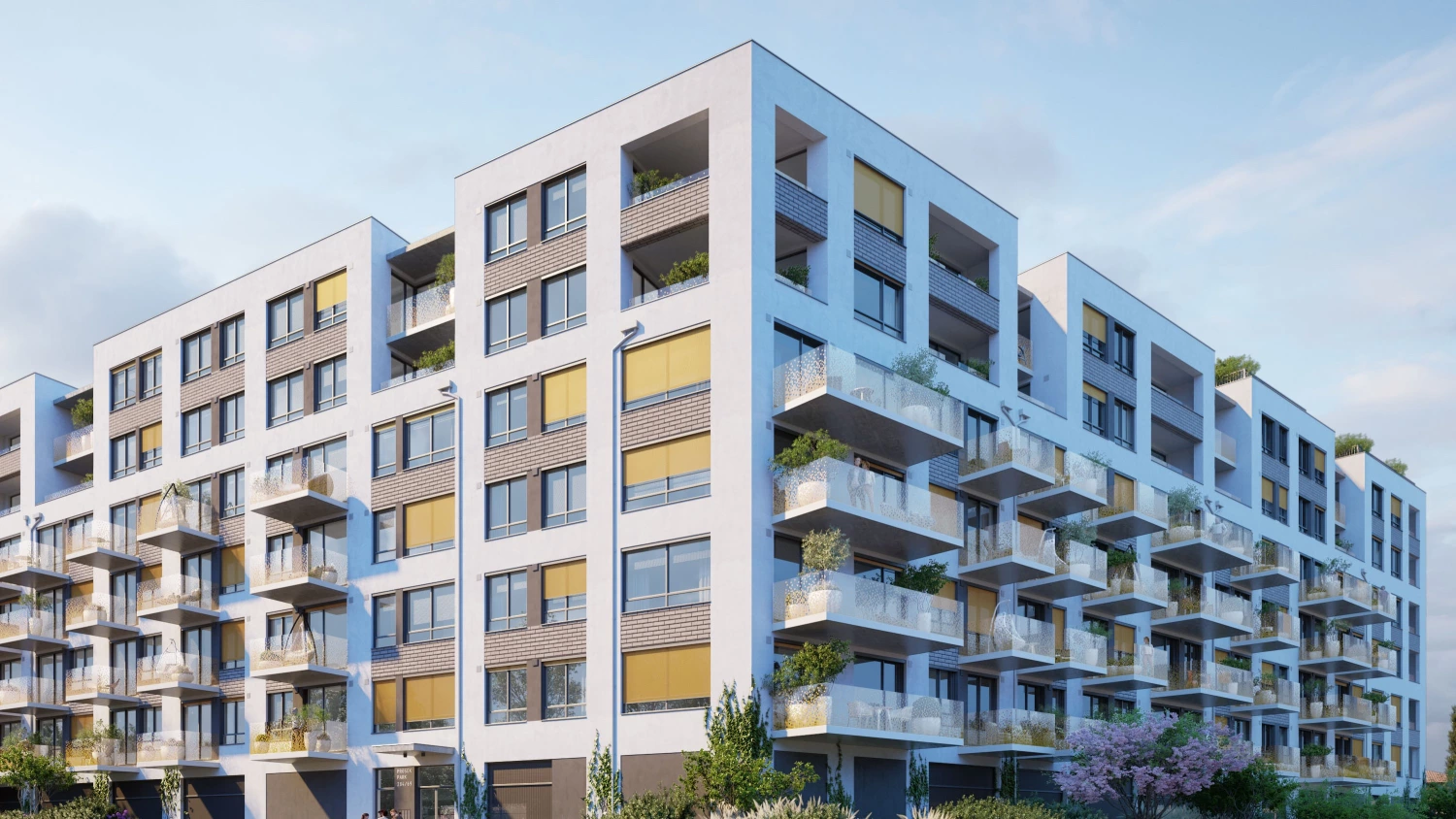
Today the sector splits along a clear line. On one side are the legacy giants — large stavební bytové družstva, mostly founded under the 1959 law, that manage tens of thousands of older flats apiece; their pressing problem is the energy retrofit of ageing panelák stock and an ageing membership, not finding land. On the other is a thin but growing new-build strand: developers such as FINEP market freshly-built cooperative apartments in Prague, Brno, Liberec and Pilsen as a deposit-light alternative to a mortgage, where the buyer joins a single-building družstvo rather than taking out a bank loan. The two strands share a legal form but answer to opposite pressures.
Governance follows the cooperative-law template: one member, one vote at the members' meeting, an elected board, and a federation — the Union of Czech and Moravian Housing Cooperatives, founded in 1969 — that provides legal, economic and technical support and lobbies on the sector's behalf. By its own count it unites about 635 member cooperatives managing some 703,000 housing units (roughly 220,000 owner-converted and 483,000 still in cooperative tenure), or close to a fifth of the national housing stock.
Honest about scale, the picture is two-sided. The Czech cooperative is enormous as a legacy of paid-off socialist flats and modest as a contemporary affordability tool, because the share-owned model produces a market-priced asset rather than a permanently sub-market home. A separate, much smaller strand is trying to change that. Sdílené domy (Shared Houses) buys buildings off the market and locks them into a non-speculative structure so they can never be resold for profit — a deliberate import of the German Mietshäuser-Syndikat idea, run through projects like První vlaštovka (First Swallow) in Prague and Družstvo Racek in Děčín. It is small, but it is the part of the Czech sector reaching for permanence rather than equity.
Czech housing policy has long been unusually centralised on paper and unusually absent in practice — the state set the legal frame and then left provision to municipalities and the market. The government that took office in 2021 made affordability a stated priority, and two measures define its answer. The first, launched in May 2024 under the Ministry of Regional Development (MMR), is the Dostupné bydlení (affordable-housing) loan programme: CZK 8bn in preferential loans to municipalities and developers to build flats let below market rent. The second is structural — and it took a fight to pass.
That structural measure is the Zákon o podpoře v bydlení (Housing Support Act). The Chamber of Deputies passed it and the Senate approved it in 2025 — by just two votes — and it took effect on 1 January 2026. It is the first national social-housing framework in a generation. Rather than building a stock of state flats, it creates a system: kontaktní místa pro bydlení (housing contact points) in 132 municipalities to help households at risk of losing their home, a voluntary guarantee scheme for private landlords who let to people in housing need, and subsidies for towns that do the same. It is budgeted at CZK 600m in its first year, rising to CZK 1.5bn once fully running.
Housing must also be available for people with regular incomes who have not inherited a house and cannot afford a mortgage due to high real estate prices — young families with children, for example, where the parents are just starting their careers.For cooperatives specifically, the support is indirect rather than targeted. The 2024 loan programme is tenure-neutral: a municipality or developer can use it to build cooperative flats as readily as municipal rental, and the deposit-light cooperative model is increasingly pitched as a route for the young buyers priced out of mortgages. Prague's city government has gone furthest, drawing up its own framework for affordable cooperative housing on city land in partnership with developers. But there is no dedicated cooperative subsidy line — the form competes for the same general pots as everything else.
Energy and renovation increasingly set the terms. Czechia renovates only about 1.1% of its building stock a year, and the ageing panelák estates — many of them cooperative — are exactly the stock that EU 2030 energy targets require to be retrofitted. The OECD's review of Czech housing reform argues that the country's deeper problem is structural: too little rental supply, planning that slows construction, and a tax system that favours owning over building to let. Its prescription is to widen the supply of affordable and rental housing rather than rely on demand-side support that simply chases prices upward.
Two readings of the new law sit opposite each other. The government and its supporters present the Housing Support Act as a long-overdue system — Minister Bartoš framed the 2024 loan programme as something the country had waited twenty years for and no one had tried — that finally gives municipalities tools and at-risk households a safety net. Critics, including parts of the social sector and the Senate minority, counter that it is too thin to matter: by some estimates it will reach under 2% of Czechs, builds no new public stock of its own, and leaves the structural shortage — and the young would-be buyers priced out of ownership — largely untouched. Both sides agree the law is a first step; they disagree on whether a first step this small changes anything.
The clearest evidence of the Czech cooperative is not in any single flagship building but in the ordinary fabric of every city — the sídliště estates whose prefabricated towers were built, flat by flat, through the cooperative model the 1959 law created. To see where the form is heading, though, it helps to look at the handful of organisations carrying it in two opposite directions: scale-built ownership, and deliberate permanence.
On the ownership side, FINEP has made cooperative new-build a product. Its schemes in Prague — in Prosek and Štěrboholy — and in Brno, Liberec and Pilsen sell apartments through a single-building bytové družstvo, letting a buyer move in with a far smaller upfront sum than a mortgage demands and convert to full ownership later. It is the socialist-era mechanism repurposed for a market in which a deposit, not a tenancy, is the thing young Czechs cannot reach.
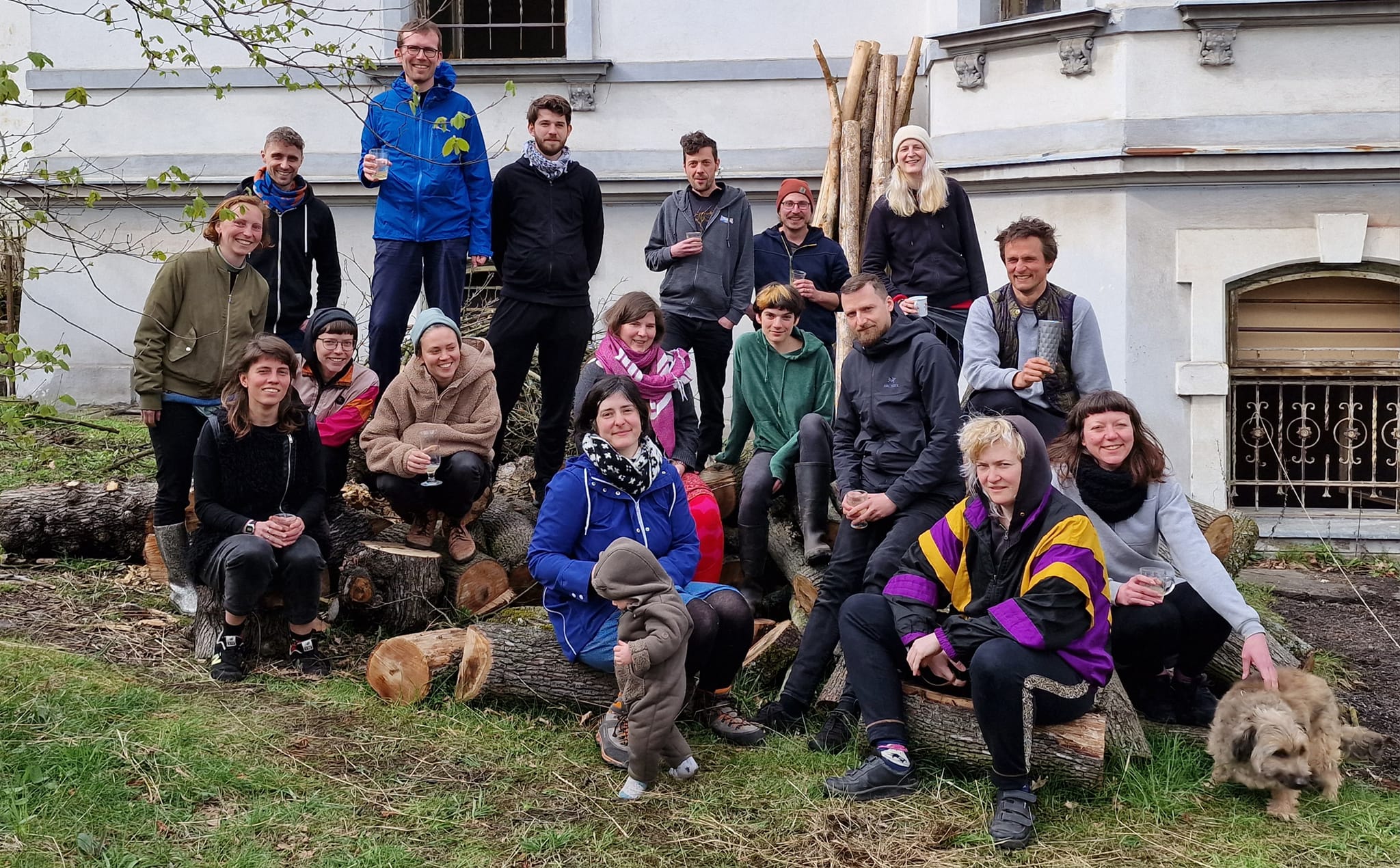
On the permanence side, Sdílené domy is building the country's first non-speculative housing network. První vlaštovka (First Swallow) in Prague was the pilot — a building bought off the market and locked into a legal structure that prevents resale for profit — and Družstvo Racek in Děčín followed. The network shares methodology and a solidarity fund so each new house can help finance the next, modelled openly on the German rental-cooperative and syndicate tradition. It is a thin layer beside the 480,000-flat legacy sector, but it is the one explicitly designed to keep homes out of the market for good.
Holding the legacy sector together is the federation. The Union of Czech and Moravian Housing Cooperatives provides the legal, technical and financial backbone for some 635 member cooperatives and the roughly 703,000 units they manage — the institutional memory that lets a družstvo founded in the 1960s still run a city-centre estate today. Whether that backbone can be turned toward the retrofit-and-affordability task the next decade demands, rather than simply maintaining what exists, is the open question hanging over the Czech model.