Loading...
🇩🇰Country profile
Denmark
Denmark invented a third kind of home — the andelsbolig, neither rented nor owned — and built a near-universal non-profit sector beside it. Can it keep both open to the next generation?
Read the profile
Loading...
Denmark answered the housing question early, and it answered it with an institution rather than a market. After the 1853 Copenhagen cholera epidemic, doctors and labour organisers built the andelsbolig — a cooperative dwelling that is neither rented nor owned outright — and the almene boliger, a non-profit rental sector open to anyone. A century and a half later both still hold a large share of the housing stock. That is why housing here is debated as a question of who controls the homes and on what terms, not simply who can outbid whom.
The tenure mix is unusually flat-bottomed. About 40% of Danes are tenants and 60% owner-occupiers on the headline measure, but the ownership figure folds in the andelsbolig: counted as its own tenure, cooperatives hold 6.0% of all dwellings — 165,000 andelsboliger across roughly 9,000 andelsboligforeninger — leaving 54.0% in freehold ownership and 19% in private rental. The non-market segment, cooperative plus the public and non-profit sector, comes to 21% of all dwellings. Few countries in Europe carry a cooperative slice large enough to register on the national pie at all.
Where many countries run a small, means-tested social sector, Denmark runs a large, universal one. The almene boliger hold about 580,000 dwellings — roughly 21% of the national stock — managed by some 550 non-profit housing associations rather than the state. Anyone can join a waiting list; municipalities reserve a quarter of vacancies for urgent social need. On income grounds around 40% of households would qualify. That breadth is the regulatory backbone of Danish affordability, and the reason the sector is treated as ordinary infrastructure rather than a residual safety net.
Those institutions show up directly in the rent ladder. The andelsbolig boligafgift — the monthly housing charge — runs at about €4.60 per square metre, the almene rent at €7.90, the all-stock median at €8.80, a newly-signed private contract at €14.30, and a furnished serviced let at €23.00 gross. The cooperative charge sits at roughly a third of a new private contract. That gap is the whole argument for keeping the non-market tiers large.
Net monthly cost per m² by tier (national; cooperative is the boligafgift housing charge, furnished is gross all-in). The andelsbolig charge and the almene rent sit at a fraction of a newly-signed private contract — the structural floor under Danish affordability.
Slack in the system is scarce. The rental-vacancy rate is just 1.8%, and residential vacancy overall is 3.5% — much of it structural, in depopulating rural municipalities rather than the cities where demand concentrates. Short-term letting adds its own quiet squeeze: in the EHC-tracked cities alone Inside Airbnb counts about 4,477 full-time-equivalent short-let units, a floor under the true national figure rather than a ceiling. Against that, Denmark counts roughly 189,707 empty buildings in total and a total stock of about 2,778,000 dwellings.
Demand keeps arriving. Denmark records about 82,300 in-migration moves a year against roughly 22,000 residential building permits, and household sizes keep shrinking toward 2.1 people. The pressure is concentrated, not universal — but where it bites, it bites hard.
For all the cushioning, the cost is climbing past the people the system was built to protect. About 23.4% of Danish renter households are housing-cost overburdened — spending over 40% of disposable income on housing — and the burden lands hardest on renters, who give up roughly 27.8% of income to housing against far less for owners. Roughly 5,800 people are counted homeless, and around 3,500 court-ordered evictions run each year. In central Copenhagen the andelsbolig that once let a teacher live in the centre now changes hands at an entry price many younger Danes cannot raise, even with the maksimalpris cap holding the headline value below the open market. It was that reach into the ordinary middle that the government cited when it reopened the social-housing question at the end of 2025.
The Danish cooperative is its own legal animal. A member buys an andel — a share in the andelsboligforening (the cooperative housing association) that owns the building — and with it gains the right to occupy one specific flat. The member does not own the flat and cannot mortgage it as a freehold; the association owns the property collectively, and the resident pays a monthly boligafgift (housing charge) that covers the cooperative's loan and running costs. About 6% of Danes live this way. Cooperative Housing International puts the sector at 165,000 units, roughly 7–8% of all Danish homes.
The crucial feature is the ceiling on resale. Under the Andelsboligforeningsloven (the Cooperative Housing Act), a departing member may not sell their share above a maksimalpris — a maximum price fixed by the association's approved valuation of debt, assets and the unit's proportional weight. There is no open-market bid to chase, which typically holds entry prices well below an equivalent freehold flat. That single rule is what makes the andelsbolig speculation-resistant by design rather than by subsidy, and it traces in an unbroken line back to the 1865 Arbejdernes Byggeforening, which already barred individual resale and refunded only the share value on departure.
The continuity is the point. The line runs from that workers' building society through the 1920s Copenhagen cooperatives founded by the labour movement to the roughly 9,000 andelsboligforeninger of today, federated under the Andelsboligforeningernes Fællesrepræsentation (ABF), the cooperatives' national representative body, which has grown from 69 member associations in 1974 to more than 5,400. The Housing Europe survey of European cooperative housing — Housing Cooperatives in Europe - Resilience and Adaption to Changing Need — places the Danish andelsbolig alongside the German and Scandinavian traditions as one of the continent's most durable non-speculative tenures, precisely because the resale cap has survived every property cycle since.
Sitting beside the andelsbolig is the larger almene boliger sector, and the two are often confused abroad. The almene sector is non-profit rental, not cooperative ownership: about 580,000 dwellings across some 550 housing associations, tenant-governed through resident democracy but let rather than share-owned, and refinanced collectively through Landsbyggefonden, the National Building Fund created in 1967 and fed by the sector's own rents. The Housing Europe study of cost-rent provision, Cost-based Social Rental Housing In Europe, sets the Danish almene model out as a leading example of rent set to cover cost rather than to clear a market.
The sector is not without strain. The maksimalpris keeps andelsbolig prices below the open market, but in Copenhagen and Aarhus the entry share has still risen far enough to exclude many of the young households the form was meant to serve; a handful of associations have taken on debt structures that left members exposed when valuations fell. Honesty about that is part of the Danish debate. Even so, no other northern-European country has held a genuinely speculation-resistant cooperative tenure at this scale for this long — the andelsbolig is small against the almene sector, but large against almost any cooperative stock outside the German-speaking world.
Danish housing policy is unusually centralised, and in late 2025 it pulled in two directions at once. In December the Social Democrat government and four parties — the Socialist People's Party, the Conservatives and the Red-Green Alliance among them — signed an agreement to enable 20,000 to 25,000 new almene boliger over the next decade. The deal raises the construction-cost ceiling that had effectively frozen new non-profit building in expensive cities, allowing up to a 20% higher cost cap in Copenhagen and Aarhus, and adds rental-assistance and temporary-housing funds. Minister for Social Affairs and Housing Sophie Hæstorp Andersen framed it as a democratic question, not only a housing one.
When ordinary people can no longer afford to live in the cities, it is not just a housing problem.The engine behind that supply promise is Landsbyggefonden. The fund is filled not from the budget but from almene tenants' own rents, which keep flowing in after a building's construction loan is repaid; those savings then finance new construction and renovation across the sector. The 2020 deal alone routed DKK 30bn through the fund into renovating roughly 72,000 dwellings by 2026 — one of Europe's largest social-housing retrofit programmes, and the reason Danish non-profit housing can expand without each project competing for fresh public money.
For cooperatives specifically the lever is regulatory rather than fiscal. The state does not subsidise the andelsbolig; it protects it. The maksimalpris valuation rules, periodically retuned by parliament — most recently in a 2024 valuation reform — are what keep the share price capped, and the ABF carries the sector's case into that legislative process. The newer instinct in municipal land policy is to route public sites to cooperatives and almene associations through concept-led allocation rather than the highest bid, keeping the land itself out of the speculative loop in the way the andelsbolig already keeps the dwelling out.
Running underneath all of this is the country's most contested housing law. The 2018 Parallel-Society legislation — long called the “ghetto law” — requires designated estates where more than half of residents are of “non-Western” background to cut their share of family almene housing to 40% by 2030, through sales, demolition and forced relocation. In February 2025 the Court of Justice of the EU's Advocate-General found the parallel-society designation to be direct ethnic discrimination under the Race Equality Directive; a final ruling is pending and could force a rewrite. It is the sharpest fault line in Danish housing: the same almene sector that delivers near-universal affordability is the instrument through which the state has pursued a demographic-engineering policy now before the European court.
Two camps frame the wider argument. One, gathered around the almene and cooperative federations — BL for the non-profit associations, the ABF for the cooperatives — argues that the non-market sector is Denmark's proven affordability machine and should be expanded, its retrofit funded, its resale caps defended, and the parallel-society demolitions halted. The other, drawn from market-liberal voices and parts of the property industry, reads the same waiting lists as evidence of over-regulation, and would loosen the maksimalpris and the rent rules to draw in private investment. The December agreement tilts toward the first camp; the EU court may yet decide how much of the second's critique of the ghetto law the country has to concede.
The Workers’ Building Society forms in Copenhagen after the 1853 cholera epidemic — share-based, no individual resale, the deep root of the Danish cooperative-housing idea. It built almost 1,500 speculation-free homes, including Kartoffelrækkerne.
Labour-movement and social-democratic actors found the first modern housing cooperatives in 1920s Copenhagen, fixing the andelsbolig as a tenure between renting and owning.
The National Building Fund is created, financed by tenant rents in the almene sector — the self-funding engine that still pays for renovation and new non-profit construction.
Parliament passes legislation requiring designated estates with over 50% "non-Western" residents to cut family almene housing to 40% — forced demolition and relocation in the name of integration.
A cross-party deal channels DKK 30bn from Landsbyggefonden into renovating roughly 72,000 almene dwellings through 2026 — among Europe’s largest social-housing retrofit programmes.
The CJEU’s Advocate-General finds the "parallel society" designation amounts to direct ethnic discrimination under the Race Equality Directive; the Court’s ruling is pending.
Minister Sophie Hæstorp Andersen and four parties agree to enable 20,000–25,000 new almene boliger over a decade, raising the construction-cost ceiling by up to 20% in Copenhagen and Aarhus.
The date by which "transformation areas" must cut family social housing to 40% — the deadline the EU court case may yet overturn.
The ten-year window the December 2025 agreement sets itself to deliver its 20,000–25,000 new non-profit homes — the supply answer to the affordability squeeze the same agreement names.
From the 1865 Arbejdernes Byggeforening and the 1933 housing acts through the 2018 Parallel-Society law to the December 2025 social-housing agreement and the 2030 "non-Western under 30%" deadline now before the EU court.
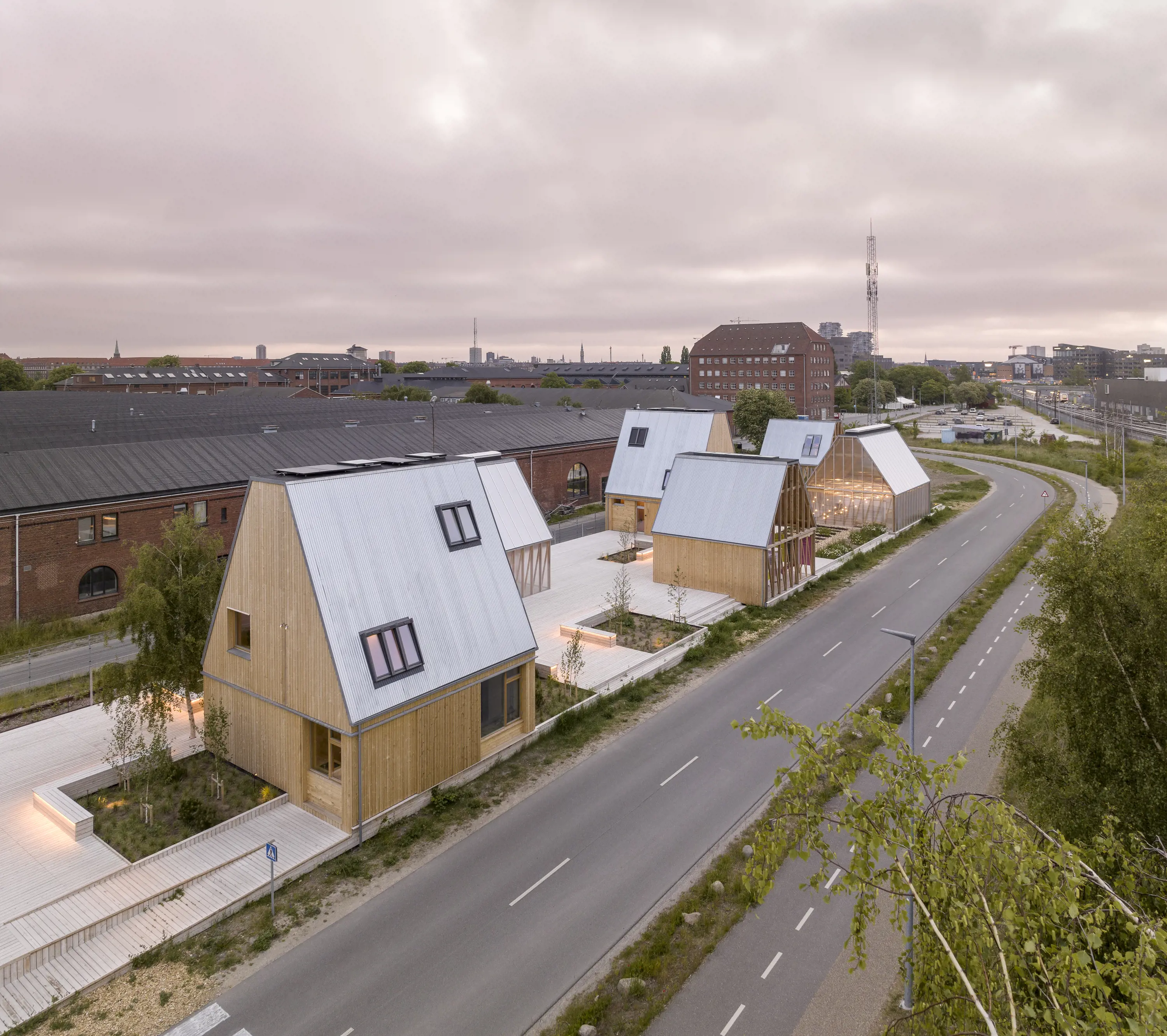
The Danish case is easiest to read in the buildings, because the country has been prototyping collective housing forms longer than almost anyone. The bofællesskab — the resident-run cohousing community Denmark effectively invented in the 1960s — is the bridge between the andelsbolig statute and everyday life, and its demonstrators range from 1970s low-rise classics to large modern cooperatives.
Tinggården, completed in 1978 near Herfølge, is the archetype: 78 homes in six family clusters, each with its own common house, the project that fixed low-rise high-density cohousing as a Danish model. Lange Eng, in Albertslund outside Copenhagen, is the large modern descendant — 54 households around a single enormous shared garden and a communal kitchen that cooks for the whole community most nights, the biggest of its kind in the country. Munksøgård, near Roskilde, goes further still, combining owner, cooperative and rental tenures in one village across five resident-governed groups — a deliberate test of whether tenures can be mixed inside a single scheme.
The newest strand pulls the same instincts toward sustainability and reuse. Realdania, the philanthropic association that funds much of Danish built-environment innovation, backs experiments in low-carbon, healthy and affordable construction. Its Living Places initiative builds prototype homes at roughly a third of the usual construction carbon, designed to be replicable rather than one-off — the Danish bet that the next generation of non-market housing has to be cheap to run and light on the planet at the same time.
Holding the portfolio together is the connective tissue the country built over a century: the Andelsboligforeningsloven that caps resale, the ABF that federates the cooperatives, BL that represents the almene associations, and Landsbyggefonden that refinances the sector from its own rents. The pattern the Housing Europe survey of European cooperatives traces elsewhere — a durable legal form plus a federating body plus patient, self-replenishing finance — is, in Denmark, not an aspiration but a working machine that has kept a large share of homes out of the speculative market for over a century. The open question is no longer whether the model works, but whether it can keep admitting the next young household before the entry price closes the door.