Loading...
🇭🇷Croatia·City profile
Zagreb
Zagreb sold almost its entire rental stock to its tenants in the 1990s. Can a city of owners build a place for everyone else to rent?
Read the profile
Loading...
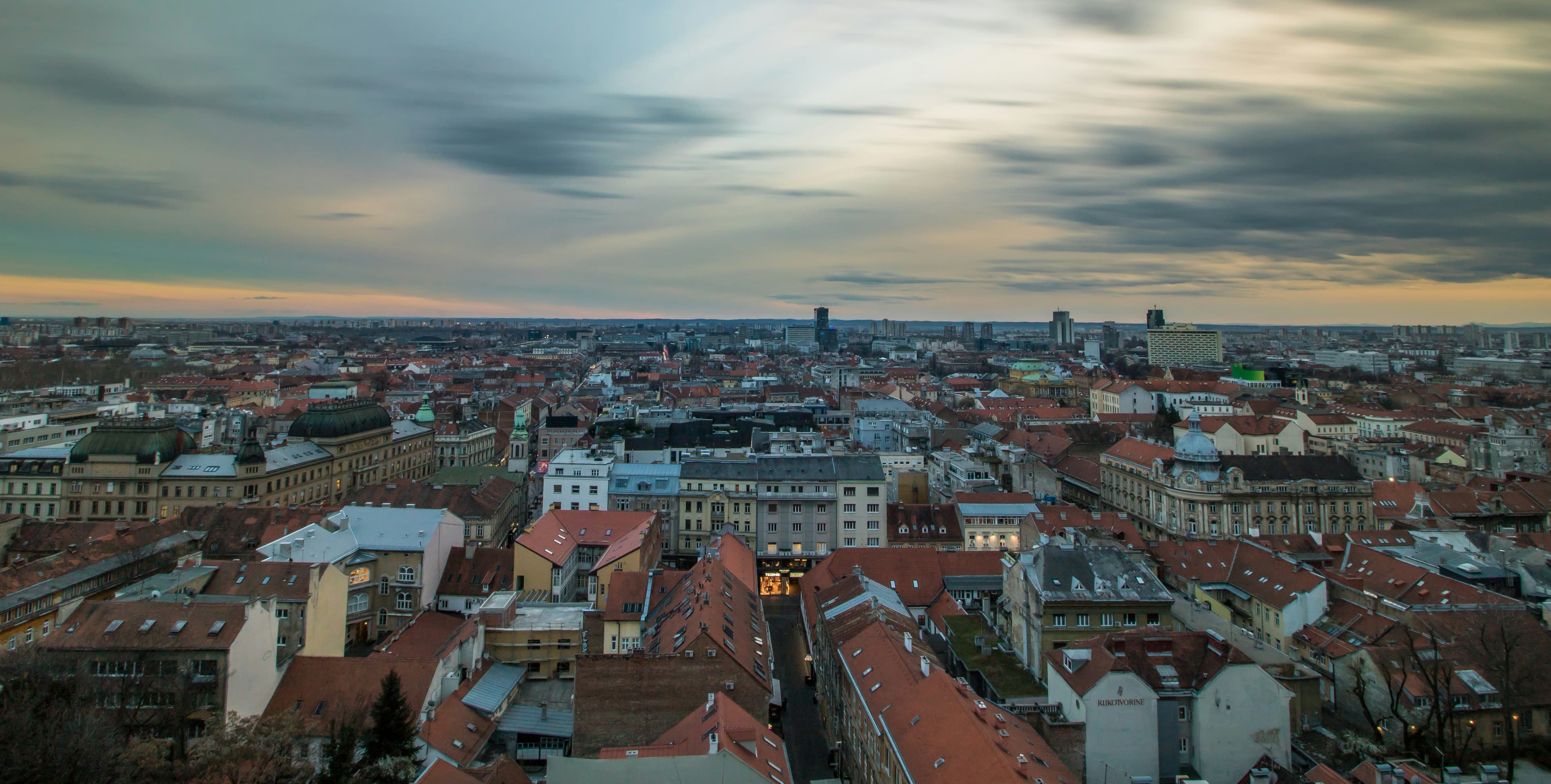
Zagreb is a compact Central European capital of about 767,131 people, an Austro-Hungarian core of ochre facades and a daily cannon fired from the old town since the 1870s. After 1991 it did something that still shapes its housing market more than any building does. It sold almost its entire rental stock to the people living in it, and became, in the process, a city of owners rather than tenants.
The tenure mix is lopsided in a way few capitals match. Ownership dominates almost everything: around 82% of households own their home, against only 11% who rent, the legacy of a right-to-buy that handed the socialist municipal stock to its tenants almost wholesale. The municipal sector that remains is tiny: roughly 4,500 city-owned flats, about 1.4% of the city's 322,000 dwellings. As an organised tenure the housing cooperative is all but absent, with only about 5 housing cooperatives registered. That leaves around 10% of dwellings in private rental and a non-market tier of just 1.4%, among the smallest of any European capital. The gap is no rounding error: the 2021 census files about 7% of Zagreb households as living rent-free in a home owned or rented by a relative — the kinship tenure that, here, does the work an organised affordable sector does elsewhere.
Social housing is more a sliver than a system. Only about 1% of Zagreb's dwellings are reserved for social-housing purposes, a targeting rule that sits on top of the small municipal stock rather than forming a tenure of its own. Eligibility is tight: roughly 18% of residents would qualify on income, but the flats to house them do not exist. Croatia built very little dedicated social housing after independence, and a study of social and spatial inequality in Zagreb's housing system traces how policy chose subsidised home-ownership over a public rental sector for three decades.
Between the protected floor and the open market there is almost nothing in between. Tenants in the city's protected municipal flats pay around €1.50 per square metre, a socialist-era rent far below replacement cost. A market tenant pays many times that: the all-stock median runs near €15, newly-let apartments ask about €14.80, and furnished, serviced lets reach roughly €16 per square metre gross. The distance from the protected floor to a market contract is roughly ten to one. With almost no cooperative or non-profit middle tier to soften it, a Zagreb renter steps straight from a sheltered minority into the full force of the market.
Net-cold monthly rent per square metre by tier (furnished is gross, all-in). The protected municipal rent sits far below the market; a private contract runs many times the municipal rate, and the city has almost no cooperative middle tier to soften the gap.
The paradox is that a shortage runs alongside a great deal of unused stock. A residential vacancy of about 13% showed up in the 2021 census, with roughly 80,000 dwellings counted as unoccupied — though much of that is second homes, inherited flats and stock left empty after the 2020 earthquake. Offices are slack too: around 34,910 square metres stand vacant, about 4.5% of the modern office stock. The losses to tourism are more concentrated. Entire-home holiday lets cluster in the Donji Grad core and Upper Town, where a median entire-place night runs about €85 and pulls flats out of the long-term market in exactly the streets visitors fill.
Jobs and universities draw roughly 12,000 net new residents to Zagreb each year, yet the city issues only about 2,200 housing permits a year to house them. Prices have climbed fast: Zagreb posted one of the steepest new-dwelling price rises of any European capital in 2024, and Deloitte's Property Index puts buying a standard new flat at around seven-and-a-half gross annual salaries. The pinch is no longer confined to the most vulnerable. A pan-European affordability study finds that at Zagreb's market rents, a single person on a minimum income cannot afford even a one-room flat. The city counts roughly 900 homeless people and about 350 residential eviction cases a year, the visible edge of a much wider middle-income squeeze.
Croatian housing policy since the 1990s has mainly dealt with housing provision that covers only a minor percentage of the population.Zagreb is unusual in this portfolio because it has almost no cooperative-housing tenure to describe. The Croatian word zadruga (cooperative) carries deep historical weight — it was once the name for the extended rural family household — but as a way to build and hold city flats together, the housing cooperative is only now arriving. There is no equity-share cooperative sector of the kind Vienna or Zurich built, and the census files almost everyone as an outright owner.
The reason is the path the country took, not a lack of need. Socialist Yugoslavia housed people through enterprise-allocated and socially-owned flats rather than member cooperatives, and the post-1991 right-to-buy converted that stock into private ownership in a single sweep. For three decades housing policy then leaned on subsidised mortgages and the state-subsidised POS construction programme. A housing cooperative had neither a legal home nor a funding line: Croatia still regulates cooperatives only through a general 2011 law written for farming and consumer zadruge, not for housing.
What exists today is a small, deliberate revival rather than a sector. MOBA Housing SCE, a transnational cooperative federation, was founded in Zagreb in 2020 as the first European Cooperative Society registered in Croatia, with the Otvorena Arhitektura (Open Architecture) cooperative as its Croatian member. Alongside it the Cooperative for Ethical Financing offers the patient, values-led capital these projects need, and the Pravo na grad (Right to the City) movement supplies the research and political pressure. These actors cluster tightly and face one shared problem above all others: there is no legal or financial framework for not-for-profit housing providers, so each pilot has to improvise its land, its finance and its legal form. The network's own analysis of financing for cooperative housing frames the missing framework as the binding constraint across central and south-eastern Europe.
Whether this revival scales now depends squarely on city hall. The model the revival is pushing rests on municipal land leased on a long building right, the same instrument the cooperative movement has used to launch its first Croatian pilot in the nearby town of Križevci. Whether Zagreb will offer its own plots on those terms — and write cooperatives into a national framework that finally recognises them — is the open question the city's housing programme has to answer. The translocal cooperative revival across the region is being knitted together precisely so that a city starting from zero does not have to invent everything alone.
Zagreb's housing politics is the politics of building something close to scratch. Tomislav Tomašević of the green-left Možemo! platform has led the city since 2021, with deputy mayor Luka Korlaet holding the spatial-planning brief, and the lead instrument is the city's own affordable-rental construction. The flagship is Podbrežje, a €42 million scheme of around 300 affordable and social rental flats due in 2027, financed entirely from the city budget. Further estates at Sveta Klara and Borovje are in planning, part of a target to build at least 1,000 affordable flats over the coming mandate.
City hall and the national government are, for once, pulling in the same direction. The city owns the land and runs the build-out; the national government sets the legal frame and the money. The Ministry of Physical Planning, Construction and State Assets is the lead author of the Affordable Housing Act, passed in 2025 as the first law to define affordable housing in Croatia. It targets 20,200 dwellings built or activated over four years and, in a notable shift, requires that half the homes in new multi-apartment buildings be let rather than sold. A National Housing Policy Plan to 2030 frames the effort, and the European Investment Bank is advising Zagreb and the other large cities on how to deliver it.
The cooperative sits just outside this programme, waiting to be let in. The city has so far built municipal rental directly rather than leasing land to cooperatives, and the national framework still has no place for a not-for-profit housing provider. A regional investor study on catalytic capital argues that concept-led land leases and patient, risk-tolerant capital are what turn a cooperative pilot into a pipeline — the bridge over the short loan terms Croatian banks offer.
The unoccupied stock from §1 has not gone unnoticed by the policy. The Affordable Housing Act counts vacant flats activated for affordable letting toward its targets, with around 9,000 of the 20,200 dwellings meant to come from existing empty stock. There is no vacant-homes tax, and the earthquake-damaged buildings of the centre are a reconstruction problem as much as a housing one. Slow permitting stays a binding constraint, and the city's experts long argued the deeper issue is institutional capacity, not just budget.
After independence, sitting tenants of the socialist municipal and socially-owned stock are given the right to buy their flats at low prices, transferring almost the entire rental sector into private ownership.
The 1996 rental law converts remaining occupants into protected tenants on very low rents, leaving the city with a small, poorly-maintained residual public stock.
Housing policy centres on subsidised mortgages and the state-subsidised POS construction programme, deepening owner-occupation rather than building a rental or cooperative tier.
A transnational cooperative federation is registered in Zagreb as the first European Cooperative Society in Croatia, with the Otvorena Arhitektura cooperative as the Croatian member.
A 5.5-magnitude earthquake damages much of the historic centre and leaves new families without homes, adding a reconstruction backlog to an already strained housing system.
The Otvorena Arhitektura cooperative and the Cooperative for Ethical Financing launch a cooperative-housing pilot in Križevci on municipal land, the first concrete test of the MOBA model in Croatia.
Croatia adopts its first National Housing Policy Plan, analysing the affordability crisis and setting a framework for affordable rental and purchase.
Parliament passes the Affordable Housing Act, the first to define affordable housing in Croatian law, with a target of 20,200 dwellings built or activated over four years and a 50% rental requirement in new multi-apartment buildings.
The City of Zagreb completes its €42 million Podbrežje scheme, around 300 affordable and social rental flats for roughly 1,000 residents — the first of a planned 1,000-flat municipal build-out.
The state plans to secure around €2 billion by 2030, and a further €3.5 billion through the 2028-2034 EU budget, to deliver the Affordable Housing Act targets.
From the post-1991 right-to-buy and the subsidised-loan years to the 2020 earthquake, the first cooperative revival and the first national Affordable Housing Act.
For Zagreb the climate question and the affordability question run on the same track. The housing stock averages around 45 years old, only about 11% of dwellings are energy-efficient, and the renovation rate crawls at roughly 0.5% a year. The post-earthquake reconstruction is the main vehicle for upgrading the older centre, and the city's new affordable estates are built to modern energy standards. A study of decarbonising affordable housing places the new non-market stock at the centre of cutting the sector's carbon, tying the climate goal to the affordable tier the city is trying to grow.
In Zagreb the argument is no longer whether to build a non-market tier but how ambitious it should be. Mayor Tomislav Tomašević frames municipal rental as the city's route out of the crisis, and stresses that affordable estates must come with schools, transport and social infrastructure, not just flats. Iva Marčetić, the architect and researcher behind the Right to the City movement's housing work, argues that decades of policy have served only a minor share of the population, and that a public and cooperative sector measured in single-digit percentages cannot discipline the market. The two camps share the goal of a larger non-market sector; they part company over its pace, and over whether the cooperative belongs at the centre of the plan or its margin.
It is important that in neighbourhoods where we develop affordable housing we do not build only residential buildings, but also all the necessary communal, transport and social infrastructure.Zagreb's working examples are early and few, and the thread that connects them is a city and a movement each trying to build a non-market tier almost from nothing. The cases below run from the city-led municipal estate to the resident-led cooperative pilot, and close with the actors trying to make the model repeatable.
Podbrežje is the clearest sign of the new municipal ambition. Built and financed by the City of Zagreb, it will bring several hundred affordable and social rental flats to the residents who need housing most, with kindergartens, transport and public space planned alongside the blocks. Its deputy mayor, Luka Korlaet, has described the architecture as pragmatic and rational, chosen to build faster and fit more flats. The caveat is scale: the scheme answers only a fraction of the demand, the build has been slow to start, and the city is financing it entirely from its own budget rather than a national programme.
MOBA Housing SCE is the cooperative counterweight to the municipal route. Founded in Zagreb in 2020 as the first European Cooperative Society in Croatia, it pools expertise and finance across Belgrade, Ljubljana, Prague and Zagreb to launch resident-led, non-speculative projects. Its Croatian member, the Otvorena Arhitektura cooperative, has mapped city-owned plots suitable for cooperative housing and drawn up conceptual designs and financial models for Zagreb. The friction is structural: with no national cooperative-housing law, the model has had to prove itself first in the smaller town of Križevci, and the Zagreb plots remain proposals rather than building sites.
The Cooperative for Ethical Financing supplies the money the banks will not. A values-led financial cooperative based in Zagreb, it provides the patient, community-minded capital that resident-led housing needs and that conventional Croatian lenders, with their short terms and high collateral demands, rarely offer. It is a thin financial layer for now, dependent on a small membership and operating in a regulatory grey zone, but it is the closest thing the city has to a dedicated source of cooperative housing finance.
Pravo na grad supplies the diagnosis and the pressure. The Right to the City organisation has mapped Zagreb's public housing stock and rental affordability in detail, and its study of housing policy in the service of social and spatial inequality is the sharpest local account of how the post-1991 sell-off and the long mayoralty of Milan Bandić shaped the city. The work is research and advocacy rather than bricks, and its influence depends on a political climate that can shift; but it is the evidence base every affordable-housing argument in Zagreb now draws on.
Underpinning the projects is a small but credible body of scholarship. The Institute for Social Research in Zagreb and the housing scholars at the University of Zagreb have anchored Croatia in the European housing-research networks, contributing the Croatian country chapters in comparative studies of European housing policy and social innovation. It is a far smaller institutional layer than Vienna's or Berlin's, and almost everything here is recent or still on paper. But it is being built on a clear-eyed reading of the city's own history, and on the one form Zagreb has barely tried: housing that people own and govern together rather than alone.