
A capital with more desks than beds
Vaduz is a capital in miniature. A prince looks down from the castle, the Landtag (Liechtenstein's parliament) meets in the town, and private banks line the Städtle, the main street, for a resident population of just 5,668 people. Since 2017 the country has counted more jobs than inhabitants, and in 2025 employment reached 105.7% of the resident population. The municipality's own spatial concept puts it plainly: Vaduz has twice as many jobs as residents, and 85% of the people who work here commute in. Housing in Vaduz is therefore less a question of how many homes exist than of who gets to live beside the desk they work at.
The tenure pattern is that of a small Swiss-style town. Of Vaduz's 3,631 dwellings, 28% are lived in by their owners, the lowest share of any municipality in Liechtenstein. 72% of households rent, and practically all of them, 72%, rent from a private landlord. The cooperative sector is a single estate: the 23 flats of Siedlung Birkenweg, built by Wohnbaugenossenschaft Liechtenstein. There is no public housing company, national or municipal. The town's own housing page directs home-seekers to the cooperative, and the municipality's only rental stock is a handful of senior flats.
- Owners
- Owner-occupier28.0%
- Renters
- Public & non-profit rental0.00%
- Cooperative0.00%
- Private rental72.0%
Social housing, as a regulatory category, does not exist here. No dwelling carries a rent covenant or an income-linked allocation rule. The state supports households instead of buildings. Its main tool for renters is the Mietbeiträge (a means-tested rent allowance for families), which reached only 261 recipients in 2021, 61% of them single parents, according to the government's 2022 report on affordable housing. So the social layer is a cash transfer spread thinly across the private rental market, not a slice of the stock.
Rents sit at Swiss levels. The median across the whole stock is €18.5 per m² a month, net of heating and service charges, and new contracts start at around €24. Furnished and serviced flats, with utilities and furniture priced in, reach €30 per m². The 2020 census found an average gross rent of CHF 1,963 for a 4-room flat, the most common size, while gross rents had risen only 5.9% since 2010. At Birkenweg, a 4½-room cooperative flat of 114 m² was let for CHF 1,615 net when it opened.
- Cooperative
- All-stock median
- New contracts
- Furnished / serviced (gross)
Net cold rent per m² a month, except the furnished tier, which is gross and includes utilities and furniture. The cooperative point is Birkenweg's opening rent for a 4½-room flat, converted from Swiss francs.
Vaduz publishes no vacancy rate of its own. Nationally, the government reports vacancy holding between 4% and 5% for a decade, mostly because residence rules keep would-be tenants out. The 2020 building statistics also counted 2,852 dwellings nationwide as not permanently occupied. No office-vacancy statistic is published for Vaduz. Short-term letting is marginal, with a median entire one-bedroom place costing €140 a night on a very small inventory.
Residence, not construction, is the binding constraint. Vaduz gains about 250 new residents a year. EEA nationals cannot simply move in: half of all residence permits must be allocated by a procedure giving every applicant an equal chance, which Liechtenstein runs as a lottery. Only 28 permits for employed people are drawn each year. Everyone else commutes, and 57% of the national workforce now crosses a border to get to work. Building is not the bottleneck. The builders' federation reported 166 new dwellings approved in the second quarter of 2026, a record since the series began. Tenancy law is, in Stiftung Zukunft.li's word, liberal.
How deep is the pressure? The honest answer is that it depends on the household. An analysis by the University of Liechtenstein found that a family on a gross income of CHF 170,000 now spends about CHF 20,760 a year on housing and energy, 22% more than five years earlier, with households on low incomes feeling it most. Against that, Stiftung Zukunft.li's study of the rental market argues that enough affordable housing exists and notes that fewer families claim the rent allowance each year. Public opinion is drifting the other way. In neighbouring Schaan, almost half of residents now rank affordable housing among their three most important issues for the future.

We are all in the same storm, but in different boats.For the families in the smaller boats, Vaduz offers one alternative to the private landlord, and it is barely a decade old.
One cooperative, ten years old
Wohnbaugenossenschaft Liechtenstein (WBL) runs a rental cooperative with an ownership flavour. Its motto is Mi(e)teigentum, a pun on Miete (rent) and Eigentum (ownership): members rent their flats but co-own the buildings. Each member buys a Genossenschaftsanteil (the membership share that makes you a co-owner) of just CHF 1,000. On top of that, each household subscribes Wohnungsanteilscheine (housing shares tied to the flat) worth CHF 30,000 to 50,000. The rents that result sit well below the market. The cooperative's statutes commit it to lasting affordability for families, people with disabilities and older people.
I found that exactly this third way, for the middle class, is missing here.The cooperative idea itself is old in Vaduz. An account of the cooperative's founding notes that farmers joined forces in an Alpgenossenschaft (an alpine grazing cooperative) about four centuries ago. The municipality still lists it alongside the Bürgergenossenschaft, a citizens' cooperative that owns the town's forest. Housing never followed. The housing-subsidy law of the 1970s did allow support for non-profit building, but no ordinance ever put it into effect. Swiss cooperative funds were closed to a foreign applicant. The first housing cooperative was only founded on 21 March 2014, with the municipality of Vaduz among its first members and the Eastern Switzerland branch of Wohnbaugenossenschaften Schweiz (the Swiss cooperative federation) as its sponsor.
Today the sector has one actor and two clusters that barely touch. The old Alp- and Bürgergenossenschaften hold land and forest for citizens by descent, and they have never built homes. WBL, by contrast, is a modern project cooperative built on the Swiss federation's model statutes. It completed Birkenweg in 2017 and then took its model to Kohlplatz in Eschen in the Unterland. Its challenges are those of any start-up cooperative: finding land below market price, raising equity from members, and borrowing without a public guarantee. The Liechtensteinische Landesbank (the state-owned bank) solved the last point for Birkenweg by waiving its usual affordability rules. None of that scales without a public partner.
That partner is now being discussed openly. The government's 2022 answer to parliament on affordable housing listed building by municipalities and housing cooperatives as a possible new instrument. That sets up the political question of whether Liechtenstein will finally fund what its own law has allowed for half a century.
Subsidies for buyers, reserves for heirs
The current government's answer to rising costs is written into its programme for 2025 to 2029, which promises revisions of the building law and of the Wohnbauförderung (the housing-subsidy law). That law's main instrument is an interest-free loan to people buying or building a home to live in. In November 2024 the government indexed it to inflation for the first time since 2003, lifting the loan to CHF 1,122 per m² and the income limit to CHF 112,200. The parts of the law that were meant to fund buildings rather than buyers have never worked. Answering a parliamentary question in 2024, government councillor Graziella Marok-Wachter called them a dead letter and floated a new model: the state would help municipalities buy land, and they would build with a housing provider.
That split of powers shapes everything. The Land (the national state) holds the subsidy law, tenancy law and residence permits. The 11 municipalities own land, zone it and decide whom to sell it to. Vaduz used exactly that lever in 2014, selling the Birkenweg plot below market to the new cooperative. It still sends a delegate, councillor Ruth Ospelt-Niepelt, to the cooperative's bodies. Its neighbour is going further. Schaan has costed what affordable housing would take and frames it not as welfare for single households but as a tool of local development.
Parliament is now pushing the cooperative route. In October 2025 the FBP (the Progressive Citizens' Party, a governing coalition partner) tabled two motions. Under the proposals, cooperatives and foundations that lock in affordability in their statutes would qualify for subsidy, and the condition tying support to a rent-to-buy model would be dropped. Parliament referred both to the government in December 2025.
Housing must not become a luxury.The market side reads the same data differently. Stiftung Zukunft.li, a liberal think tank, argued in 2023 that the country has an oversupply rather than a shortage, with vacancy at 4%, and warned that suspending market mechanisms often makes things worse. Builders point to costs. Köbi Steiger, president of the Baumeisterverband (the building contractors' association), told the chamber of commerce that it would be desirable for projects to focus on quality again, not only on cost.
The real surplus is land, not flats. According to the government's 2022 report, 395 ha of building reserves lie in residential zones, or 35% of all land zoned for housing. Owners hold plots for their children or in the expectation of rising prices. The government concedes that measures to bring this land to market would be the most effective, and also the least likely to pass. Even basic market data is still being built. A rent index was commissioned in 2023 to fill that gap.
Sustainability follows the same pattern of cautious consensus. According to the government's voting brochure, 70% of buildings are heated with oil or gas. Yet in January 2024 voters rejected the laws implementing the EU buildings directive and a solar obligation. A slimmer draft now covers only what EEA law requires, with rules due from about mid-2027 under the Energiestrategie 2030 (the national energy strategy). Birkenweg, certified to the Minergie-A near-zero-energy standard, shows what a cost-rent cooperative can deliver on that front.
- 1970s[source]
Housing-subsidy law allows non-profit building
The Wohnbauförderungsgesetz anchors support for non-profit housing, but no ordinance ever implements it.
- 2014-03-21[source]
First housing cooperative founded
Wohnbaugenossenschaft Liechtenstein is founded, with Vaduz among its first members, days after the municipality agrees to sell the Birkenweg plot at a preferential price.
- 2017[source]
Birkenweg completed
The first cooperative estate in Liechtenstein opens in Vaduz with 23 Minergie-A flats, all let on completion.
- 2022-10-31[source]
Government reports on affordable housing
Answering a 2022 parliamentary postulate, the government finds 35% of residential zones unbuilt and names cooperatives as a possible instrument.
- 2023-07[source]
Rent and property price indices commissioned
The government asks its offices to build a rent index within one to three years and a residential property price index within two to four.
- 2024-01-21[source]
Voters reject building-energy laws
A referendum throws out the implementation of the EU buildings directive and a solar-panel obligation.
- 2024-11-20[source]
Housing subsidy indexed to inflation
First adjustment since 2003: the interest-free loan rises to CHF 1,122 per m² and the income limit to CHF 112,200.
- 2025-10-24[source]
FBP tables two affordable-housing motions
The motions would let cooperatives and foundations receive subsidy and drop the rent-to-buy condition; parliament refers them to the government in December 2025.
- 2026-02-25[source]
New building-energy draft
A slimmer draft limited to what EEA law requires goes to consultation, with rules due to apply from about mid-2027.
- 2030[source]
Energy strategy horizon
Target year of the Energiestrategie 2030, on the road to the Energievision 2050.
Birkenweg and the search for a third way
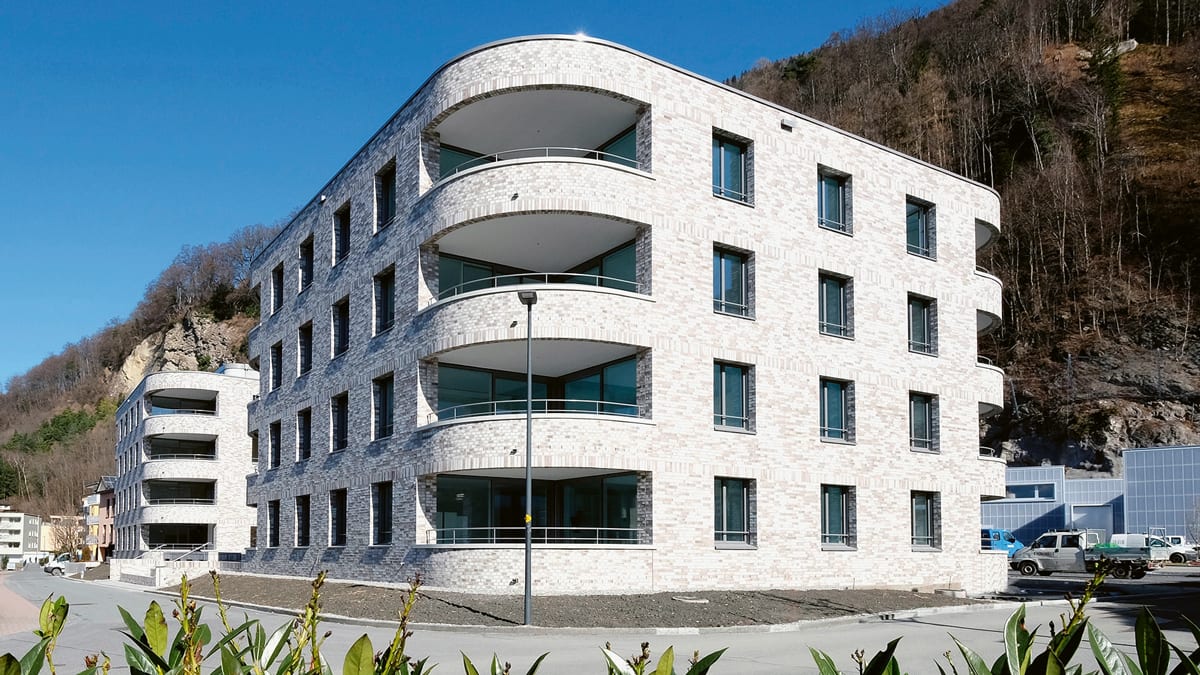
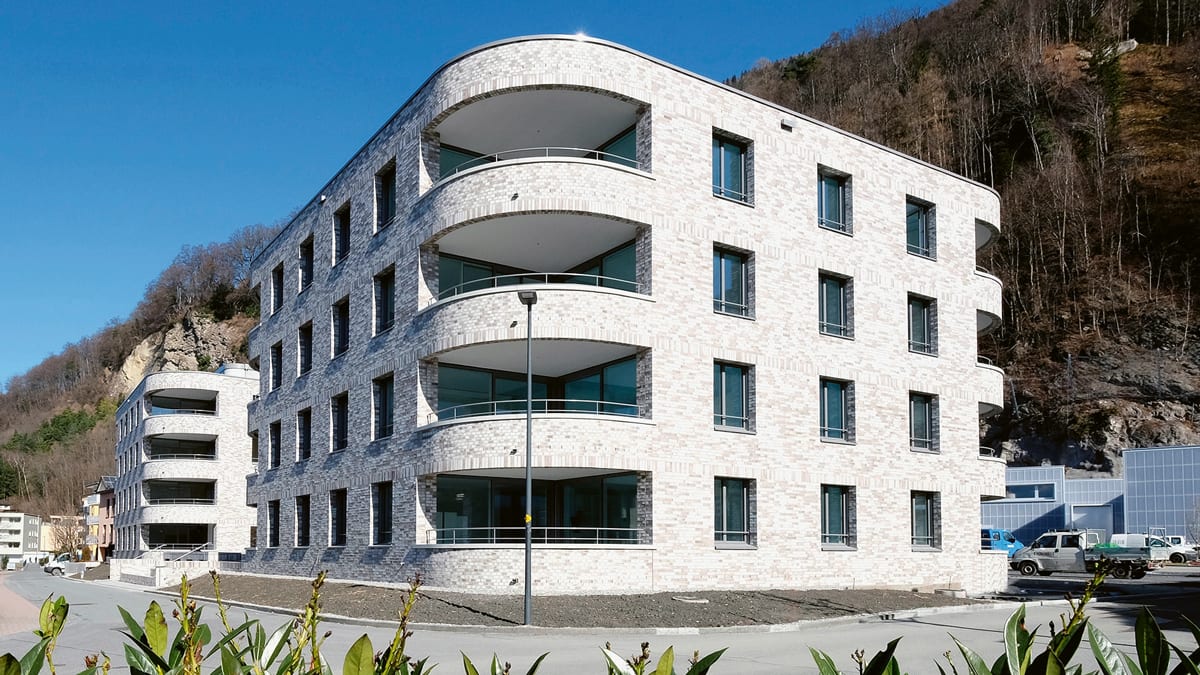
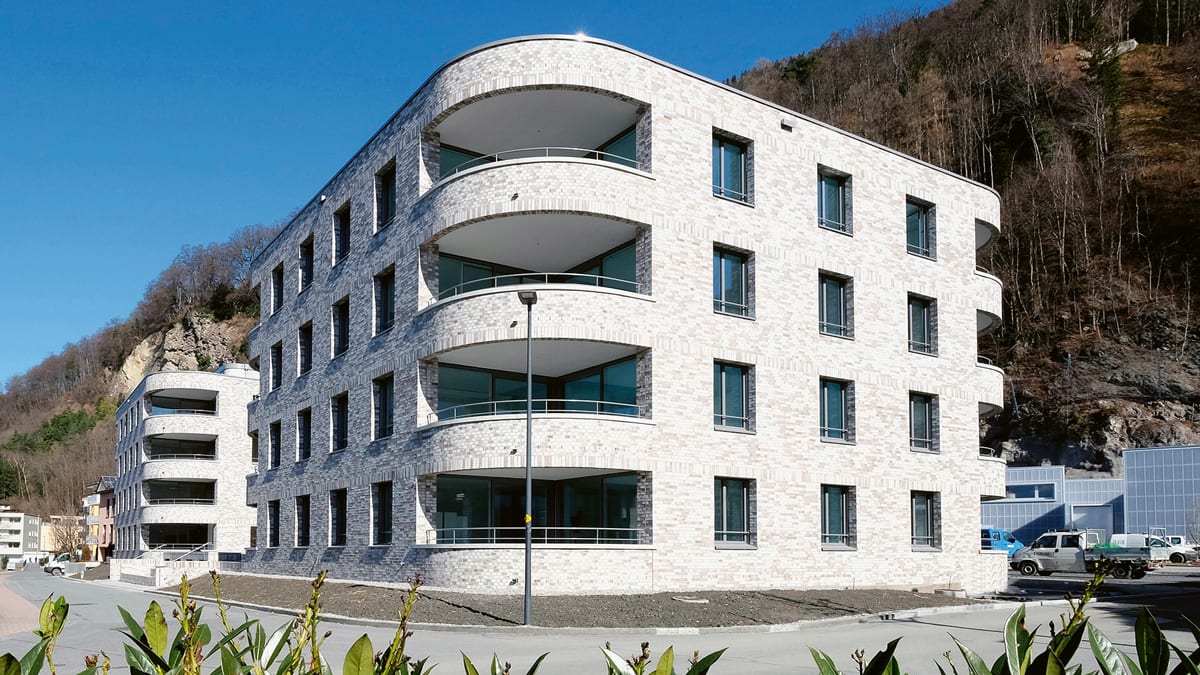
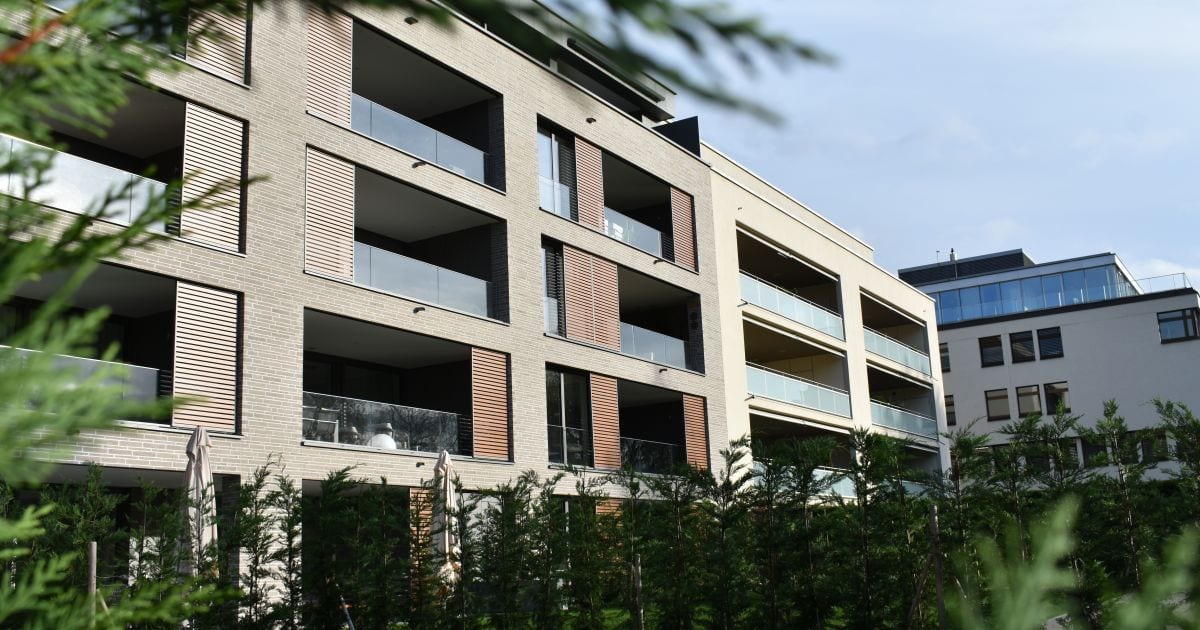
Siedlung Birkenweg is the proof of concept. Two four-storey buildings by BBK Architekten of Balzers, the winners of a 2015 competition, stand south of the town centre around a semi-public courtyard. Their 23 flats were all let on completion in spring 2017. The estate cost CHF 13.9 million and is certified Minergie-A. It rests on three commitments that are rare here: public land sold below market, members' equity in place of a developer's margin, and a bank willing to lend on a cooperative's terms.
Wohnbaugenossenschaft Liechtenstein is the organisation that can make Birkenweg more than a one-off. Its statutes aim at housing in every municipality of the country, and its second estate at Kohlplatz in Eschen took the model beyond the capital. What it lacks is access to subsidy. That is precisely what the FBP motions and the government's planned land-purchase model would change.
Haus St. Florin is Vaduz's own small experiment in non-market housing. On the top floor of its social centre, the municipality built senior flats of 60 to 65 m² with a roof garden and shared rooms. They go to pensioners who have lived in Vaduz for at least five years, from a waiting list. Where applicants are equally placed, lots decide. Care services from the LAK (the national foundation for elderly and home care) can be booked on top.
Wohnbauten Möliholz shows another way to add homes in a built-up town. Diagonal Architekten placed five maisonettes around a restored workers' house of the Jenny, Spoerry & Cie. textile mill in Mühleholz, a building that the municipality has protected since 1997. Around 1900 the mill had already turned workshops and farm buildings into workers' housing. The project is private, but it is a reminder that Vaduz's first answer to a workforce it could not house was adaptive reuse.
The argument over what comes next draws on a short shelf of evidence. The government's 2022 report on affordable housing remains the most complete official analysis. Stiftung Zukunft.li's shortage study and its rental-market review argue for the market view, while the University of Liechtenstein's cost-of-living analysis tracks who is paying more. A 2017 report in the Swiss cooperative magazine Wohnen is still the best record of how Birkenweg was financed.
References
Statistics7Click on any number to see the source
Housing market
Population & migration
From our library8
- Mi(e)teigentum erobert Fürstentum – Wohnbaugenossenschaft Liechtenstein, Siedlung Birkenweg Vaduz — Knowledge
- Wohnungsknappheit in Liechtenstein? — Knowledge
- Mietwohnungsmarkt Liechtenstein — Knowledge
- Lebenshaltungskosten in Liechtenstein: ein teures Paradies — Knowledge
- Postulatsbeantwortung Bezahlbares Wohnen in Liechtenstein (BuA 128/2022) — Knowledge
- Schaan rechnet vor, was bezahlbares Wohnen kosten würde — Knowledge
- Wohnbauboom statt teurerer Preise — Knowledge
- Wohnbaugenossenschaft Liechtenstein — Organisation
Further sources19
- Regierung des Fürstentums Liechtenstein, Wirtschafts- und Finanzdaten 2026 — Regierung des Fürstentums Liechtenstein · 2026
- Räumliches Konzept der Gemeinde Vaduz — Gemeinde Vaduz · 2022-02-09
- Hauptergebnisse der Volkszählung 2020 veröffentlicht — liechtenstein.li · 2022-12-15
- Postulat Bezahlbares Wohnen in Liechtenstein — Landtag · 2022-04-04
- Lottery for Residence Permits — integration.li
- Auslosung von Aufenthaltsbewilligungen an EWR-Staatsangehörige — liechtenstein.li · 2023
- Wohnen – Gemeinde Vaduz — Gemeinde Vaduz
- Genossenschaften – Gemeinde Vaduz — Gemeinde Vaduz
- Wohnbaugenossenschaft realisiert zweites Projekt in Eschen — Liechtensteiner Vaterland · 2018-10-26
- Regierungsprogramm 2025–2029 — Regierung · 2025
- Teuerungsbedingte Anpassung der Wohnbauförderung — Regierung via Presseportal · 2024-11-20
- Kleine Anfrage zur Wohnbauförderung (Norma Heidegger) — Landtag · 2024-11-08
- FBP setzt ein Zeichen: bezahlbar wohnen, Gesellschaft stärken — FBP · 2025-10-24
- Die FBP hat Nägel mit Köpfen gemacht — FBP · 2026-09-21
- Immobilienpreis- und Mietpreisindex werden erarbeitet — Landesspiegel · 2023-07-16
- Informationsbroschüre zu den Volksabstimmungen vom 21. Januar 2024 — Regierung · 2024
- Neuer Vernehmlassungsbericht zur Umsetzung der EU-Gebäuderichtlinie — Regierung · 2026-02-25
- Genehmigung der Energiestrategie 2030 und Energievision 2050 — Regierung via Presseportal · 2020-10-06
- Haus 177, ehem. Arbeiterwohnhaus Jenny, Spoerry & Cie., Mühleholz — Gemeinde Vaduz
Funding & land tenure
What a housing cooperative could actually build on hereLand tenure has not been assessed for Liechtenstein yet — that is a gap in the research, not a finding.