Loading...
🇧🇬Bulgaria·City profile
Sofia
Sofia owns its homes more completely than almost any capital in Europe. So why can't it house the people who need it most?
Read the profile
Loading...
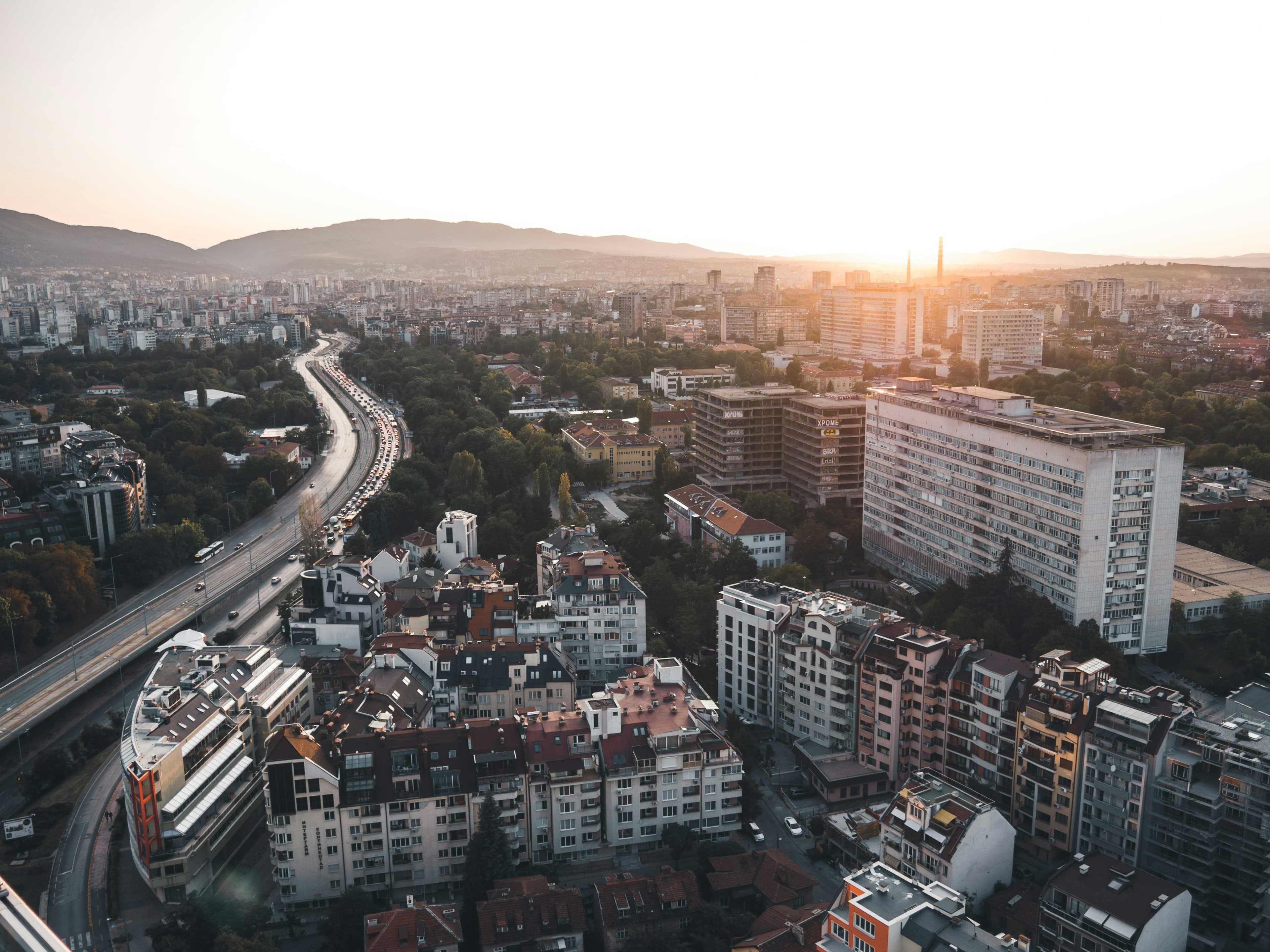
Sofia is one of Europe's oldest cities, settled for some 7,000 years and rebuilt over the Roman Serdica at the foot of Vitosha mountain. It is also a city that, after 1989, handed almost all of its homes to private owners faster and more completely than almost anywhere on the continent. That choice still defines the market today: very high ownership, a thin and largely informal rental sector, and a public stock so small the city is only now writing its first plan to rebuild it.
Read the deeds and the post-1989 sell-off is written across the whole stock. Fully 84% of Sofia households own their home outright, leaving a slim 12% are counted as tenants in the figures. But that tenant slice is mostly not a market: in the Eurostat survey only about 2% of Bulgarians pay market rent, while around 12% live rent-free or at a reduced rent — overwhelmingly in family-owned flats and post-restitution arrangements rather than a true private rental sector. Cooperative housing as a legal tenure is effectively absent — close to 0% of dwellings — because the post-1990 sell-off left no room for it to form, and municipal landlords hold only about 0.7% of the stock, roughly 3,200 flats. Set beside the rest of Europe, this is an ownership society in which even the small 'rental' tier is largely informal and non-market.
In Sofia, social housing is less a tenure than a faint rule stamped on a handful of municipal flats. Only about 1.5% of Sofia's dwellings carry a social-housing rule, a thin targeting layer that sits on top of the small municipal stock rather than forming a tenure of its own. Bulgaria built almost no dedicated social housing after the war, and what survives is owned by the municipality and tightly rent-controlled. Means-tested support is the main instrument, but it reaches only around 8% of residents — a point the country's housing profile in the EU comparative reviews returns to repeatedly.
Climb from the cheapest rents to the dearest and the distance is startling. Tenants in the city's few municipal flats pay around €0.80 per square metre, a heavily subsidised rate. Above them, occupied stock as a whole rents at a median near €3.52; a newly-let apartment asks about €8, the advertised median is closer to €9.29, and a furnished, serviced let reaches roughly €9.50 per square metre gross. The municipal floor is a rounding error in the market: for almost everyone the relevant rungs run from the all-stock median up to a new market contract, and that gap is widening fast.
Net-cold monthly rent per square metre by tier (furnished is gross, all-in). Heavily subsidised municipal rents sit far below the market, but the municipal pool is tiny; for almost everyone the relevant ladder runs from the all-stock median to a newly-let or furnished market contract.
Strangest of all, Sofia is full of locked doors. Bulgaria's 2021 census counted a residential vacancy near 28% in the capital, some 200,761 unoccupied flats — far more than tight demand alone would explain. Strip out the homes that are merely between uses and the city's own working estimate of genuinely empty, usable dwellings is closer to 16% of the stock. The rest is inherited flats, unmodernised units and apartments quietly let off the books, because tenancy law is weakly enforced and many owners prefer untaxed income. Offices are slack too, with around 289,000 square metres vacant, roughly 12.5% of the office stock. Holiday lets barely register beside all this dormant space: entire-place one-bed listings advertise at a median of about €55 a night, clustered in the central core rather than spread across the city.
The problem cannot be solved with municipal resources alone.All those empty flats sit oddly beside a market that will not loosen. Jobs and universities pull people in at roughly 22,000 moves a year, while Sofia signs off only about 4,500 housing permits a year — newcomers chase a supply that barely grows. The strain no longer stops at the bottom of the income scale. Sofia's housing costs run higher relative to income than the rest of Bulgaria, and the city is repeatedly named the country's least affordable, with prices among the fastest-rising in Europe. The poorest fifth of households is hit hardest, yet young Bulgarians on city wages now carry mortgage and rent burdens that pull the middle class in too. Affordability now ranks among the public's leading worries, and those most exposed — the homeless, here around 1,800, and informally-housed Roma families — have almost no formal safety net.
Sofia is the rare European capital where a cooperative-housing deep dive has to begin with an absence. The legal cooperative tenure — kooperatsia in the housing sense — is effectively non-existent here: the catalogue records close to zero cooperative dwellings and no active housing-cooperative federation. There is no Genossenschaftsanteil-style share to buy, no rental-cooperative tradition, none of the limited-equity machinery that defines Vienna or Zurich. To understand Sofia's housing, you first have to understand why the form never arrived.
The answer is the speed of the 1990s transition. Restitution returned pre-socialist property to former owners, and a right-to-buy let sitting tenants take ownership of their flats for token sums. Within a few years roughly 97% of the national stock was privately owned and the public-rental sector had collapsed to a residual few percent, a share that has barely moved since, as the comparative EU housing reviews record. A society that might have built cooperatives instead built individual owners, almost overnight, and never developed the not-for-profit housing framework that cooperatives elsewhere grew inside.
What Sofia has instead is the etazhna sobstvenost — condominium ownership, the system that governs the shared parts of every apartment block. It is collective ownership of a kind, but it is not cooperative housing: each owner holds their own flat outright and votes in the block's general meeting in proportion to their share. The 2009 Condominium Ownership Management Act tried to organise these owners into managed associations. In practice the form is the opposite of a cooperative's pooled strength — fragmented, under-funded, and slow to act, because major repairs need the consent of owners holding at least two-thirds of the building. That threshold is the single biggest reason the panelka blocks are so hard to renovate as a group.
The closest thing to a non-market housing movement is a thin civic layer, not a cooperative one. Habitat for Humanity Bulgaria works on housing poverty and energy-poor homes, framing decent housing as a right rather than a commodity. A handful of Sofia-based studios and collectives — Studio Komplekt among them — have organised community and adaptive-reuse projects that rehearse collective stewardship of space, even where they are cultural rather than residential. The comparative literature on cooperative-housing pioneers in central and south-eastern Europe treats Bulgaria as a near-blank page, and on the evidence of the catalogue it is right.
So any cooperative future for Sofia is something to be built, not described. Sofia's first social-housing plan and the new national strategy both reopen a door that stayed shut for three decades. Whether what comes through it is a genuine cooperative channel, or only municipal building under another name, is the question its politics now has to settle.
Sofia's housing politics is the politics of building a system that the 1990s dismantled. Mayor Vasil Terziev, elected in 2023 on a reform ticket, committed the city in mid-2025 to draw up its first long-term social-housing plan, with technical support from the Council of Europe. It is a frank starting point: the municipality concedes it cannot close the gap alone and is seeking state and European partners. For a city whose social-housing tools amount to a few thousand municipal flats and a means-tested allowance, even a plan is a departure.
Most of the real power, though, sits a tier above the town hall. The city owns its small municipal stock and runs the social-housing plan; the state holds the legal frame and the purse. In April 2026 the Regional Development Ministry announced a new national housing strategy focused on social housing and marginalised settlements, the first such framework in years. Minister Nikolay Naydenov has tied it to the building-renovation effort, calling the targets an obligation rather than a political choice. The housing benefit and the renovation grants alike are disbursed nationally, not by the municipality.
The biggest concrete programme is energy renovation, and it doubles as the country's main housing-investment channel. Bulgaria's buildings-retrofit plan aims to renovate nearly 56 million square metres of residential floor space by 2030, within a stock-wide effort the ministry costs at around €20 billion to 2050. Sofia's huge panelka inheritance is the core of this work. The catch is governance, not money. With only about 9% of dwellings energy-efficient and a renovation rate near 0.4% a year, the two-thirds-consent rule inside each condominium keeps blocks from acting, and energy poverty still touches around 20% of households.
The vacancy and the evictions from §1 are the policy's hardest test. Sofia has no vacant-homes tax and weak tenancy enforcement, so its enormous empty stock stays off the market while people sleep rough. The flashpoint came in April 2025, when the city demolished homes in the Zaharna Fabrika Roma settlement despite an interim ruling from the European Court of Human Rights ordering it not to proceed. Only six families were rehoused. The Council of Europe's human-rights commissioner has since pressed Bulgaria to halt forced evictions and widen Roma access to social housing.
In Sofia the green agenda and the housing agenda have quietly merged into one programme. SofiaPlan, the municipal urban-planning agency, frames a 30-km former-freight-rail loop, the Green Ring, as a long-horizon corridor for retrofitting panelka blocks and reusing rail land — though it is still largely a plan on paper. The European retrofit and adaptive-reuse playbooks the city draws on point the same way: cut the carbon of the existing stock, and treat the renovation budget as the lever. For Sofia that pins the climate target onto the very estates where most of its people live.
After 1989, municipal and state flats are transferred to their tenants and pre-1944 owners are restituted. Within a few years almost all of Bulgaria’s housing is privately owned, leaving the public-rental sector at around 3% nationally.
A dedicated law tries to organise the country’s fragmented apartment ownership into managed associations, but the high consent thresholds for major repairs leave most panelka blocks hard to renovate as a group.
The state launches a fully-grant-funded retrofit scheme for multi-family blocks, the first serious attempt to insulate the panelka stock, though early rounds reach only a fraction of the eligible buildings.
A disused 1981 district-heating plant by the National Palace of Culture reopens as a municipal contemporary-arts centre, after an artist-led campaign begun in 2014 — an early model for civic adaptive reuse in the city.
Sofia demolishes homes in a long-standing Roma settlement despite an interim ruling from the European Court of Human Rights ordering it not to proceed, leaving most residents without alternative shelter.
Sofia commits, with Council of Europe support, to draw up its first long-term social-housing strategy, conceding that the gap cannot be closed with municipal resources alone.
The Regional Development Ministry announces work on a new national housing strategy focused on social housing and marginalised settlements — the country’s first such framework in years.
Bulgaria’s buildings-retrofit plan aims to renovate nearly 56 million square metres of residential floor space, part of a stock-wide programme the ministry costs at around €20 billion to 2050.
SofiaPlan, the municipal urban-planning agency, frames a 30-km former-freight-rail loop as a long-horizon retrofit-and-greening corridor, wrapping panelka blocks and reusing rail land — ambitious, and still largely on paper.
From the post-socialist sell-off and the panelka inheritance to the energy-renovation programme, the first municipal social-housing plan, and the Green Ring horizon.
The argument in Sofia is no longer whether to build a non-market tier, but who it is built for and how fast. Mayor Vasil Terziev frames the social-housing plan as a partnership the city cannot fund alone, casting the gap as a shared state-and-European responsibility. Željko Jovanović, who heads the Roma Foundation for Europe, points to Zaharna Fabrika and argues that secure housing is a legal right and a precondition for taking part in society at all — and that demolitions without rehousing cut people off from it. Both want the tier Sofia does not yet have; what divides them is its pace and who gets through the door first.
Secure housing is not a privilege. It is a legal right — and a prerequisite for economic resilience and democratic participation.Sofia's working examples are not yet cooperatives or social-housing schemes — they are the renovation of what exists and the reuse of what stands empty. The thread that connects them is a city relearning collective stewardship after privatising almost everything. The cases below run from the vast panelka estates that house hundreds of thousands, through a single reborn heating plant, to the handful of actors trying to turn one-off wins into something repeatable.
The panelka estates are the largest demonstrator of all, by sheer scale. Lyulin, Mladost and Druzhba house hundreds of thousands of people in prefabricated concrete blocks raised in the 1960s to 1980s, and roughly two million Bulgarians still live in such buildings. Retrofitting them promises large energy savings at a fraction of the carbon cost of demolition. The friction is structural: most blocks still look as they did decades ago because the fragmented condominium owners cannot reach the two-thirds majority a deep renovation needs, and the grant programmes move slowly through that bottleneck.
Toplocentrala is the clearest sign that empty buildings can become commons. A disused 1981 district-heating plant beside the National Palace of Culture, abandoned for decades, reopened in 2022 as a municipal contemporary-arts centre after an artist-led campaign begun in 2014. It is owned by Sofia Municipality and run through a participatory model with the independent arts scene, and it is part of the same European adaptive-reuse networks that document community-driven regeneration. Its caveat is candour about money: the team acknowledges it still depends on institutional funding and has to court a wider audience to cover its costs.
Habitat for Humanity Bulgaria is the closest thing to a standing non-market housing actor. It works on energy-poor homes and housing poverty, channels volunteer labour and small grants into repairs, and argues for housing as a right rather than a commodity. It has also pushed for better condominium management and accessible home-renovation finance, the missing plumbing that keeps small owners from acting together. Its limits are the limits of the sector around it. It operates at the scale of individual homes and households, not city blocks, because there is no cooperative or social-housing pipeline for it to plug into. It treats the symptoms of the missing tier rather than building the tier itself.
Holding these scattered efforts together is a slim design-and-research scene. Studio Komplekt has organised cultural and community projects in reused space, and Aedes Studio works on architecture and urban research from a Sofia base — both rehearsing, in their different registers, how the city might steward space collectively. International investors have only just begun to look: Sofia entered the main European real-estate outlook survey for the first time this year, ranked low for prospects but newly on the map. It is a thinner institutional layer than Prague's or Warsaw's, and almost everything here is recent. But it is real, and it is being built on the two things Sofia cannot give away — a huge stock of buildings worth saving, and a slowly returning idea that housing is a public question.