The owned city behind the line
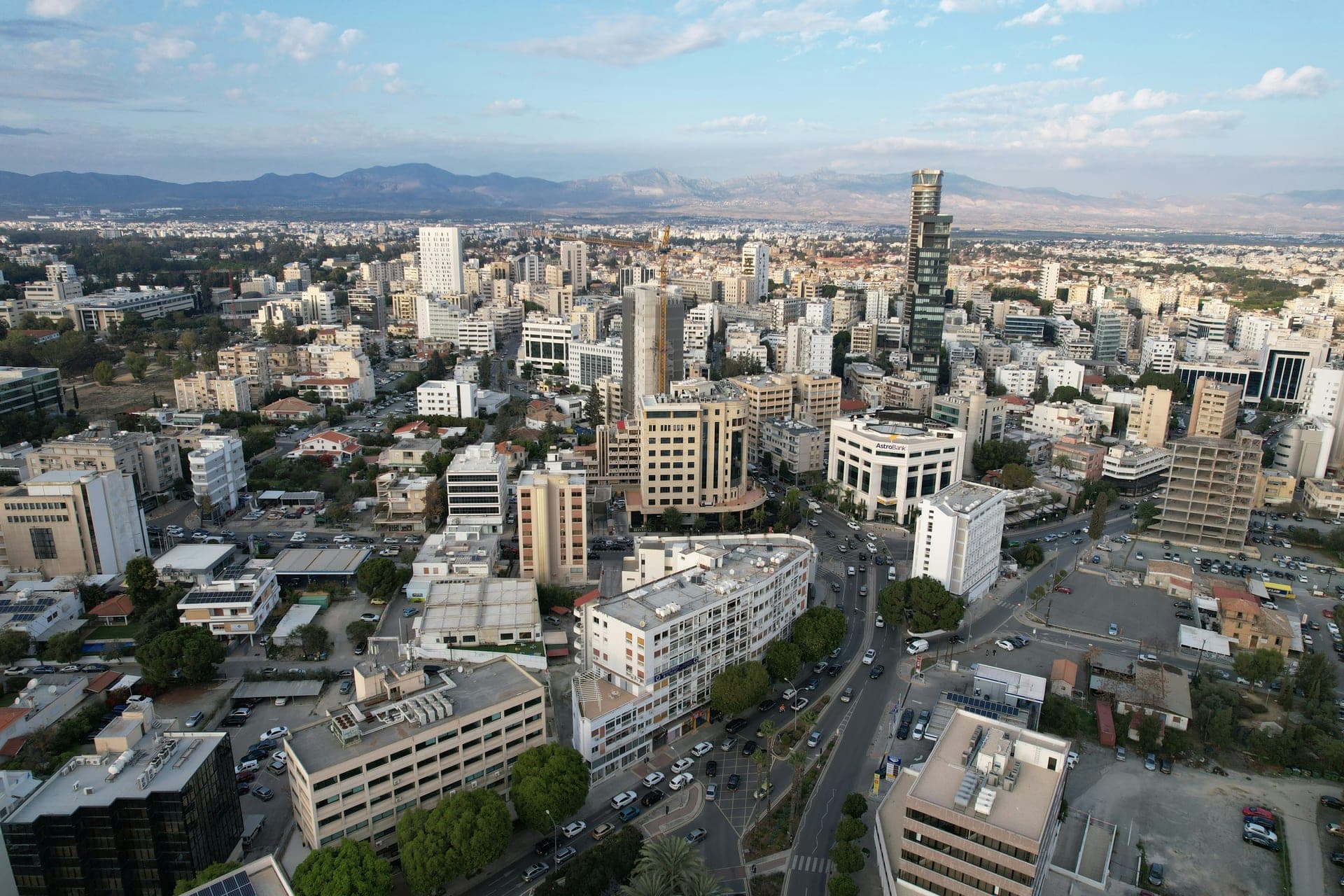
Nicosia is Europe's last divided capital. A United Nations buffer zone has run through its centre since the 1960s, sealed after 1974, leaving a star-shaped Venetian walled city split down the middle. That line shaped the housing map. Residents moved out to the suburbs that ring the old core, and the capital became a city of owners on its edges and emptied streets at its heart.
Ownership runs deeper here than almost anywhere in the union. About 67% of households own their home, and the rental sector is correspondingly slight: only 24% rent, one of the lowest renter shares of any EU capital. There is no housing-cooperative tier at all: the catalogue records 0% of dwellings and no housing cooperatives, because the Cypriot cooperative tradition was built in finance, not in homes. Public landlords hold roughly 6.5% of dwellings, around 8,500 flats run by the state housing body and the refugee-resettlement schemes. Private landlords let the remaining 17.5%, and a small residual sits in non-market arrangements — the homes the 2021 census records as provided free of charge or held under other tenure, a pattern of family and inherited occupation that is large by EU standards on the island.
- Owners
- Owner-occupier67.0%
- Renters
- Public & non-profit rental6.5%
- Cooperative0.00%
- Private rental17.5%
- Other9.0%
- Provided free / other9.0%
What passes for social housing here is a rule written over other tenures, not a slice beside them. Only about 2.5% of Nicosia's dwellings carry a social-housing rule, a means-tested subsidy that sits on top of the small public stock. Cyprus leaned for decades on family ownership and inheritance instead of a social-rental sector. The main support today is the rental subsidy and minimum-income system: roughly 17% of residents qualify for some form of housing assistance. A dedicated affordable-rental tier is only now being assembled.
Stack the rents by tier and the absence of any buffer is plain. Tenants in the city's regulated public flats pay around €4 per square metre, a deeply subsidised floor with no cooperative tier beneath the market. Across the whole stock the typical rent is near €9.50; sign a new lease and the median jumps to €14, while furnished, serviced lets reach €16.50 per square metre gross. The distance from the public floor to a new market contract is more than three to one, and rents are climbing faster here than almost anywhere in the EU.
- Public/municipal housing
- All-stock median
- New contracts
- Furnished / serviced (gross)
Net-cold monthly rent per square metre by tier (furnished is gross, all-in). There is no cooperative tier to anchor the floor; the regulated public rent sits far below the market median, and a newly-let private contract runs more than three times the public rate.
The capital is at once over-supplied and starved. When the last count was taken in 2021, about 17% of homes stood empty, around 9,500 empty buildings, much of it inherited, unmodernised or stranded along the buffer zone where the old town meets the line. Offices are looser too: roughly 88,000 square metres stand vacant, about 8% of the office stock. Yet the rental market itself is desperately tight, with a rental vacancy near 3%. Short-term letting sharpens the squeeze in the centre, where a one-bedroom flat fetches a median €75 a night and, in some inner-city streets, the large majority of units have shifted to short stays — withdrawing exactly the homes a reviving old town needs.
Newcomers keep arriving faster than the cranes can answer. Net inbound migration runs at roughly 5,500 moves a year, with another 6,500 people living in the city on three-to-twelve-month stays, drawn by universities, the relocation of foreign companies and a growing student population. Against that inflow the city issues only about 1,100 housing permits a year. The crisis lands unevenly. Cypriot households still spend the lowest share of disposable income on housing in the EU, around 11% against a 19% average, the legacy of near-universal ownership. But for those outside that inheritance the picture inverts: house prices and rents are rising faster than the EU average, young people leave the parental home at 27, and rent or mortgage arrears now touch 4.6% of the population against 3% EU-wide. The burden has reached the middle class through the front door of new tenancies, and surveys rank housing among the sharpest worries of the young.

A cooperative tradition that never built a flat
Cyprus has a deep cooperative tradition, but it is the wrong kind for housing. The island's synergatismos was a movement of cooperative credit and savings societies, founded in the 1920s by farmers and small traders to escape the loan sharks. It became one of Europe's densest cooperative-banking networks. What it never became was a builder of homes: there is no equivalent here of the Viennese or Zurich rental cooperative, no member-owned housing stock, no limited-equity tenure. The catalogue's reading of no cooperative dwellings is not a gap in the data. It is the fact itself.
The tradition that did exist ended in collapse. Local credit societies adopted full banking practices from the 1980s, lending freely against overvalued property. When the financial crisis hit in 2013, the Cyprus Cooperative Bank carried the highest rate of bad loans on the island. The state injected billions, took ownership, and in 2018 the Central Bank withdrew its licence; the good assets passed to Hellenic Bank, ending 97 years of cooperative finance. The movement that might have seeded a housing-cooperative sector was, instead, absorbed and wound down.
So the present-day cooperative-housing landscape is, in honest terms, nearly empty. There are no traditional housing Genossenschaften, no new-build project cooperatives, no self-organised collectives on the German Mietshäuser-Syndikat model. The actors that do the work a cooperative sector does elsewhere are different in kind: the state, through the Cyprus Land Development Corporation, the public housing and land-development body Cypriots know as KOAG; the municipality, in the old town; and a handful of university-led experiments. Their challenges converge on the same two scarcities a fledgling cooperative would face here — access to affordable land in an ownership market, and finance after the collapse of the very institutions that once pooled it.

That absence reshapes what the politics can even reach for. Elsewhere a cooperative sector is the affordable channel a city chooses to widen; in Nicosia there is no such actor to widen, so one has to be invented before it can be steered. The RE-DWELL research network has run urban living labs in two Nicosia neighbourhoods, testing how municipalities, citizens and bodies like KOAG might co-design affordable, sustainable housing where no cooperative middle layer exists. International work on how to promote cooperative housing reads, from a Cypriot vantage, less as a menu than as a founding manual. The question the politics now turns on is whether the state can build the tier the market and the cooperative banks never did.
Building the tier the island never had
Nicosia's housing politics is the politics of building a non-market tier from almost nothing. The national government holds the main levers, and Interior Minister Constantinos Ioannou has bundled them into a single housing strategy. It runs three tracks at once: one-off grants of €20,000 to €50,000 for up to 400 young couples and individuals under 41; the Renovate-Rent scheme, which pays owners of idle homes €15,000 to €35,000 to refurbish and let at 30% below market for four years; and the construction of roughly 500 affordable homes on state-owned land across four cities, a €77 million programme.
Three tiers of government each hold a different piece, with the city hall nearest the street. The national ministry sets the law and the money; the executive arm is the Cyprus Land Development Corporation, which builds and lets the state's affordable stock. The municipality, under Mayor Charalambos Prountzos, runs the old-town regeneration the others cannot. KOAG's first Nicosia block, 54 affordable-rent apartments in Strovolos, is moving on €12 million of public funding, part of around 247 units it aims to deliver across the island in 2026.
With no cooperative sector to fund, the state improvises its own non-market instruments. Build-to-Rent offers developers higher building ratios in exchange for letting at reduced rates. Renovate-Rent pulls idle private stock into a four-year affordability covenant. Both try to manufacture the long-term affordable tenancy a cooperative tradition would otherwise supply. The Ministry of Interior's housing department stitches the instruments together, and the recurring criticism is that they remain a patchwork rather than a system.

Those empty shells around the old town now have a remedy aimed squarely at them. The EU-funded Regeneration and Revitalization of Nicosia Inner City, with a total EU contribution of about €17.77 million, buys and renovates buildings near the buffer zone to deliver at least 310 student dormitories. The logic is to refill the emptied core with residents. The friction is real: a €300 monthly rent cap on the student units left part of an earlier €25 million envelope unspent, because investors found the numbers too tight.
- 1974[source]
Partition freezes the centre
The buffer zone that already split Nicosia hardens into a sealed line after the events of 1974, leaving the historic core emptied along its edges and shaping the housing geography of the capital for half a century.
- 1989[source]
Nicosia Master Plan
The two municipalities begin a rare cross-line collaboration to restore the walled city together, an early bi-communal effort to bring residents back to the historic centre.
- 2013[source]
Banking crisis and bail-in
A deposit bail-in and the start of the cooperative-banking collapse reshape Cypriot finance; the cooperative credit movement, founded in the 1920s, begins its terminal decline.
- 2018[source]
Cyprus Cooperative Bank wound down
The Central Bank withdraws the Cyprus Cooperative Bank's licence and its good assets pass to Hellenic Bank, ending 97 years of the island's cooperative-finance tradition.
- 2023[source]
Unified housing policy
The Ministry of Interior announces a single housing framework bundling first-home grants, the Renovate-Rent scheme and affordable-housing construction on state land.
- Nov 2024[source]
Renovate-Rent + young-buyer grants open
Owners of idle homes can claim grants to renovate and let at 30% below market for four years; up to 400 young couples and individuals under 41 receive one-off grants of €20,000-€50,000.
- 2026[source]
KOAG affordable-rent build
The Cyprus Land Development Corporation sets a 54-apartment affordable-rent block in Strovolos in motion with €12 million, part of roughly 247 units it aims to deliver across the island in 2026.
- Mid-2026[source]
Inner-city regeneration target
The EU-funded regeneration of Nicosia’s inner city aims to deliver at least 310 student dormitories and renovate Ledra and Onasagorou streets, with a total EU contribution of about €17.77 million.
- ~2030[source]
Affordable homes on state land
The government plans roughly 500 affordable homes on state-owned land across Nicosia, Limassol, Larnaca and Paphos, a €77 million programme that is the first sustained attempt to build a non-market tier.
From the partition that froze the old town to the cooperative-banking collapse, the unified housing strategy and the EU-funded regeneration of the inner city.
Sustainability is the quiet weakness in the plan. Nicosia's housing stock averages around 38 years old, only about 12% of dwellings are energy-efficient, and the renovation rate crawls at roughly 0.5% a year — far short of the EU's deep-retrofit goals, and a problem in a city where energy poverty touches close to 18% of residents through hot summers. Cyprus is one of two EU countries where house prices barely moved between 2010 and 2024, which long masked the retrofit deficit; the climate case for treating regeneration and energy upgrading as one task is only now entering the housing conversation.
Few in the chamber dispute that the state must act; they split on how big the response should be. Mayor Charalambos Prountzos frames the recovery of the centre around residents, arguing that bringing back population is an overriding objective for the old town. The opposition reads the national tools as too small for the problem. Andreas Kafkalias, a member of parliament for AKEL, argued that if the government thinks two incentive bills solve affordable housing, it has not grasped the scope of the issue. Across the spectrum, professional bodies and parties are now calling for a single housing authority to gather data and set a ten-to-twenty-year strategy, an idea that gathers support each year.
If the government thinks that these two bills solve the problem of affordable housing, it confirms they have not grasped the scope of the issue.Refilling the core: state blocks, student halls and living labs
Nicosia's working examples are not cooperatives — there are none to point to. They are the substitutes a city assembles when the market and the cooperative banks have left a gap: a state developer, a municipal regeneration, and a clutch of university-led experiments. Taken in turn — from the fully public to the frankly experimental — they show both what Nicosia can already do and how slender the institutions are that would make any of it repeatable.
The Strovolos affordable-rent block is the clearest sign of the new state ambition. Built by the Cyprus Land Development Corporation, it brings 54 rental flats on €12 million of state funding, part of a wave KOAG is rolling out across Kokkinotrimithia, Lakatamia, Agios Dometios, Kaimakli and Pallouriotissa. Its caveat is structural rather than local: the corporation is being asked to stand in for an entire missing tenure, and 247 units a year island-wide is modest against a tightening rental market. KOAG, as its own chair puts it, is the executive branch of the state's housing policy — which means the policy is only ever as ambitious as the corporation is resourced to be.
The Regeneration of Nicosia Inner City is the boldest bet on the divided core. Funded with about €17.77 million from the EU recovery facility and run by the municipality, it buys and renovates buildings near the buffer zone to deliver at least 310 student dormitories, with the medical school of the University of Athens already housing students near Ledra Street. The friction is candid. A €300 rent cap kept private investors away from part of the scheme, and a long-time resident has warned that turning the old town into student housing risks trading one kind of emptiness for noise and transience rather than rooted community.
The RE-DWELL urban living labs are the most experimental thread, and the closest thing Nicosia has to a cooperative-style practice. Across two city neighbourhoods, researchers worked with the municipality, residents and the Cyprus Land Development Corporation to co-design sustainable, affordable neighbourhoods, testing a participatory toolbox alongside parallel pilots in Lisbon and London. The work is documented as a serious method, not a one-off, but it remains a research exercise: its findings have yet to harden into a delivery body or a funding line of their own.
Hold these projects up and what shows through is how few hands steer them. Housing policy is currently split across the Ministry of Interior's housing department, KOAG, the planning service and the welfare office, with no single body forecasting need or setting long-term strategy — which is why professional chambers and opposition parties keep pressing for a unified housing authority. The comparative evidence frames the problem precisely: a study of Cyprus in a Europe-wide review of housing policy, the FEANTSA overview that ranks Nicosia's affordability against Berlin, Vienna and Brussels, and analyses of how financialisation hollows out affordable supply all read, here, as warnings about what happens when the public tier is built late. The foundation Nicosia has is not a cooperative memory. It is a divided centre full of empty shells, and a young population with nowhere affordable to live in it.
References
Statistics15Click on any number to see the source
Housing market
Tenure & affordability
Cooperative, social & public
Adaptive reuse & vacancy
Population & migration
From our library9
- Youth access to affordable and quality housing: A comparative analysis of national policies — Knowledge
- Cyprus Land Development Corporation (CLDC / KOAG) — Organisation
- Transdisciplinarity for Affordable and Sustainable Housing — Knowledge
- International policies to promote cooperative housing — Knowledge
- Cyprus Ministry of Interior — Housing Policy Department — Organisation
- Building Prosperity: unlocking the potential of a nature-positive, circular economy for Europe — Knowledge
- Housing Policies in the EU — Knowledge
- Tenth Overview of Housing Exclusion in Europe — Knowledge
- Housing policy under the conditions of financialisation - The impact of institutional investors on affordable housing in European Cities — Knowledge
Further sources13
- United Nations Buffer Zone in Cyprus — Wikipedia
- Two new affordable-rent projects set in motion in 2026 by KOAG — CBN Cyprus
- Housing Scheme — Renovate-Rent — Cyprus Ministry of Interior
- Housing Subsidy Scheme for young couples / individuals up to 41 — Cyprus Ministry of Interior
- Government unveils subsidies, grants for first-time buyers and affordable rentals — Cyprus Mail
- Regeneration and Revitalization of Nicosia Inner City — European Commission
- Can students bring Nicosia's old town back to life? — Cyprus Mail
- Mixed reaction to government's housing shortage fix — Cyprus Mail
- Calls for unified housing authority grow — Cyprus Property News
- Cyprus house prices and rents outpace EU average — Cyprus Mail
- The slow death of the Cyprus Co-op Bank — Co-operative News
- Cyprus Cooperative Bank closes as licence withdrawn — Xinhua
- Walls of Nicosia — Wikipedia
·