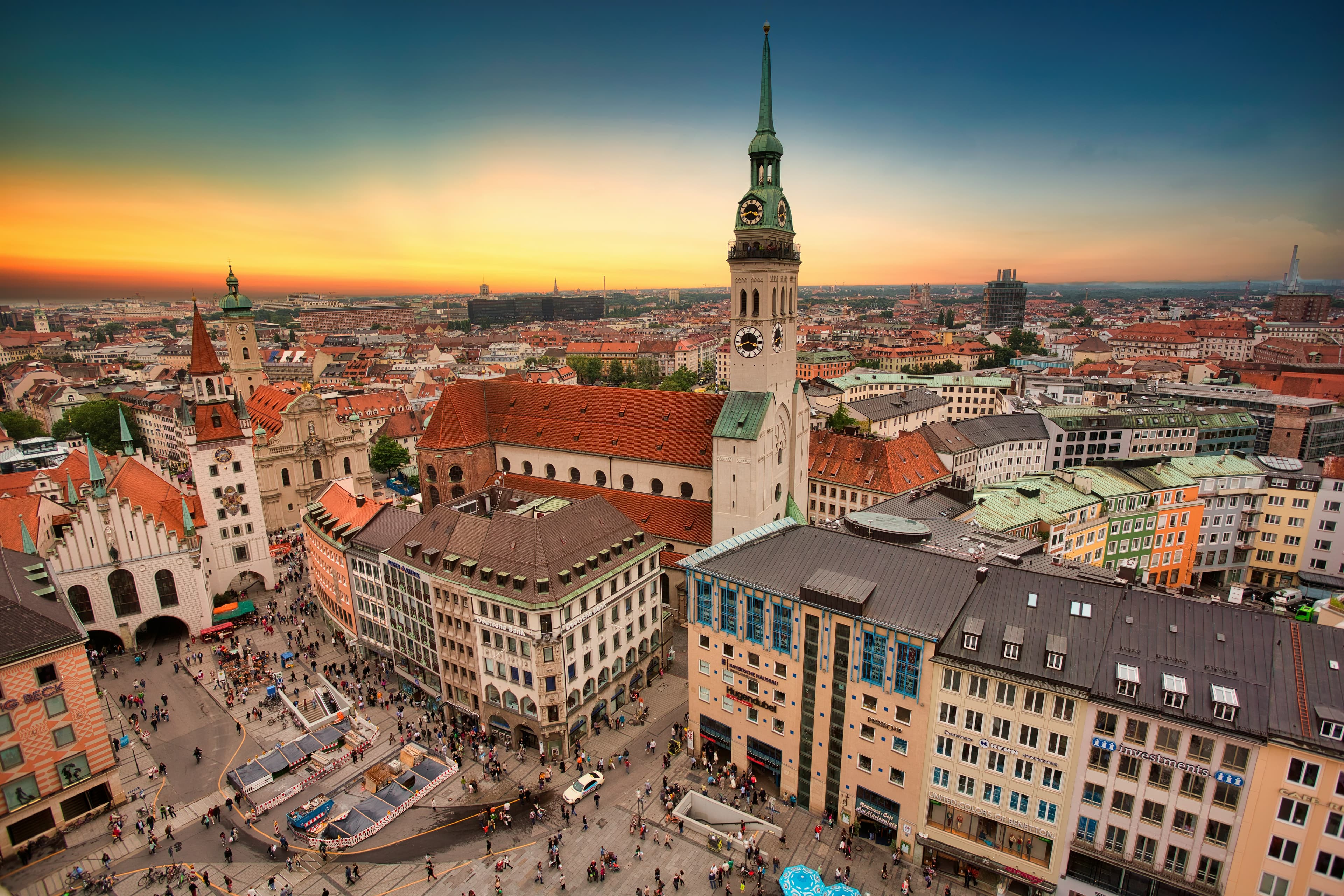
The city that stopped selling its land
Munich is Germany's wealthiest large city, the home of carmakers and insurers, and the most densely settled municipality in the country. It is also the place where renting is most expensive and where the gap between what people earn and what a flat costs is widest. Three decades ago the city made a quiet decision that still shapes everything: it would stop selling its land outright, and tie new building to a share of affordable homes. That choice is the spine of the story below.
Who owns and who rents sets up everything that follows. About 73.3% of Munich households rent and only 24% own — one of the lowest ownership rates of any German city. Cooperatives hold around 4% of dwellings, roughly 33,000 homes across about 60 housing cooperatives, and house some 4.2% of residents. Münchner Wohnen, the municipal landlord, holds about 8.7% of dwellings, around 71,000 flats. The remaining 60.6% is private rental, the tenure that sets the price most newcomers actually pay. The cooperative and municipal homes together — the non-market tier, about 12.7% of stock — are small for a city this size, which is why every percentage point is fought over.
- Owners
- Owner-occupier24.0%
- Renters
- Public & non-profit rental8.7%
- Cooperative4.0%
- Private rental60.6%
- Unclassified2.7%
- Unknown / Other2.7%
Social housing is a separate idea from any of those tenures. It is a regulatory layer — a covenant capping rents and reserving flats for eligible households — that sits on top of the tenure pie rather than forming a slice of its own. About 5.2% of Munich's dwellings carry such a covenant, far fewer than the homes that would qualify: the city reckons roughly half of all households are income-eligible for a subsidised flat. The covenant rides on municipal stock, on price-bound private new-build, and on some cooperative homes alike. The thinness of that layer against the need is the affordability problem stated plainly.
Put the rents side by side and the value of a non-market tenancy becomes concrete. Members of older cooperatives pay around €6.69 per square metre, net cold, and tenants in Münchner Wohnen's flats about €9.50. By contrast the all-stock median sits near €15.35, the highest of any large German city, a newly-let private contract asks a median €23.35, and furnished, serviced lets reach €33.35 per square metre gross. From the cooperative floor to a fresh market contract the jump is more than three to one. That single ratio is why a cooperative or municipal flat in Munich is less a discount than a different world.
- Cooperative
- Public/municipal housing
- All-stock median
- New contracts
- Furnished / serviced (gross)
Net-cold monthly rent per square metre by tier (furnished is gross, all-in). The old cooperative floor sits far below the market median; a newly-let private contract runs more than three times the cooperative rate — the steepest mainstream rent ladder of any large German city.
Where some cities can blame idle stock, Munich largely cannot. Residential vacancy is only about 2.7%, roughly 22,403 unoccupied flats, much of it churn and renovation rather than genuine slack. The slack instead sits in the workplace: around 1.58 million square metres of offices stand vacant, about 6.4% of the office stock, a frontier the new administration wants to convert. Holiday letting drains comparatively few homes overall — full-time entire-home short-term rentals are estimated at 1,214 dwellings — yet the bite is local, concentrated in the central districts and the Glockenbachviertel, and that figure is an Airbnb-only floor that misses other platforms.
Inflow and output pull in opposite directions. Jobs, two large universities and the wider Bavarian economy draw a net 110,000 moves a year into the city, yet Munich issues only about 6,500 housing permits a year to absorb them. The shortfall no longer bites at the bottom alone. Munich is the most expensive of the European cities the European Commission flags for extreme city-level price premiums, and tight markets here have pushed families out to the surrounding districts in search of room. Around 9,000 people are counted as homeless and about 2,200 eviction cases pass through the courts each year, the hard edge of a crisis that the wider public now ranks among its first concerns.
We must finally penalise rent-gouging. We need a legally watertight right of first refusal, a cap on index-linked rents, and a tougher rent brake.The Genossenschaft, rediscovered
The German cooperative is the Genossenschaft, and in Munich it is overwhelmingly a rental form. A member buys a Genossenschaftsanteil — a share that secures the right to rent a flat for life at a rent set to cover costs, not to turn a profit. The member does not own the flat and cannot sell it for a capital gain. That asset lock is the whole point: it keeps the home off the speculative market across generations, which is why a cooperative rent in Munich can sit at less than half the market rate.
The tradition runs deep but came in two waves. The first cooperatives were founded around 1900 to house railway and factory workers, and the large legacy societies still own substantial estates across the city. After decades of quiet, a second wave arrived around 2000, led by WOGENO and then wagnis eG, founded by residents who wanted to build participatory, ecological housing rather than wait for a flat. This new generation reconnected the cooperative idea to the city's land policy, and turned the Genossenschaft from a heritage form into a live instrument of housing supply.
Today the sector clusters into three groups facing different problems. The century-old societies own the most homes but have largely closed their waiting lists, so their stock barely circulates — a Munich flat-hunter can wait years for a vacancy that may never come. The participatory project cooperatives, WOGENO, wagnis eG, KOOPERATIVE GROSSSTADT and Progeno among them, build the celebrated new schemes but compete for scarce city land and patient finance. A third, thinner layer of self-organised and steward-ownership initiatives experiments with collective models that a comparison of German shared-housing forms traces in detail. All three share one constraint: land in Munich has become so dear that building anything new without the city's help is close to impossible.
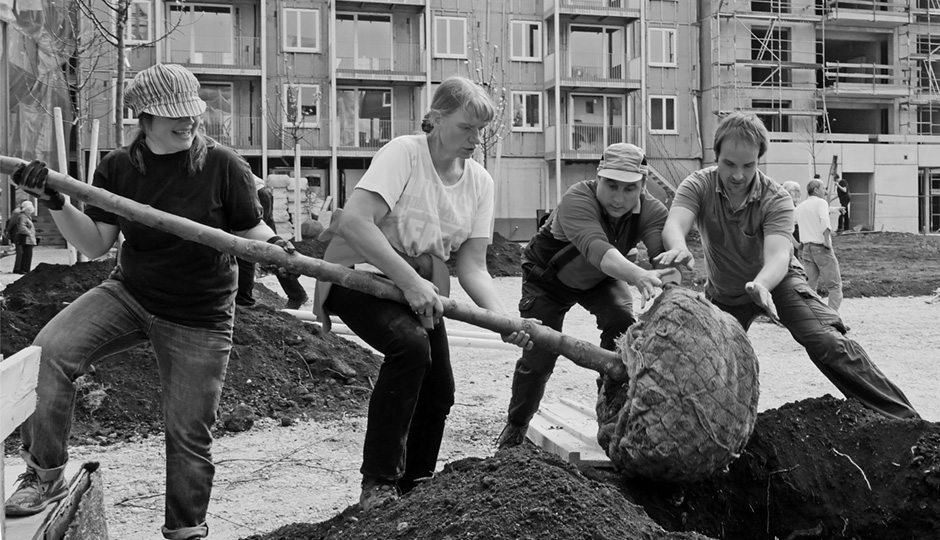
What turns this history into present-day policy is the way Munich casts the cooperative. The city treats it as a deliberate channel for permanently affordable housing, not a private leftover. It reserves a share of its own land for cooperatives and joint building groups, grants it on long ground leases rather than selling it, and scores the tenders on concept rather than price. A study of Dutch demand for housing cooperatives notes that Munich already makes 20 to 40% of its own land available to cooperatives at reduced prices precisely because they guarantee lasting affordability. That land bargain is the subject the city's housing programme turns on.
A new mayor, an old land bargain
Munich's housing politics turned a corner in 2026. Dominik Krause of the Greens became Oberbürgermeister on 1 May, the city's first Green mayor, after defeating the long-serving Social Democrat Dieter Reiter and campaigning on housing as the central social question of the coming years. His 10-point plan sets a path to about 50,000 additional homes — 20,000 in the northern development areas, around 10,000 from converting empty offices, and at least 20,000 through rooftop additions and infill. The city points to the largest municipal housing programme in Germany, worth €2 billion, and to roughly 76,000 homes built over the past decade.
Control over housing is split three ways in Munich's case. The federal government writes tenancy law and the rent brake, the Mietpreisbremse, which caps the rent on a new contract at a margin above the local Mietspiegel reference table. Bavaria enforces it and runs the state subsidy lines. The city itself holds the land, the municipal landlord and the local rules. Krause's most distinctive municipal move is a digital Mietwucher-Melder, a rent-gouging detector that scans listings portals and warns landlords whose asking rents breach the legal limit, with a contact point in the mayor's office to advise tenants and pursue serious cases.
The cooperative sits deliberately inside this programme. Munich's land policy, Sozialgerechte Bodennutzung — Socially Just Land Use, the rule that makes landowners fund affordable homes and infrastructure when zoning lifts their land value — splits city development land into shares for social housing, for concept-led rental building, and for joint building groups. The city grants the plots on Erbbaurecht, a long ground lease that keeps the land public, and scores the tenders on quality. A UNECE survey of effective housing policies singles out Munich's land model, noting binding periods that now run up to 80 years and rents in the conceptual tier capped well below the market.
- 1994[source]
Socially Just Land Use adopted
Munich introduces Sozialgerechte Bodennutzung, requiring landowners who benefit from new zoning to fund a share of affordable housing and public infrastructure — the policy that still shapes every large development.
- 2000[source]
WOGENO and wagnis lead a cooperative revival
A new wave of project cooperatives — WOGENO (founded 1993) and wagnis eG (2000) among them — begins winning city land to build participatory, community-led housing after decades of cooperative dormancy.
- 2017[source]
Prinz Eugen Park timber settlement
The city completes Europe’s largest contiguous timber housing settlement on a former barracks — 566 timber homes across eight plots, backed by €13.6m in municipal timber-construction subsidy.
- 2016[source]
wagnisART wins the German Urban Design Award
wagnis eG’s five interlinked buildings in Domagkpark, designed through an intensive residents’ participation process, become the most-cited proof that the cooperative form can scale in Munich.
- 2022[source]
"Wohnen in München VII" adopted
The city council adopts its seventh housing action programme, aiming for roughly 8,500 completions a year including over 2,000 price-bound homes, then repeatedly adjusts it as building and financing costs rise.
- 2023[source]
Land granted only on ground lease
Faced with land prices it can no longer afford to sell, the city shifts to granting municipal plots almost exclusively on Erbbaurecht — long ground leases that keep the land in public hands.
- Mar 2026[source]
Munich elects its first Green mayor
Dominik Krause (Greens) defeats incumbent Dieter Reiter (SPD) in the runoff with 56.4% of the vote, campaigning on housing as the city’s central social question.
- May 2026[source]
Krause takes office; rent-gouging detector launched
Krause is sworn in on 1 May and moves to set up a digital Mietwucher-Melder that scans listings portals and warns landlords whose asking rents breach the legal limit.
- 2035[source]
~50,000 new homes targeted
Krause’s 10-point plan sets a path to about 50,000 additional homes — 20,000 in the northern development areas, around 10,000 from office-to-residential conversion, and at least 20,000 through rooftop additions and infill.
From the founding of the Socially Just Land Use rules and the post-2000 cooperative wave to the first Green mayor and a €2bn building programme.
The vacant offices flagged earlier are where the supply plan now looks first. The city's large stock of empty office floor is the conversion frontier the new administration is staking part of its housing target on, and a study of Europe's obsolescent office stock finds that while most outdated offices cannot easily become homes, the share that can is worth pursuing. The bigger near-term supply comes from the development areas: the former Bayernkaserne in Neufreimann alone is planned for around 5,500 homes for up to 15,000 people. There is no vacant-homes tax, and Munich also restricts Zweckentfremdung — the misuse of homes as holiday lets — in protected districts.
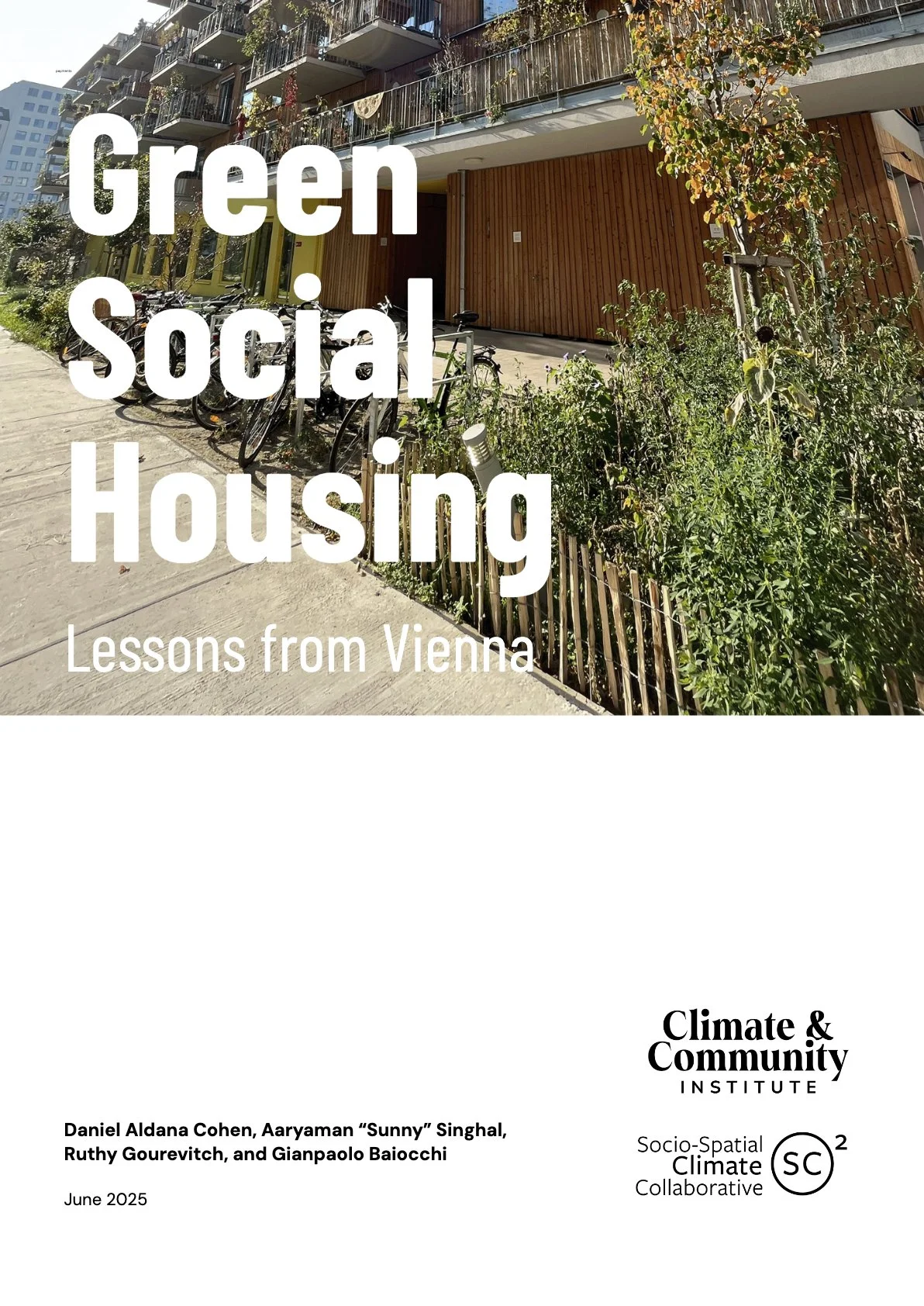
Decarbonising the stock and keeping it affordable have become one problem in Munich. The city's housing stock averages around 50 years old, only about 19% of dwellings count as energy-efficient, and the renovation rate crawls at roughly 1% a year — far short of the deep-retrofit pace the climate targets need. The city's timber pilots and the cooperatives' low-carbon new-build are the main vehicles for cutting the sector's emissions, which ties the climate goal directly to the non-market tier the city is trying to grow. A study of Vienna's social housing shows how the non-market stock can be the platform for that retrofit rather than a drag on it.
In Munich the argument is over the instrument, not the diagnosis. Beatrix Zurek, who chairs the Munich tenants' association, presses for tougher legal tools — a watertight municipal right of first refusal, a cap on index-linked rents, and a stricter rent brake. Georg Hopfensperger, deputy chairman of the landlords' association Haus + Grund München, calls the rent-gouging detector pure populism and hopes the new mayor will show more restraint. Neither disputes that Munich's rents are the country's steepest; what divides them is whether the cure is sharper enforcement or faster building.
What the Left is doing here is pure populism, and ultimately it harms tenants too. It remains to be hoped that the new mayor, Dominik Krause, shows more sense of proportion in his plans.Built on borrowed land: Munich’s cooperative quarters
Munich's working examples cluster on the big former-barracks and industrial sites the city has opened for new quarters, and the thread that connects them is the land bargain: cooperatives and municipal builders win plots on concept tenders and ground leases, then build the experiments the open market would not. The examples below run from the largest mixed quarter down to the smallest self-built house, and close with the actors trying to make the model repeatable.
DomagkPark is the clearest picture of the model at quarter scale. Built on a former barracks in Schwabing, it brings around 1,800 apartments and 4,000 residents, with a strong resident-participation process and a mix of municipal, cooperative and private builders side by side. Its caveat is the one that shadows every Munich scheme: even on city land with concept tenders, the new flats let at prices that only the subsidised and cooperative share keeps genuinely affordable, and demand for those homes far outruns supply.
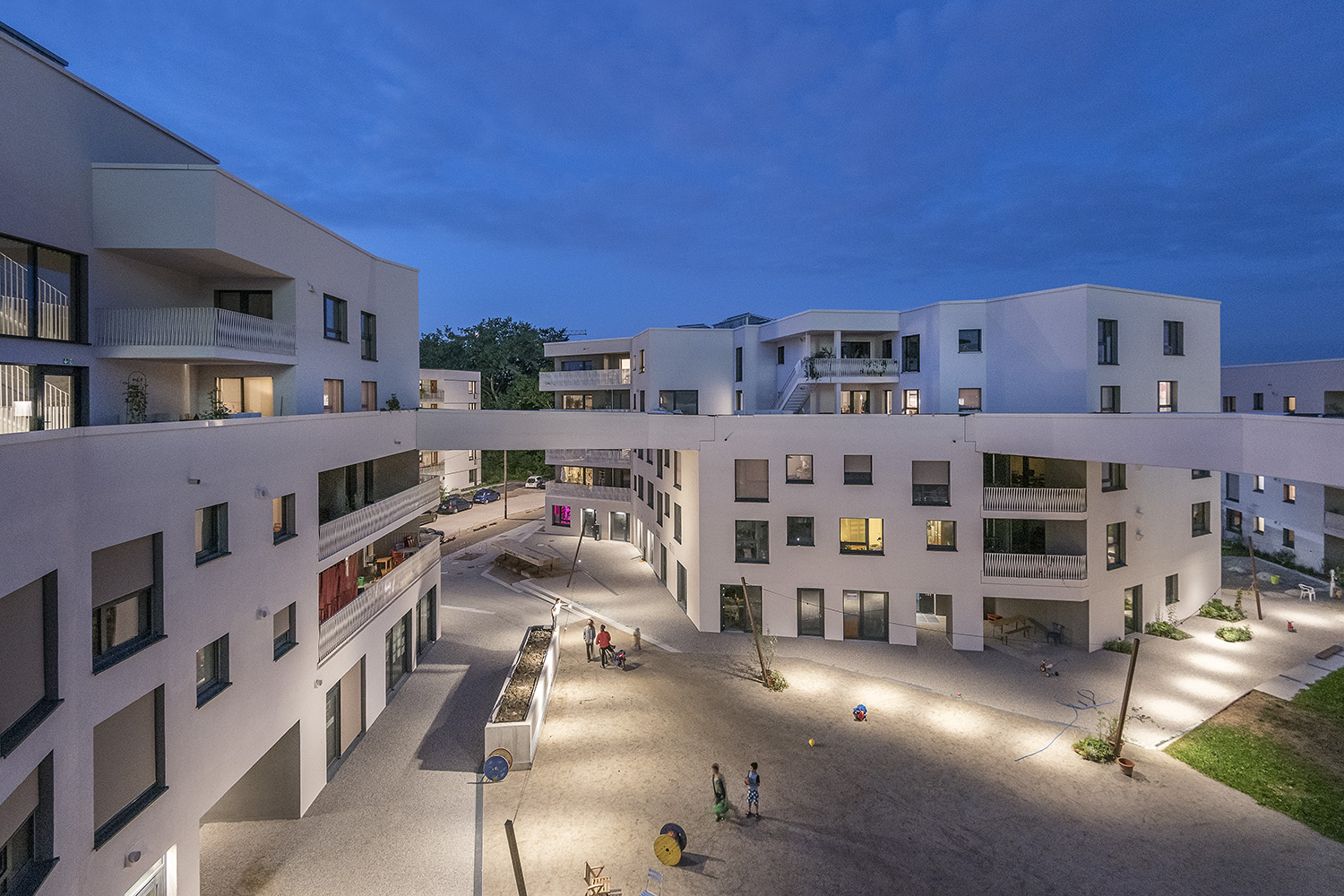
wagnisART, within that quarter, is the project most often invoked as proof the cooperative form can scale. wagnis eG's five interlinked buildings, joined by roof-garden bridges and shaped through an intensive residents' design process, won the German Urban Design Award and run on passive-house standards and rooftop solar. The friction is in the queue behind it: the cooperative's flats are so sought-after, and its membership so committed, that joining the waiting list is no guarantee of a home — the success has made the scarcity sharper, not softer.
Prinz Eugen Park is Munich's bet on building low-carbon at scale. The city turned another former barracks into Europe's largest contiguous timber housing settlement — 566 homes across eight plots, all in timber or timber-hybrid construction, backed by €13.6 million in municipal subsidy for the higher upfront cost. The honesty in the story is the subsidy itself: timber still costs more to build than concrete, so the demonstrator only pencilled because the city paid the premium, and scaling it depends on whether that premium falls.
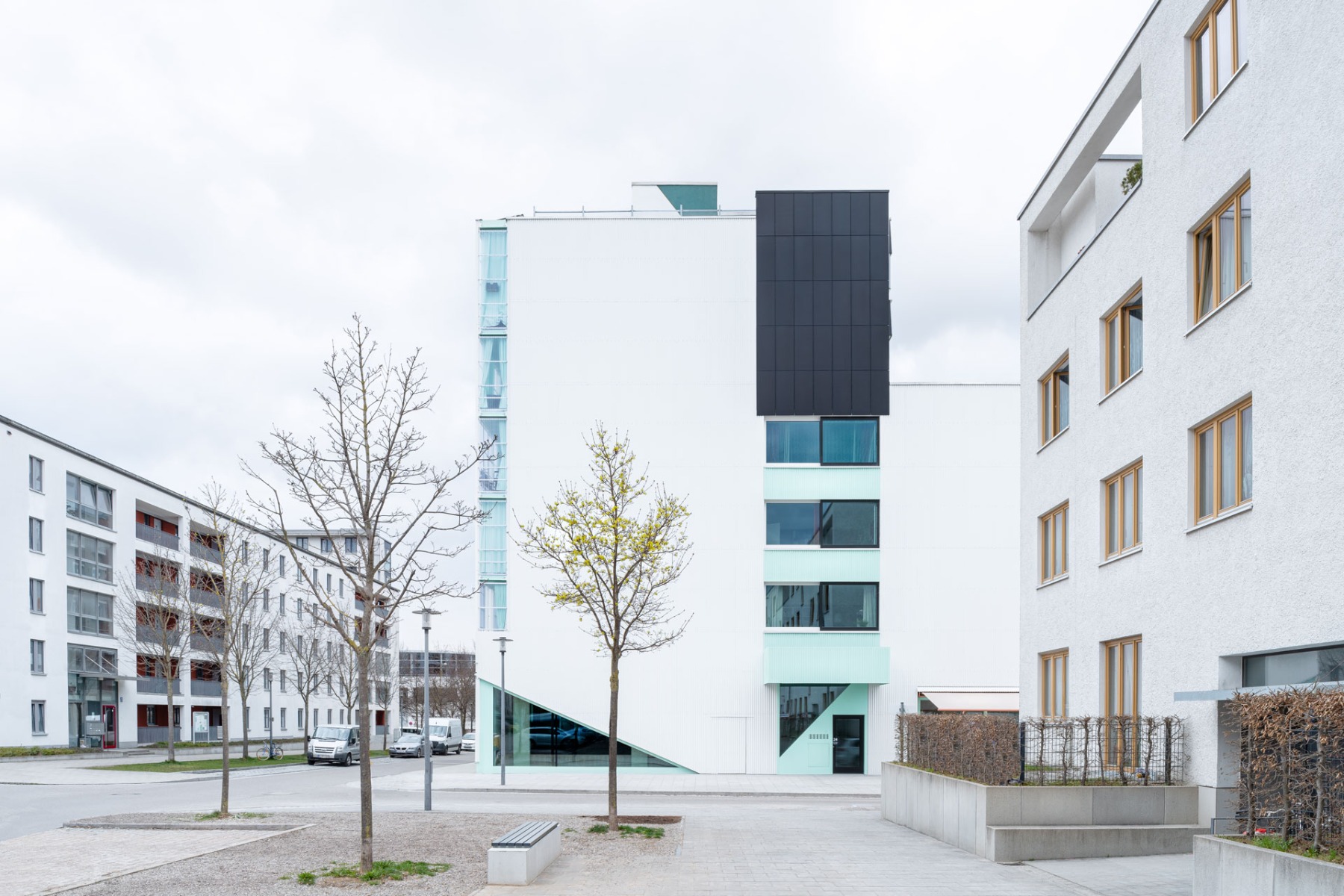
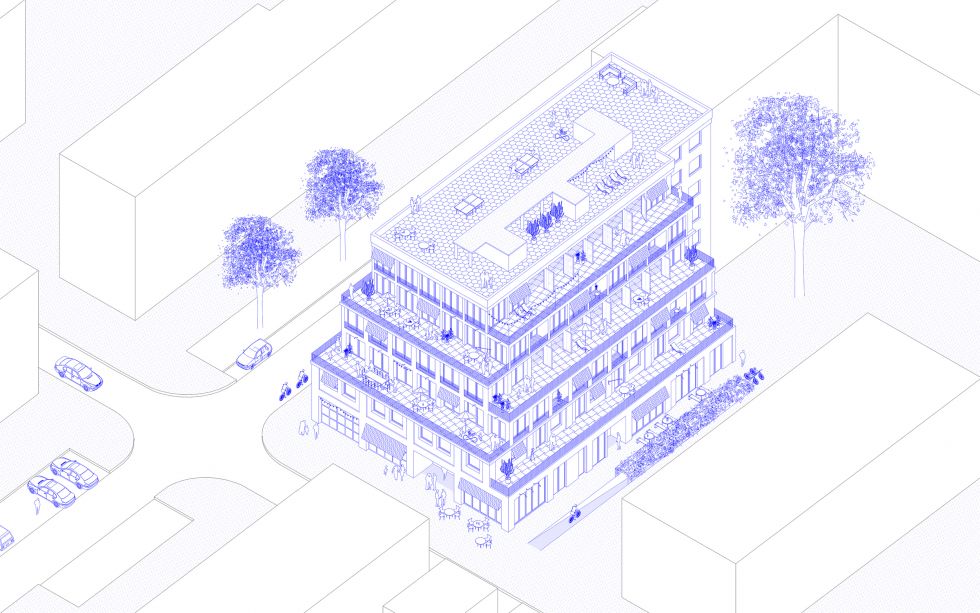
San Riemo and the Wabenhaus show the form at building scale, where the experiments get sharpest. San Riemo, a KOOPERATIVE GROSSSTADT project in Messestadt Riem, packs 27 adaptable flats into a three-aisle structure with a rooftop garden and a residents' café, testing how far floor plans can flex over a household's life. The Wabenhaus fits 22 homes into hexagonal modules with built-in furniture. Both trade private floor space for shared rooms — a deliberate sufficiency bet that asks residents to accept smaller flats in return for more common space, which suits some households and not others.
None of these quarters would stand without a small scaffolding of supporting institutions. GIMA München eG, a cooperative land agency, assembles and holds plots so smaller cooperatives can build on them, and Stattbau München advises the joint building groups through the city's concept tenders, the kind of community-finance and stewardship work that a study of civic-space economics examines. GWG München, the municipal housing company now folded into Münchner Wohnen, supplies the public stock the cooperative tier complements. It is a denser support network than most German cities can show. But all of it rests on one scarce input the city cannot manufacture — land — and on a political will to keep granting it on lease rather than selling it to the highest bidder.
References
Statistics20Click on any number to see the source
Housing market
Tenure & affordability
Cooperative, social & public
Adaptive reuse & vacancy
Population & migration
From our library19
- Understanding the housing crisis: Staff Working Document accompanying the European Affordable Housing Plan — Knowledge
- Part 1: Mapping the housing needs in the EU, assessing the impacts of scarcity and providing an overview of relevant EU legislation — Knowledge
- wagnis eG — Organisation
- Lessons from Germany's Shared Housing Models: Expanding Ownership Opportunities and Improving the Built Environment — Knowledge
- The demand for housing cooperatives in the Netherlands — Knowledge
- #Housing2030 Effective policies for affordable housing in the UNECE region — Knowledge
- Rethinking European Offices 2030 - Risks and Opportunities from Obsolesence — Knowledge
- Green Social Housing - Lessons from Vienna — Knowledge
- DomagkPark — Project
- wagnisART — Project
- Prinz Eugen Park — Project
- San Riemo — Project
- Wabenhaus — Project
- KOOPERATIVE GROSSSTADT eG — Organisation
- Designing Sustainable Urban Futures - Concepts and Practices from Different Countries — Knowledge
- GIMA München eG — Organisation
- Stattbau München — Organisation
- Funding the Cooperative City: Community Finance and the Economy of Civic Spaces — Knowledge
- GWG München (GWG Städtische Wohnungsgesellschaft München mbH) — Organisation
Further sources12
- Antrittsrede von OB Dominik Krause — Landeshauptstadt München
- Dominik Krause — 10-point plan for Munich — Dominik Krause
- New mayor Krause: plans on rents and administration — t-online München
- Dominik Krause — biography — Wikipedia
- Sozialgerechte Bodennutzung (SoBoN) — FAQ — Landeshauptstadt München
- Wohnen in München — housing policy — Landeshauptstadt München
- Neufreimann / Bayernkaserne — new quarter — Neubauprojekte München
- Beatrix Zurek — demands protection for tenants — Mieterverein München
- Georg Hopfensperger — 'Die Mär vom Mietwucher' — Haus + Grund München
- Prinz Eugen Park — timber settlement — DETAIL
- wagnisART wins the German Urban Design Award (2016) — Topos Magazine
- Munich — city facts (density, geography) — Wikipedia