
The densest social stock, the steepest rents
Paris packs more than 2.0 million people inside the ring road, on a footprint smaller than most European capitals. The crowding is the oldest fact about its housing: Haussmann rebuilt the centre in the 1850s, and the city has been squeezing more residents into the same stone ever since. Two figures define it today. Paris holds the densest social-housing stock of any large French city, and yet its open-market rents are among the highest in Europe.
Tenure in Paris runs the opposite way to France at large: renting is the norm, not ownership. Some 61.9% of households here rent and just 33.4% own. Within the rental side, the city and its social landlords run a large public stock: 19.4% of all dwellings, some 271,906 logements sociaux, the legacy of two decades of deliberate expansion. The resident cooperative, by contrast, barely exists here: about 100 homes across 8 projects, a tiny fraction of the stock, because France's cooperative tenure was dormant in law for forty years. Private landlords let the remaining 42.5%, the largest single tenure and the one where the squeeze bites hardest. Owners and renters do not quite account for everyone: a further 4.7% are logés gratuitement — housed rent-free, typically in employer-provided or family-owned homes — the residual INSEE counts outside both ownership and tenancy.
- Owners
- Owner-occupier33.4%
- Renters
- Public & non-profit rental19.4%
- Cooperative0.01%
- Private rental42.5%
- Other4.7%
- Housed free of charge4.7%
Social housing in Paris is a regulatory layer as much as a stock. The 19.4% logement-social share is a covenant of capped, means-tested rents, allocated to households below income ceilings, that mostly sits inside the public-landlord stock but can also apply to homes built by non-profit and semi-public landlords. The demand dwarfs the supply: about 65% of applicants on the waiting list qualify for the very lowest-rent band, and the list runs to many years. The point of the layer is to hold a slice of the city below the market, which makes the size of that market gap the whole story.
Set the rent tiers side by side and the gap is the whole point. A tenant in the social stock pays around €7.52 per square metre; against that floor, the all-stock median runs near €26.60, a newly-let private flat asks a median €27.20, and a furnished, serviced let reaches €41.46 per square metre gross. A new market contract therefore costs more than three times the social rent, and a furnished let more than five. That distance is why a social tenancy in Paris is held for life and why the encadrement des loyers — the per-neighbourhood rent cap reintroduced in 2019 — became one of Europe's most-watched regulatory experiments.
- Public/municipal housing
- All-stock median
- New contracts
- Furnished / serviced (gross)
Monthly rent per square metre by tier (furnished is gross, all-in). The capped social floor sits far below the market median; a newly-let private flat runs more than three times the social rate, and a furnished let more than five.
Two other drains run alongside the rental squeeze: stranded floorspace and tourism. When the 2021 census counted Parisian homes it logged a residential vacancy of about 9.8%, roughly 107,000 unoccupied homes — but much of that is second homes and unmodernised stock rather than usable supply. Offices are looser: around 1.5 million square metres stand vacant, about 9% of a vast office stock the city now wants to shrink. Sharper still is the short-let market: an estimated 18,884 dwellings run year-round as entire-home holiday rentals, packed into the central arrondissements, thinning long-term supply in exactly the streets most visitors see — a pattern an EU survey of housing scarcity tracks across the continent's tightest tourist markets.
Behind the scarcity is an arithmetic the city cannot win: arrivals far outpace new homes, and the pain no longer stops at the poorest. Roughly 130,000 people move into Paris in a net year against only about 7,500 housing permits issued — a gap that compounds annually. It now catches the salaried middle, where a young professional or a student priced out of the social list meets the full force of the private market. Around 18,000 people are homeless in the city, energy poverty touches about 11% of households, and roughly 1,800 residential evictions proceed each year. EU-wide research notes that in rent-regulated, large-social-sector cities like Paris and Vienna, established moderate-income households keep below-market rents while younger, lower-income and migrant newcomers absorb the market price — a dualisation that pushes the burden onto those least able to bear it.
In 2012, they numbered 143,000. Their number has more than doubled: such a rise, in so little time, ought to have the effect of an electric shock.A cooperative tenure the law forgot
France runs two parallel cooperative forms, and only one builds homes people occupy as members. The coopérative d’habitants is a resident cooperative: members hold parts sociales — shares in the cooperative rather than in a flat — and in return hold the right to live in a home that stays out of the speculative market. The other form, the coopérative HLM, is a social-landlord and developer model that mostly delivers regulated home-ownership and rental. Paris's tiny living cooperative sector is the first kind; its larger institutional reach runs through the second.
The reason the resident form is so small is a legal accident. France created housing cooperatives early, but a 1971 law abolished the resident-cooperative tenure and pushed members toward outright ownership, and for four decades the form simply did not exist in French law. It returned only with the 2014 loi ALUR, the Duflot housing law, which re-established the coopérative d’habitants as a recognised tenure. Everything in the living cooperative sector here is, in effect, younger than a decade.
Today the sector clusters into three groups facing different problems. The first is the new resident cooperatives proper — UTOP, the city's pioneer, sits here — small, self-organised, dependent on municipal land and a social-landlord partner. The second is the wider habitat-participatif movement of co-designed, co-managed buildings, federated nationally by Habitat Participatif France and supported by Habicoop, which struggles less with law than with finance and the patience of public timetables. The third is the cooperative-HLM and solidarity-land world — CoopImmo and La Coop Foncière among them — that delivers regulated ownership and the bail réel solidaire, separating land from building to hold prices down. The resident coops fight for land and finance; the participatif groups fight for time; the HLM cooperatives fight to keep their model affordable as land prices climb.
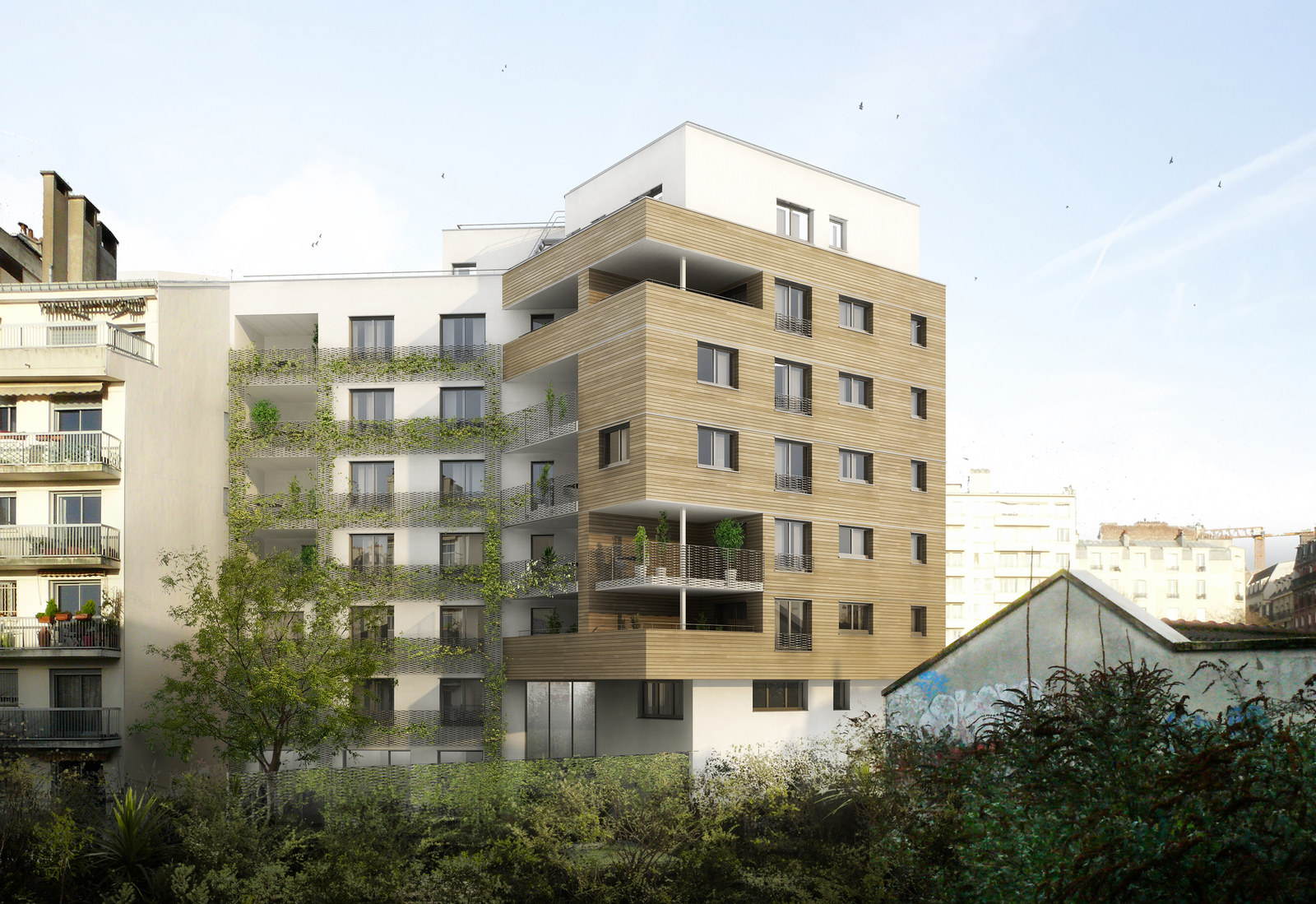

Where these forms sit in city policy is what carries us into Paris's politics. The city treats participatory and cooperative housing as a deliberate, if marginal, affordable channel: it runs appel-à-projets tenders that hand municipal land to resident groups working with a social landlord, and it leans on the bail réel solidaire to keep ownership prices below the market. A survey of land-policy instruments for affordable housing — land banking, leasing, community land trusts — sets out exactly this toolkit, and names Paris as one of its European test beds.
A city legislating against its own market
Paris's housing politics is the politics of a city governing against the grain of its market. Under Anne Hidalgo's administration, with Jacques Baudrier holding the housing brief, the headline instrument is the PLU bioclimatique — the bioclimatic local plan adopted in 2024 and in force from 2025. It commits the city to 40% public housing by 2035 — split as 30% social and 10% affordable — and reserves specific plots for housing through a device known as pastillage, marking buildings on the map for residential use so the market cannot bid them away.
Control over housing is split up and down the French state. The national government writes the tenancy law and the loi SRU, which since 2000 has obliged tense-market communes to hold a minimum share of social housing — the lever Paris used to reach a quarter of its stock. The Île-de-France region and the Grand Paris metropolis steer the wider land and transport frame. The city itself allocates land, runs the office public de l’habitat landlords, sets the encadrement des loyers caps, and decides what gets built where. For a capital, the municipal lever is unusually strong, which is why so much of the fight plays out at the Hôtel de Ville.
Cooperatives and participatory housing sit deliberately inside this programme, if at its edge. The city's land tenders favour resident groups paired with a social landlord, and the bail réel solidaire is its main tool for affordable ownership — both ways of adding homes the budget could not build outright. The financing runs through public institutions: the Caisse des Dépôts et Consignations and its Banque des Territoires arm are the long-term lenders behind most social and affordable building in France, the role a comparative study of European housing-body models examines in detail.

All that stranded floorspace catalogued in §1 is where the plan turns most inventive. The bioclimatic rules force the largest office refurbishments — those over 5,000 square metres in mostly-tertiary zones — to turn at least a tenth of their floor into homes, and the city runs pilot conversions of vacant office buildings into social and intermediate housing. Baudrier has pushed in parallel to sharpen the tax on vacant and second homes, arguing it could return tens of thousands of dwellings to use. The case for treating office-to-housing conversion as a supply frontier is set out in a study of adaptive reuse for housing.
In Paris the carbon question and the affordability question have folded into one. Its housing stock averages around 75 years old, only about 16% of dwellings count as energy-efficient, and the renovation rate crawls at roughly 0.9% a year — far below the deep-retrofit pace the bioclimatic plan needs. The plan ties carbon to housing directly: it greens new construction, mandates retrofit, and treats office-to-housing conversion as a way to add homes without pouring new concrete. The #Housing2030 review of effective affordable-housing policy across the UNECE region gathers the principles for doing this affordably.
- 2000[source]
Loi SRU sets a social-housing quota
The Solidarity and Urban Renewal law requires tense-market communes to hold a minimum share of social housing, later raised to 25% by 2025 — the legal lever Paris used to expand its stock.
- 2014[source]
Loi ALUR opens the cooperative door
The Duflot housing law revives the resident cooperative (coopérative d’habitants) as a legal tenure for the first time since 1971, letting projects like UTOP form.
- 2019[source]
Encadrement des loyers returns
Paris reintroduces rent control, capping new-let rents per neighbourhood and dwelling type; landlord federations begin a string of legal challenges to the method.
- 2020[source]
Caserne de Reuilly delivered
A former army barracks in the 12th reopens as roughly 582 mixed homes — half of them social, family or student — one of the decade’s landmark public conversions.
- 2024[source]
A quarter of Paris in social housing
The city reaches around 271,906 logements sociaux, about a quarter of all dwellings, after roughly doubling the social stock over two decades.
- 2025[source]
PLU bioclimatique in force
The bioclimatic local plan takes effect, reserving land for housing (pastillage), forcing large office refurbishments to convert part of their floor to homes, and setting the public-housing target.
- Mar 2026[source]
Municipal elections
After two terms under Anne Hidalgo, Parisians vote in a contest where housing — rent control, social-housing balance and the Paris Habitat affair — is a central issue.
- Mar 2026[source]
Grégoire takes office
Socialist Emmanuel Grégoire succeeds Anne Hidalgo as mayor, taking office on 29 March with a pledge of 60,000 new public homes by the end of his term.
- Jul 2026[source]
Vacant-homes tax doubled
The Council of Paris raises the tax on homes empty for a year to 30% in the first year and 60% in the second, from January 2027, aiming to return 20,000 of 139,075 vacant homes.
- 2035[source]
Target: 40% public housing
The bioclimatic plan commits the city to 40% public housing — 30% social and 10% affordable — by 2035, the headline goal the current programme is steering toward.
From the loi SRU social-housing quota and the doubling of the social stock to rent control, the bioclimatic plan and the 40% public-housing target.
What Parisians argue over is not whether the city should intervene but how far its reach actually extends. Christophe Robert, who heads the Fondation pour le Logement des Défavorisés, the former Fondation Abbé Pierre, warns that homelessness has more than doubled since 2012 and that policy has stalled. From the other camp, the landlord federation UNPI argues the encadrement des loyers rests on a flawed calculation and accelerates landlord disengagement at the worst possible time. Both agree the market is failing newcomers; they disagree on whether regulation is the cure or part of the disease.
The situation is catastrophic. The hour is grave.From the barracks to the cooperative: building inside the wall
Paris's working examples run from giant public conversions to a single pioneering cooperative, and the thread connecting them is a city trying to add affordable homes on land it has almost run out of. The projects below run in descending order of scale — from the city's biggest barracks conversion down to a single resident-built cooperative — before turning to the actors trying to make the model repeatable.
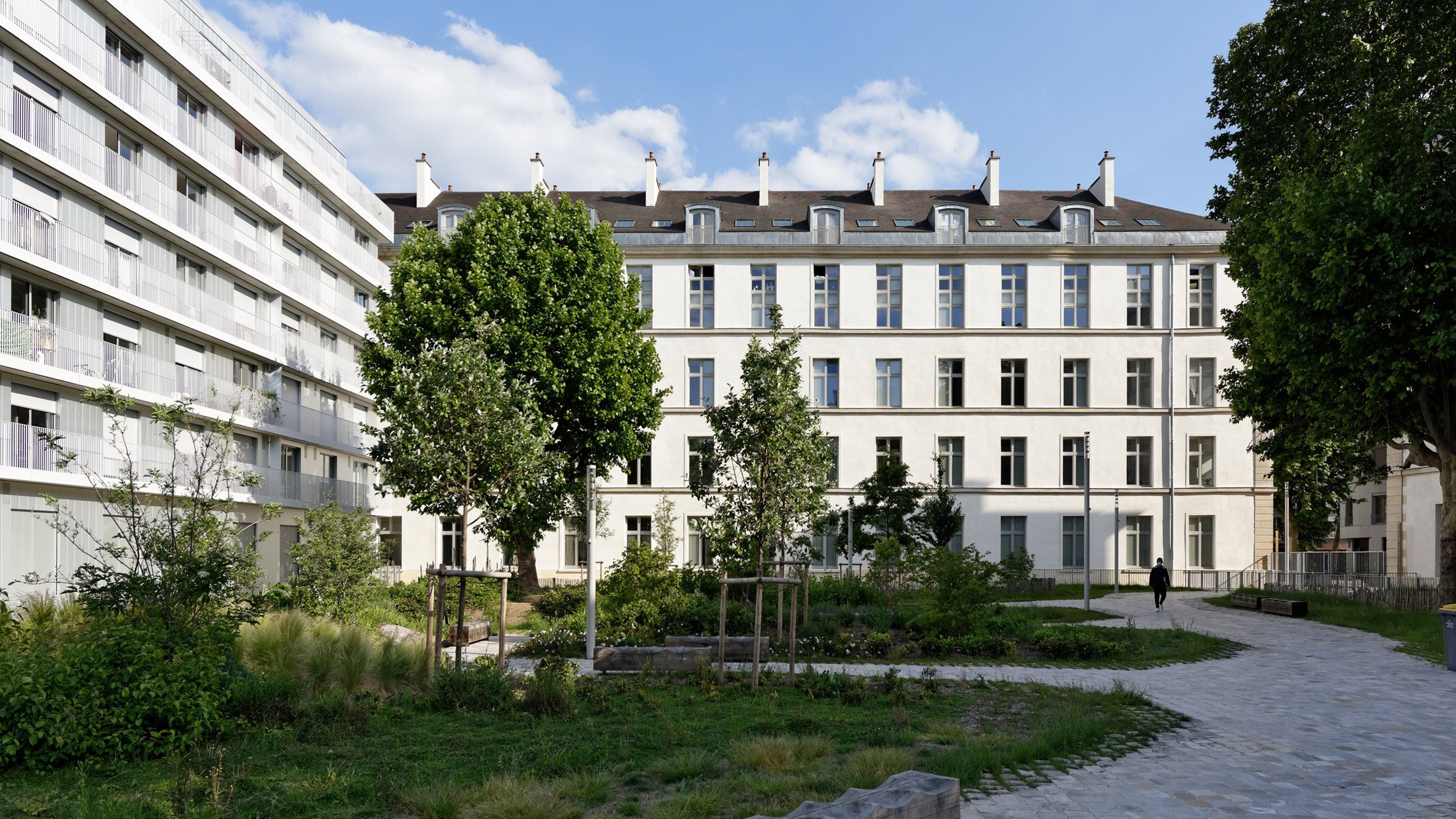
Caserne de Reuilly is the clearest sign of the public ambition. A former army barracks in the 12th arrondissement, it reopened as roughly 582 mixed homes — half of them social, family or student housing — delivered through the city landlord and structured for social and functional mix. It is widely held up as a model conversion. The caveat is that schemes of this scale are rare, depend on the state releasing its own land, and take many years from barracks to keys.
Clichy-Batignolles is the eco-district version of the same idea. Built around the Martin Luther King park on a former rail yard in the 17th, it holds around 3,400 homes, split 50% social, 20% intermediate and 30% market, and is one of Paris's flagship écoquartiers. Its friction is exactly the one critics raise about green regeneration everywhere: a high-amenity, park-centred district can tip toward eco-gentrification, where the social quota cushions but does not cancel the upward pull on surrounding prices.
UTOP is the cooperative experiment made concrete. Born from the 2014 loi ALUR and a city land tender, it is Paris's first resident cooperative: 17 social apartments on rue Sorbier in the 20th, designed by the future residents with the cooperative-HLM landlord CoopImmo, let at around €13 per square metre, a fraction of the market rate. Members own parts sociales rather than flats, so the homes can never be resold for profit. Its caveat is its scale — a single building of 17 homes, years in the making — which is precisely why it matters as a proof of concept rather than a solution.

The conversion frontier shows up at building scale too. Résidence Bertelotte turned former offices into student housing using bio-based timber panels and locally-sourced straw insulation, an early test of the office-to-housing logic the bioclimatic plan now mandates. La Serre, an 18-storey residential tower carrying a large share of social housing and hundreds of façade trees, pushes density and greenery together. Both answer the supply question in the city's own grain — building up and reusing what stands — though neither, as headline architecture, comes cheap.
The handful of buildings rests on an institutional scaffolding far broader than the tiny cooperative sector would suggest. Habitat Participatif France federates the participatory-housing movement, Habicoop supports the resident-cooperative form, and La Coop Foncière works the solidarity-land model that holds ownership prices down. The patient money runs through the Caisse des Dépôts et Consignations and ethical lenders such as La Nef and the Group Crédit Coopératif, while practices like Lacaton & Vassal have made transformation-not-demolition a Pritzker-winning principle. A study of community finance for the cooperative-city and a primer on cooperative architecture and regulation in Zurich both reach the lesson Paris keeps relearning: the institutions are willing, but in a city this dense, land and time are the binding constraints.
References
Statistics17Click on any number to see the source
Housing market
Tenure & affordability
Cooperative, social & public
Adaptive reuse & vacancy
Population & migration
From our library22
- Part 1: Mapping the housing needs in the EU, assessing the impacts of scarcity and providing an overview of relevant EU legislation — Knowledge
- UTOP — Project
- Habitat Participatif France — Organisation
- Habicoop — Organisation
- CoopImmo — Organisation
- La Coop Foncière — Organisation
- Land Policy Instruments for the Provision of Social and Affordable Housing — Knowledge
- Caisse des Dépôts et Consignations — Organisation
- Banque des Territoires — Organisation
- Unlocking Potential - A Comparative Analysis of Approved Housing Body Models in the European Union — Knowledge
- Adaptive Reuse for Housing — Knowledge
- #Housing2030 Effective policies for affordable housing in the UNECE region — Knowledge
- Fondation pour le Logement des Défavorisés — Organisation
- Caserne de Reuilly — Project
- Clichy-Batignolles — Project
- Résidence Bertelotte — Project
- La Serre — Project
- La Nef — Organisation
- Group Crédit Coopératif — Organisation
- Lacaton & Vassal — Organisation
- Funding the Cooperative City: Community Finance and the Economy of Civic Spaces — Knowledge
- Cooperative Conditions - A Primer on Architecture, Finance and Regulation in Zurich — Knowledge
Further sources12
- Jacques Baudrier alerte sur la « situation catastrophique » du logement — Le Journal du Grand Paris
- Jacques Baudrier — adjoint au maire de Paris (logement) — Ville de Paris
- 30e rapport — la France s’enfonce dans la crise du logement — Fondation pour le Logement des Défavorisés
- PLU bioclimatique : vers un Paris plus vert et plus solidaire — Ville de Paris
- Transformer les bureaux vacants en logements — Ville de Paris
- Encadrement des loyers dans la ville de Paris — UNPI
- Encadrement des loyers : l’UNPI dénonce des méthodes « très contestables » — Batiactu
- Anne Hidalgo, une maire qui a mis Paris dans les clous de la loi SRU — AEF info
- Paris expérimente la coopérative d’habitants (UTOP) — Institut Paris Région
- Caserne de Reuilly — programme exemplaire — Paris Habitat
- L’aménagement de Clichy-Batignolles — Ville de Paris
- Les écoquartiers : symboles de gentrification ? — Le Drenche
·