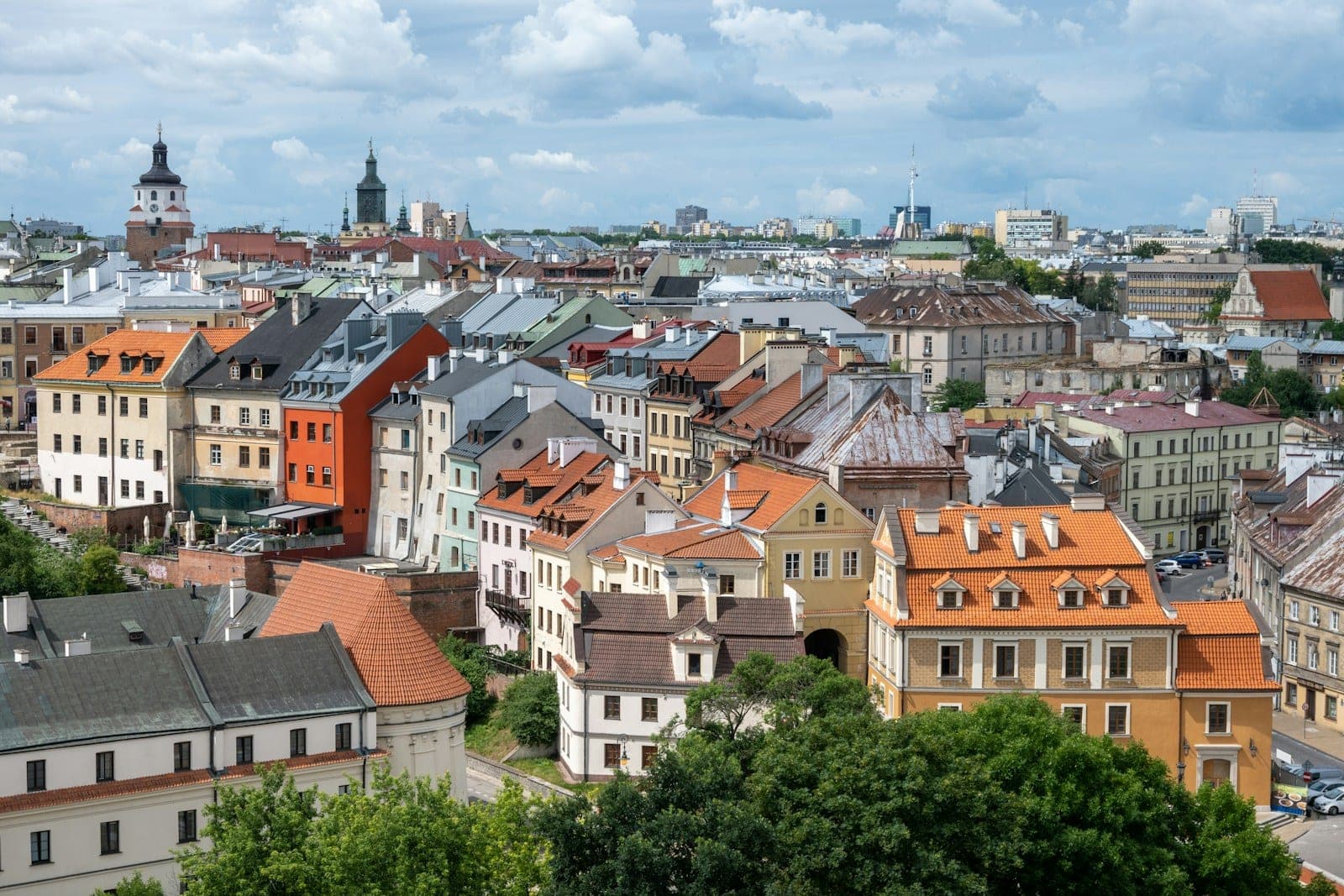
A university city on a cooperative foundation
Lublin is the largest city in eastern Poland and, above all, a university town. 60,828 students are enrolled at its 9 universities this year, and 12.78% of them come from abroad. The city grew fastest after 1956, when cooperatives rather than the state or the market turned the fields around the old town into housing estates. That inheritance still decides who owns a Lublin flat. It also explains why today's squeeze lands hardest on the people who arrived after the estates were full.
Ownership dominates the stock of 173,181 dwellings. Counted by owner, 93.7% belong to private individuals or to housing cooperatives whose members hold their flats on a transferable right. Cooperatives alone hold 19.6% of the stock, some 33,870 flats spread across 71 cooperatives, and about 20.6% of residents live in one. The municipality owns just 5% of dwellings, around 8,626 flats. The private rental slice the owner-based count can show is about 1%. Treat it as a floor. Polish housing statistics file a flat bought to let to students under its private owner, so most of Lublin's rental market is hidden inside the ownership figure.
- Owners
- Owner-occupier74.1%
- Cooperative19.6%
- Renters
- Public & non-profit rental5.0%
- Private rental1.0%
- Unclassified0.30%
- Unknown / Other0.30%
Social housing in Poland is a rule attached to a flat, not a separate landlord. In Lublin 6% of dwellings carry it: the municipal flats, plus those built by the city-owned TBS Nowy Dom (a social rental company let at regulated rents). The layer therefore runs across the tenure slices rather than forming one of its own. The queue for it is short on paper and long in practice. Roughly 1% of households were waiting for a municipal or social flat in 2024. Dziennik Wschodni counted 3,869 housing-aid cases on the city's books and an average wait of about six years.
The rent ladder measures the distance between an old tenure and a new arrival. A cooperative member pays a maintenance charge of about €1.42 per m² a month, which covers running costs rather than a market rent. A municipal tenant pays around €2.05 per m². On the open market the median reaches €10.83 per m², and new listings ask about €10.12 per m². Furnished and serviced lets, with utilities and furniture priced in, run to €14.29 per m². On these figures the top of the ladder is flat: a new lease costs roughly what sitting tenants already pay. The sharp break sits lower down, between anyone with a cooperative or municipal flat and everyone without one. Buying offers no escape. Flats on the secondary market changed hands at a median of 10,265 zł per m² in July 2026.
- Cooperative
- Public/municipal housing
- New contracts
- All-stock median
- Furnished / serviced (gross)
Net-cold monthly rent per square metre by tier; the furnished tier is gross, all-in. The cooperative figure is a maintenance charge, not a rent. Each value opens its own source.
Some homes stand idle while others are queued for. The 2021 census found about 7,100 dwellings unoccupied, some 4.1% of the stock. A share of that sits in the city's own hands. At the end of 2025 the Zarząd Nieruchomości Komunalnych (ZNK, the municipal property office) managed 8,460 flats, and 501 of them stood empty awaiting repair. Offices show the same pattern on a smaller scale. 10.5% of office space is vacant, around 23,100 m².
We have a situation in Lublin where more than 500 flats stand empty and people wait up to 10 years for a home. That cannot be explained by a lack of money alone. It is a problem of how the housing stock is managed.Demand comes in waves. About 3,656 people register as permanent residents each year, and around 12,000 people stay for three to twelve months, mostly students and contract workers. In April 2022 phone data placed 68,400 Ukrainians in the city, lifting its estimated population to 406,982. Supply has slowed since. The regional statistics office's report on housing construction in 2025 records 2,900 completions in Lublin, eighth among regional capitals, with 92% of them built by developers. Private rents are set by contract, and no city-level cap applies. A whole 1-bed flat let short-term goes for a median of €73 a night.
Nationally, the squeeze is widest among the young and those who rent. 53.8% of Poles aged 25 to 34 still live with their parents, against 29.7% across the EU. Overall only 5.2% of Poles spend more than 40% of disposable income on housing. Among tenants paying market rent the figure is 15.1%. The pressure has also reached middle earners. Habitat for Humanity Poland's 2025 housing survey found 27% of Poles caught in a rent gap, earning too much for public support and too little for the private market. 14% spend more than half their pay on housing. A 2025 study of housing affordability in Poland's regional capitals compares how affordable owning and renting became between 2020 and 2023. Asked what the state should do, Poles still lean towards ownership: 51% want help to buy, 22% favour municipal building and 20% social rental.
Behind every one of those numbers sits the cooperative fifth of Lublin, the part of the city that was once the answer to the same question.
From the waiting list to a transferable right
A Polish spółdzielnia mieszkaniowa (housing cooperative) grants its members one of two rights. The lokatorskie prawo (tenant-member right) lets a member use a flat indefinitely in return for a wkład mieszkaniowy (housing contribution, roughly the unsubsidised share of building costs) and a monthly charge. It cannot be sold or inherited. The spółdzielcze własnościowe prawo (cooperative ownership right) can be sold, inherited and mortgaged, while the cooperative keeps legal title to the building. No new rights of that second kind have been created since July 2007. Most members have since converted to outright ownership, a path traced in Housing Law in Poland: From the Cooperative Model to Flat Ownership. That is why the statistics count Lublin's cooperatives on the owners' side of the ledger.
The tradition here is post-war. Lubelska Spółdzielnia Mieszkaniowa (LSM) was founded in April 1957, as the thaw of 1956 revived cooperative ideas in a city still short of homes after the war. Its first 150 flats on ul. Grażyny were handed over in December 1959. Industry followed. When the lorry factory FSC asked LSM to build for its workers, LSM's first president Stanisław Kukuryka told it to found its own cooperative instead, and RSM Motor was born. SM Czechów arrived in 1974 and SM Czuby in 1979. By the 1970s the candidate lists of Lublin's cooperatives held about 35,000 people, and a family could wait a decade for keys. After 1989 the model changed course. Cheap conversions turned members into owners, part of what the Sciences Po study of housing financialisation calls Poland's super-homeownership society.
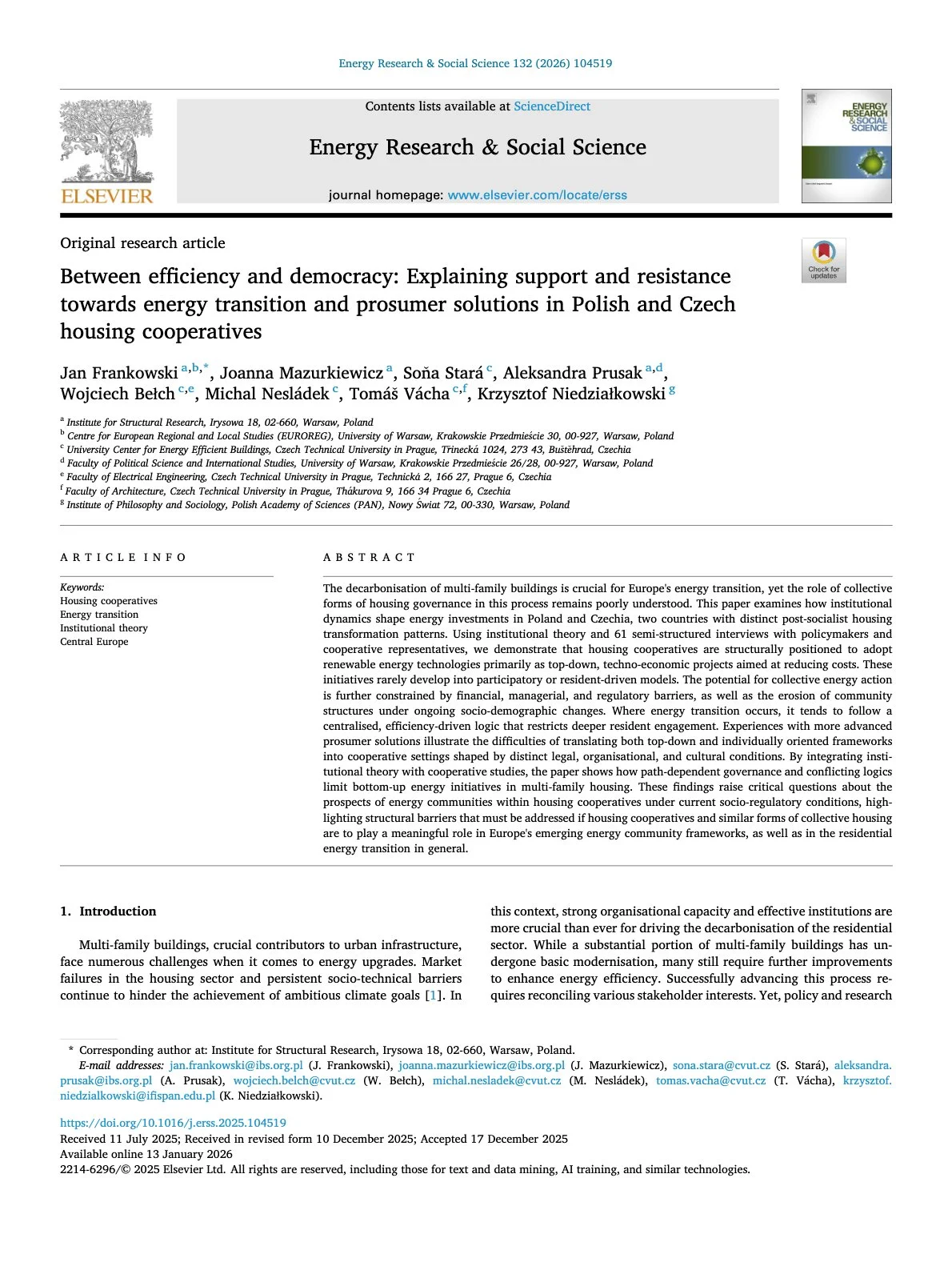
The sector today is large, old and rarely building. LSM manages 13,228 flats in 212 buildings. SM Czuby reports 45,240 residents across six estates, and RSM Motor 7,127 flats. These estate cooperatives now work mainly as managers of ageing blocks. They pay for insulation, metering and lifts, and they argue over governance. SM Czuby dismissed its board partly over executive pay, and the board elected in 2023 lasted only a year. New output has almost stopped. Cooperatives built 2.1% of Lublin's completions in 2025, though the city still ranked third nationally for cooperative completions in 2018 to 2020 with 494 flats. A second, much smaller cluster barely exists yet. The 2022 law on kooperatywy mieszkaniowe (self-build housing groups of at least three people, barred from selling at a profit) came into force in March 2023, but no Lublin project has yet come to light. The two clusters face different problems. The estates need retrofit money and member trust. Newcomers would need land and credit. Research on energy transition in Polish and Czech housing cooperatives shows how the first problem plays out, with boards weighing efficiency against members' votes. A study of late-socialist block housing in Poland shows how residents now judge the estates themselves.
The state has started to write cooperatives back into policy. Since 28 January 2026 an amendment lets cooperatives run social rental housing on the terms set for social rental agencies. It also lets them build on land from the Krajowy Zasób Nieruchomości (KZN, the National Property Resource). It also ended remote voting at general meetings, a response to the governance disputes. Whether Lublin's estate cooperatives take up the new role is now a question for the city's housing politics.
Grants instead of mortgage subsidies
Poland's government has swapped mortgage subsidies for grants. The Tusk coalition closed Bezpieczny Kredyt 2% (a state-subsidised 2% mortgage) to new applications on 2 January 2024. Its planned successor, a zero-interest loan called Kredyt na Start, was dropped in December 2024. The money went into rental building instead. An amendment to the act on social forms of housing development came into force in August 2025. Under it the Fundusz Dopłat (the subsidy fund run by BGK, the state development bank) can pay up to 80% of the cost of municipal flats and of repairing empty ones. The fund's annual ceiling rises to 10 billion złoty by 2030, and total spending on the programme is set at up to 45 billion złoty to 2030. Tomasz Lewandowski is the deputy minister for housing at the Ministry of Development and Technology (MRiT). He has said he would count it a success if the state were eventually building 20,000 to 25,000 homes at affordable rents.
The government is not working on any mortgage-subsidy programme at the moment. Quite apart from the fact that I am opposed to such measures in general, right now they would have no justification: inflation is down and interest rates are falling.The money flows down through three tiers. The national tier writes the law and fills the fund. The regional tier is SIM Lubelskie, a non-profit społeczna inicjatywa mieszkaniowa (social housing initiative) owned by 17 municipalities of the region and the KZN. It lets homes long-term and never sells them. Lublin itself is not a shareholder. The city acts on its own through the ZNK and TBS Nowy Dom. Mayor Krzysztof Żuk, in office since 2010, won a fourth term in 2024 with 57.49% of the first-round vote. His administration handed over 121 new municipal flats in Felin in September 2026, and deputy mayor Tomasz Fulara has a 99-flat block on ul. Wrońska due in summer 2028. Ewa Lipińska, who runs the city's housing department, puts the queue at about 300 families waiting for a municipal flat and 150 waiting to swap. According to a Nowa Lewica party announcement, this year's national allocation brings Lublin about 37 million złoty for 105 flats.
For cooperatives the instruments are newer and thinner. Since 2017 BGK has offered preferential credit for tenant-member flats. The 2022 kooperatywa law gives self-build groups a legal shell. The January 2026 amendment opens social renting and national land to cooperatives. The OECD's Housing Reforms in Czechia and Poland reviews the reforms Poland would need to widen its affordable rental supply. Habitat for Humanity Poland's report on models of involving the private sector in affordable housing sets out one alternative: social rental agencies that lease private flats for tenants on lower incomes.
- Apr 1957[source]
Lubelska Spółdzielnia Mieszkaniowa founded
The cooperative that would build most of post-war Lublin is established during the 1956 thaw.
- 1965[source]
Hansen's Słowackiego estate begins
Oskar and Zofia Hansen's Open Form estate rises on 17 hectares, about 2,000 flats in 18 buildings, completed in 1970.
- Nov 1997[source]
TBS Nowy Dom starts letting
The city-owned social rental company begins operating; it has since built 1,058 flats in Czechów, Bronowice and Felin.
- Jul 2007[source]
No new cooperative ownership rights
Cooperatives can no longer create the transferable cooperative ownership right; conversions to full ownership continue.
- Jan 2024[source]
Subsidised 2% mortgage closes
Bezpieczny Kredyt 2% stops taking applications; the new government turns to rental building.
- Aug 2025[source]
Social-housing law amended
Grants of up to 80% for municipal building and empty-flat repair; Fundusz Dopłat ceiling rising to 10 billion złoty a year by 2030.
- Jan 2026[source]
Cooperative law amendment in force
Cooperatives may run social rental housing and use national land; general meetings return to in-person voting.
- Jul 2026[source]
Short-term rental bill adopted
The government sends parliament a bill creating a central register of tourist accommodation.
- Sep 2026[source]
Felin municipal flats handed over
Three blocks with 121 municipal flats, 80% financed by the BGK subsidy fund.
- Summer 2028[source]
Wrońska block due
A 9-storey block with 99 municipal flats, costing about 32 million złoty.
- 2030[source]
Horizon of the national programme
Up to 45 billion złoty for social and municipal housing, and up to 75,000 empty municipal flats returned to use.
From the first cooperative estates to the national social-rental build-out and its 2030 horizon.
Empty homes get an answer through repair rather than tax. The same fund aims to bring up to 75,000 empty municipal flats back into use nationally. Lublin spent almost 2 million złoty on repairing vacant flats in 2025, and it hands some to future tenants who renovate them at their own cost. No vacancy tax is on the table. Deputy funds minister Monika Sikora has said she favours taxing buyers of multiple flats, but no bill exists. On short-term letting, the government adopted a bill in July 2026 that creates a central register of tourist accommodation. Reports disagree on whether it still lets municipalities draw ban zones: Gazeta Prawna says yes, from 2029, while Finwire reports they were dropped. Office conversion is still anecdotal in Lublin. In 2018 the rental firm Mzuri announced plans to turn the office building at ul. Narutowicza 56A into about 20 rental flats.
Climate goals travel through the same buildings. The national Ciepłe Mieszkanie (Warm Home) programme granted Lublin almost 3 million złoty in 2024 to replace old stoves in blocks of flats, covering 30% to 90% of eligible costs. LSM began insulating its estates in 1998, and the new Felin blocks carry solar panels and connect to the district-heating network. The EU's revised buildings directive will raise the bar again for every cooperative board in the city.
The argument turns on who should build. Lewandowski wants the state to build rental homes at scale. Developers answer that only more supply of every kind will close a shortage estimated at 1.5 to 2 million homes nationwide.
Of course, everyone would like a municipal flat with a low rent, built with public money. But where is that money supposed to come from?Hansen's open form and the second building wave
Osiedle Słowackiego is the estate architects still travel to Lublin to see. Oskar and Zofia Hansen designed it for LSM, and it was built between 1965 and 1970. It holds about 2,000 flats in 18 buildings on 17 hectares. The Hansens laid it out as a Linear Continuous System, one expression of their Open Form theory: buildings as a frame that residents complete. Polish architects later judged it the most successful multi-family scheme of the People's Republic's first 30 years. Its limits were set by the rules of its day: new national regulations had lowered building standards, so it could not match the comfort of the first LSM estate.
There is no other estate like it in Poland.Lubelska Spółdzielnia Mieszkaniowa itself is the proof that a cooperative can outlive its founding era. It holds about 120 hectares of land, of which 65 hectares are green space, and it runs a seniors' house with 60 flats. Every one of its residential buildings is now metered and insulated. The estates of Mickiewicza, Piastowskie, Sienkiewicza and Konopnickiej still show how much ground a member-owned body can hold and keep open.
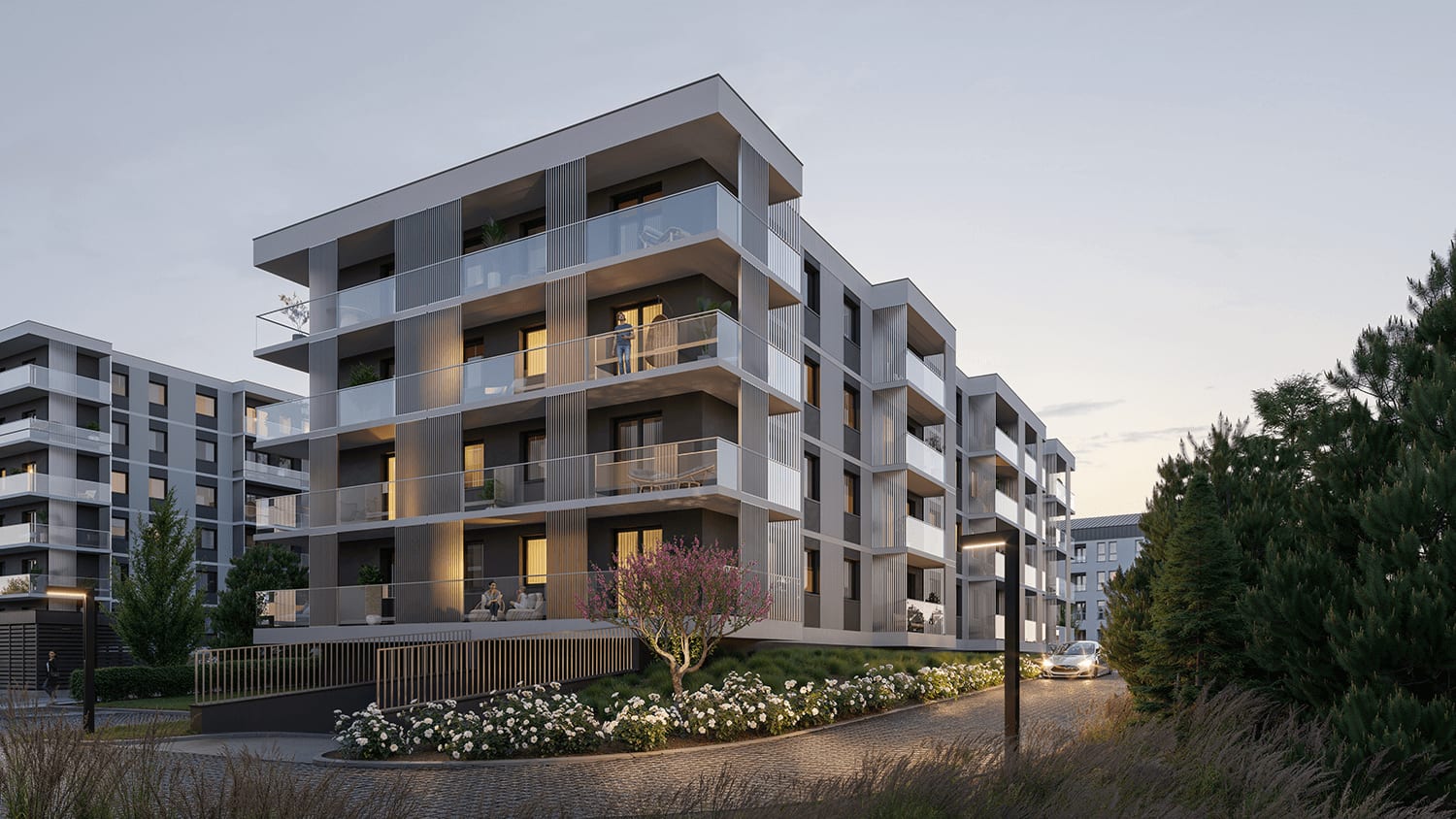
The Felin municipal flats on ul. Królowej Bony show the new public model at work. Three blocks hold 121 flats of 26 to 63 m², and BGK's subsidy fund paid most of the cost. The buildings carry solar panels and connect to district heating. Mayor Żuk called them a concrete answer to the needs of people and families waiting for stable homes, and said the city is already studying further sites.
TBS Nowy Dom has built 1,058 rental flats in Czechów, Bronowice and Felin since it began letting in 1997. Its recent pace draws fire. Councillor Tomasz Gontarz counted only 84 flats in five years and called it far too few. Its next scheme on ul. Łukasińskiego pairs new blocks with the modernisation of flats it already owns.
The former Baxter factory on ul. Wojciechowska is the city's largest brownfield conversion. The developer Budomex is building about 660 flats on 40,000 m² of floor area with a park, to a design by MWM Architekci, under the fast-track Lex Deweloper planning law. The architects say the scheme breaks with the monotony of most Polish estates. The homes will sell at market prices, so the site recycles industrial land without adding to the affordable tier.
SIM Lubelskie widens the frame beyond the city limits. Its rental blocks in 17 towns of the region offer households a long-term lease at a moderate rent from a landlord that never sells. That is the kind of anchor a university city of newcomers lacks most, and the one Lublin's founding cooperatives once supplied.
References
Statistics16Click on any number to see the source
Housing market
Tenure & affordability
Cooperative, social & public
Adaptive reuse & vacancy
Population & migration
From our library8
- Housing Reforms in Czechia and Poland — Knowledge
- Models of involving the private sector in the supply of affordable housing — Knowledge
- Budownictwo mieszkaniowe w województwie lubelskim w 2025 roku — Knowledge
- Dostępność mieszkań dla gospodarstw domowych w miastach wojewódzkich — Knowledge
- Between efficiency and democracy: Explaining support and resistance towards energy transition and prosumer solutions in Polish and Czech housing cooperatives — Knowledge
- A "Concrete Desert" That Has Become a Green Meadow? Late-Socialist Block Housing in Poland — Knowledge
- Housing Law in Poland - From the Cooperative Model to Flat Ownership — Knowledge
- Housing policy under the conditions of financialisation - The impact of institutional investors on affordable housing in European Cities — Knowledge
Further sources42
- Potencjał akademicki miasta — City of Lublin
- Ponad 500 pustostanów i nawet 10 lat czekania na mieszkanie — Dziennik Wschodni
- Ceny transakcyjne mieszkań w Lublinie (RCN) — deweloperuch.pl
- Policzyli, ilu jest Ukraińców. Lublin to już 400-tysięczne miasto — Dziennik Wschodni
- Budownictwo mieszkaniowe w województwie lubelskim w 2025 roku — GUS, Urząd Statystyczny w Lublinie
- Share of young adults aged 25-34 living with their parents (ilc_lvps08) — Eurostat
- Housing cost overburden rate by tenure status (ilc_lvho07c) — Eurostat
- Sytuacja mieszkaniowa w Polsce 2025 — Habitat for Humanity Poland
- Co trzeci Polak zbyt biedny na najem lub kupno mieszkania, a za bogaty na wsparcie — architektura.info
- Jakiej polityki mieszkaniowej oczekują Polacy? CBOS podał wyniki badania — money.pl
- Spółdzielcze własnościowe prawo do lokalu — Wikipedia
- Lubelskie bloki jeszcze długo postoją — Dziennik Wschodni
- Historia SM Czechów — SM Czechów
- O Lubelskiej Spółdzielni Mieszkaniowej — LSM
- SM Czuby w liczbach — SM Czuby
- RSM Motor — domyspoldzielcze.pl
- Fakty i mity o pensjach prezesów lubelskich spółdzielni mieszkaniowych — Jawny Lublin
- Gdzie spółdzielnie wciąż budują mieszkania? — rynekpierwotny.pl
- Kooperatywa mieszkaniowa: jak działa — rynekpierwotny.pl
- Zmiany w ustawie o spółdzielniach mieszkaniowych przyjęte przez Sejm — Ministerstwo Rozwoju i Technologii
- Kredyt 2 procent: koniec przyjmowania wniosków — Rzeczpospolita
- Kredytu zero procent nie będzie — Rzeczpospolita
- Budownictwo społeczne i komunalne: wreszcie są konkrety — XYZ
- Nowelizacja podwyższająca limity wydatków na budownictwo społeczne — Portal Komunalny
- Państwo zbuduje czynszówki i pomoże kredytobiorcom — Rzeczpospolita
- Krzysztof Żuk — Wikipedia
- Lublin: powstaną nowe mieszkania komunalne — Radio Lublin
- Nowa Lewica zapowiada ponad 700 mieszkań na Lubelszczyźnie — Lublin24
- Spółdzielnie mieszkaniowe: tanie mieszkania — Dziennik.pl
- Rząd chce ingerować w rynek mieszkaniowy — Portal Samorządowy
- Ustawa o najmie krótkoterminowym — Ministerstwo Sportu i Turystyki
- Ustawa o najmie krótkoterminowym 2026: rejestr CWTON i kary — Gazeta Prawna
- Najem krótkoterminowy 2026: ustawa bez stref zakazu — Finwire
- Biurowiec w Lublinie zmieni funkcję. Będą mieszkania na wynajem — PropertyNews
- Blisko 3 mln złotych dotacji w ramach programu Ciepłe Mieszkanie dla Miasta Lublin — WFOŚiGW w Lublinie
- Konrad Płochocki, PZFD: podaż mieszkań pozostanie pod presją — Parkiet
- Osiedle Słowackiego — LSM
- 121 nowych mieszkań komunalnych w Lublinie. Rodziny odebrały klucze — Radio Lublin
- 121 nowych mieszkań komunalnych na Felinie. Pierwsze rodziny otrzymały klucze — Lublin112
- TBS Nowy Dom: o firmie — TBS Nowy Dom
- Jedno mieszkanie na miesiąc. Przez 5 lat powstało ich tylko 84 — Spotted Lublin
- Kiedyś była fabryka, będą mieszkania i park — PropertyDesign