
A city of owners discovers a rental emergency
Vitoria-Gasteiz is the quiet, deliberate capital of the Basque Country, a city that spent four decades planning its parks, its cycle lanes and its expansion onto the surrounding plain. Housing, for most of that time, was something its residents simply bought. The 2021 census found 82.1% of homes lived in by their owners, one of the highest ownership rates of any provincial capital in Spain. Fewer than one in five households rent, and the protected, below-market stock runs to only 3.6% of all dwellings.
That settled picture has cracked. In 2025 the Basque housing department, applying Spain’s 2023 housing law, formally declared Vitoria-Gasteiz a stressed residential market zone, a designation that lasts three years and unlocks caps on new rents. The trigger is a familiar one across Europe: a small rental market, almost no public alternative, and a queue for subsidised housing that, on the Basque Government’s own Etxebide register, is the most intense of the three Basque capitals. A city built for owners now has to answer for its renters.
The political weight sits with the city council under Mayor Maider Etxebarria and with the Basque Government, the two bodies that between them own the land, the planning powers and the public developers. Whether the stressed-zone label becomes real relief or a paper designation is the question the rest of this profile follows.
What it costs to rent, build and leave empty
For the minority who do rent, the market is tight and shallow. A furnished one-bedroom flat lets at around €680 a month on the Idealista portal, while a furnished family flat of roughly ninety square metres reaches about €1,100. Those are not Madrid or Barcelona figures, but against Vitoria’s wages and its near-total absence of cheaper public competition they bite.
Below-market and cooperative options sit well under the open market; furnished family lets set the ceiling. Public/cooperative figures are indicative monthly rents for protected tenancies; market figures are curated from Idealista listings. Source: EHC catalog · Idealista · Alokabide protected-rent schedules
Supply is the deeper problem. New construction costs about €1,280 per square metre and serviced land in the Basque Country runs near €298.6 per square metre, a combination that pushes private developers towards sale rather than rental. Meanwhile the city is not short of walls: residential vacancy stands at 4.1% of the stock, some 4,876 dwellings sitting empty in the expansion districts of Salburua and Zabalgana and the older centre. The raw material for a rental supply already exists; what is missing is the vehicle to mobilise it.
A thin public layer, and a cooperative idea still arriving
If four in five homes are owned, the remaining sliver is where housing policy has to work. The genuinely public, municipally managed rental stock is tiny: 406 dwellings held through the city’s urban-development company Ensanche 21, barely 0.3% of all homes. The broader protected-rental layer, mostly delivered by the Basque public developers Alokabide and VISESA, lifts the below-market share only into low single digits.
- Owner-occupied82.1%
- Cooperative & non-market0.3%
- Public & social rent3.6%
- Private market rent14.0%
Tenure of principal dwellings. Owner-occupation dominates; the cooperative and public-rental layers are marginal, and the private rented sector is the residual. Source: INE Census 2021 + EHC tenure reconciliation
The cooperative tradition that anchors housing in Vienna, Zurich or Copenhagen barely exists here as a tenure. Spanish housing cooperatives have historically been a way to build and then sell flats, not to hold them in common for the long term. That is beginning to change: the resident-owned, never-resold cesión de uso model that bodies such as Sostre Cívic have pioneered elsewhere in Spain offers Vitoria a template it has not yet built at scale. The Basque Government’s Etxebide register channels demand; what the city lacks is a standing cooperative developer to meet it.
Empty offices, retrofitted blocks and a passive-house pioneer
Vitoria-Gasteiz already owns one of Europe’s most quietly radical regeneration stories. In the working-class Coronación district, the city retrofitted an ageing residential block to the passive-house standard, one of the first social-housing passivhaus interventions in southern Europe, cutting heating demand to a fraction of the norm. The expertise to renovate rather than demolish is therefore local, not imported.
There is plenty to renovate. Office vacancy sits near 11.8%, leaving on the order of 38,227 square metres of empty office floor, and the residential vacancy noted earlier adds thousands of unused flats. The Anillo Verde, the green ring of parks and restored wetlands that won the city its European Green Capital title, set the precedent that Vitoria can plan ambitiously and follow through. Turning empty commercial floor and idle dwellings in Salburua and Zabalgana into occupied, affordable homes is the same kind of long-horizon project, run by the same municipal developer, Ensanche 21.
The politics of who gets to stay
Housing has moved to the centre of Vitoria’s politics in barely two years. The council led by Mayor Maider Etxebarria of the Basque Socialists has leaned on the powers that the stressed-zone designation unlocks, while the Basque Government in the same city has built the legal scaffolding around it. In 2026 a rent-reference index for Álava took effect, capping rents in Vitoria-Gasteiz on new contracts and for large landlords.
The debate is less left-versus-right than fast-versus-careful. One camp, spanning the Socialists and EH Bildu, argues the city must use the new caps hard and build protected rental quickly; another, around the centre-right and parts of the development sector, warns that aggressive caps in a market this thin will simply dry up the little private supply there is. The 2025 General Urban Plan, the first in more than two decades, tries to thread the needle by earmarking the great majority of future homes as protected.
A city can plan a forest to the last hectare and still leave its housing to the market. Vitoria-Gasteiz is now testing whether the same civic will can be turned on rents.- 1980
Capital of Basque self-government
Vitoria-Gasteiz becomes the seat of the Basque Government and Parliament, concentrating regional housing powers in the city.
- 2012
European Green Capital
The city wins the EU award for its green ring and compact planning, proving its capacity for long-horizon urban projects.
- 2021[source]
A census of owners
The INE census records owner-occupation at 82.1% of 120,459 dwellings, among the highest of any Spanish provincial capital.
- Jul 2025
Housing Shock Plan announced
The city council unveils a plan to build several thousand protected homes by 2028, more than half of them for rent, in the Zabalgana and Salburua expansion districts.
- Oct 2025[source]
Vitoria-Gasteiz declared a stressed market zone
The Basque housing department designates the city a stressed residential market zone for three years, enabling rent caps.
- Dec 2025
A new General Urban Plan
The council approves its first general plan in more than two decades, earmarking the great majority of new homes as protected.
- Apr 2026[source]
Álava rent-reference index caps rents in Vitoria-Gasteiz
The provincial rent-reference index takes effect, the instrument that lets caps apply to new contracts and large landlords.
- 2028
Target for the protected-housing plan
The horizon by which the council intends its protected homes in the expansion districts to be delivered.
Could the green capital become a cooperative one?
Vitoria-Gasteiz has, unusually, most of the ingredients already on the table. It has thousands of empty dwellings and tens of thousands of square metres of idle office floor. It has a municipal developer in Ensanche 21 and public housing companies in Alokabide and VISESA that know how to build. It has proven, in the Coronación passivhaus retrofit and the Anillo Verde, that it can renovate rather than demolish and plan for decades rather than electoral cycles. What it has never assembled is a way to hold homes in common, outside the speculative market, for the long term.
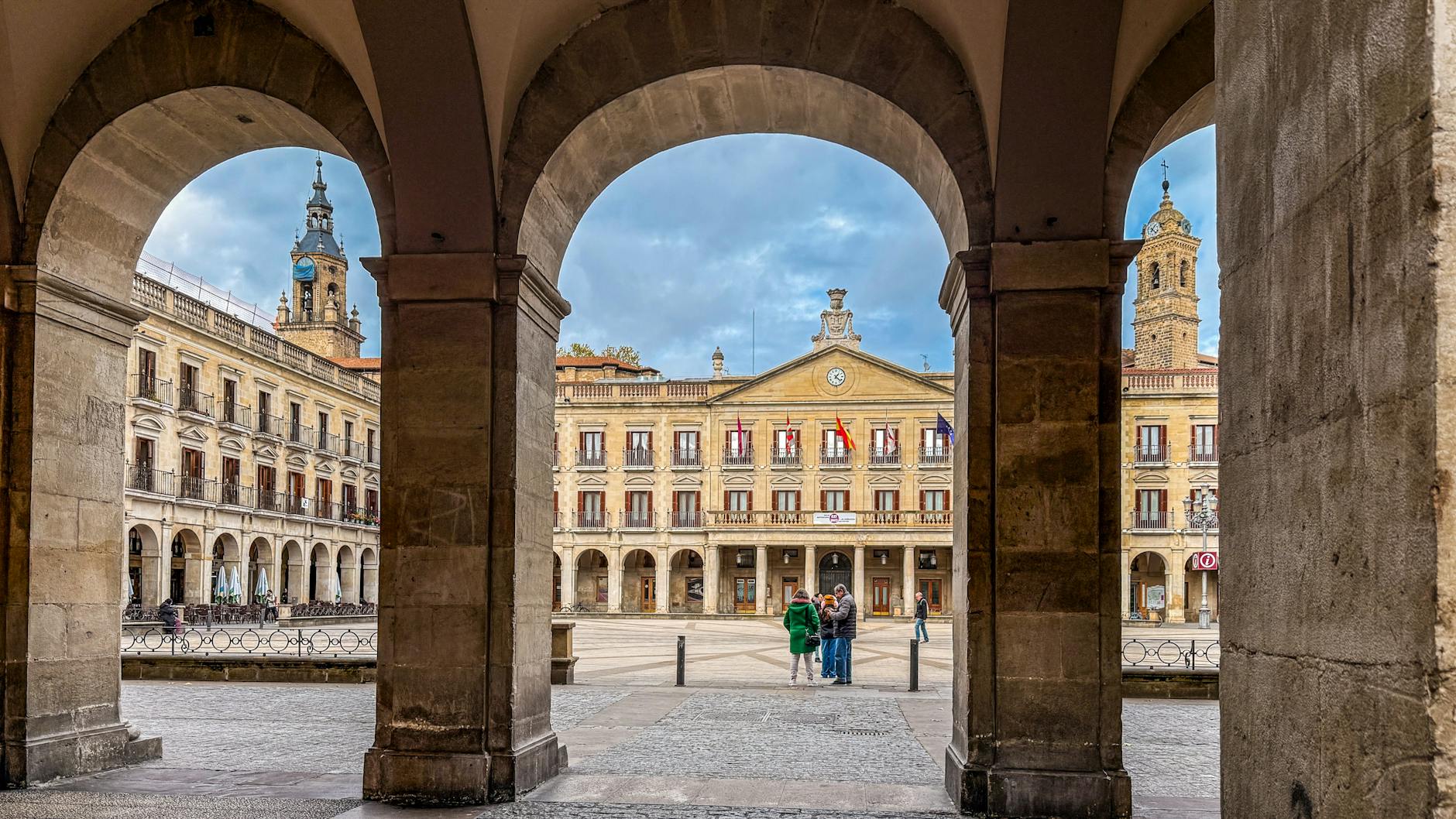
That is the gap a cooperative model could fill, and it would not start from zero. Adaptive reuse is the obvious entry point: the empty offices and flats the market has left idle are exactly the stock a reuse-first cooperative would convert, keeping the Coronación logic of renovation over demolition. A standing cooperative could mix generations and backgrounds in a single building rather than sorting them by income, and run courtyard-scale, resident-governed communities of the kind Vitoria’s compact districts are built for. It could also offer something the city demonstrably needs: the roughly 8,000 mid-term residents, the university researchers at the UPV/EHU campus and the engineers cycling between the Michelin and Mercedes-Benz plants, are precisely the people for whom a cooperative network of dignified temporary stays would be an alternative to commercialised serviced flats.
The wider point is that a green capital that learned to think of its forest, its water and its bicycles as a shared civic project could think the same way about its homes, joining a network of cities, architects and cooperatives building a Europe without mental borders. The materials are here; the question is whether the city, its public developers and its residents decide to assemble them. Explore how the European Housing Coop model could take root here.
References
Statistics9Click on any number to see the source
Housing market
Adaptive reuse & vacancy
Population & migration
Further sources4
- Resolution declaring Vitoria-Gasteiz a stressed residential market zone — Boletín Oficial del Estado · 2025
- Eight in ten homes in Vitoria are owner-occupied (INE Census 2021) — Noticias de Álava · 2024
- Vitoria-Gasteiz — city overview — Wikipedia · 2026
- Álava rent-reference index caps rents in Vitoria-Gasteiz — Noticias de Álava · 2026
Funding & land tenure
What a housing cooperative could actually build on hereGasteiz / Vitoria is not in the funding registry yet — the tenure figures above are national.