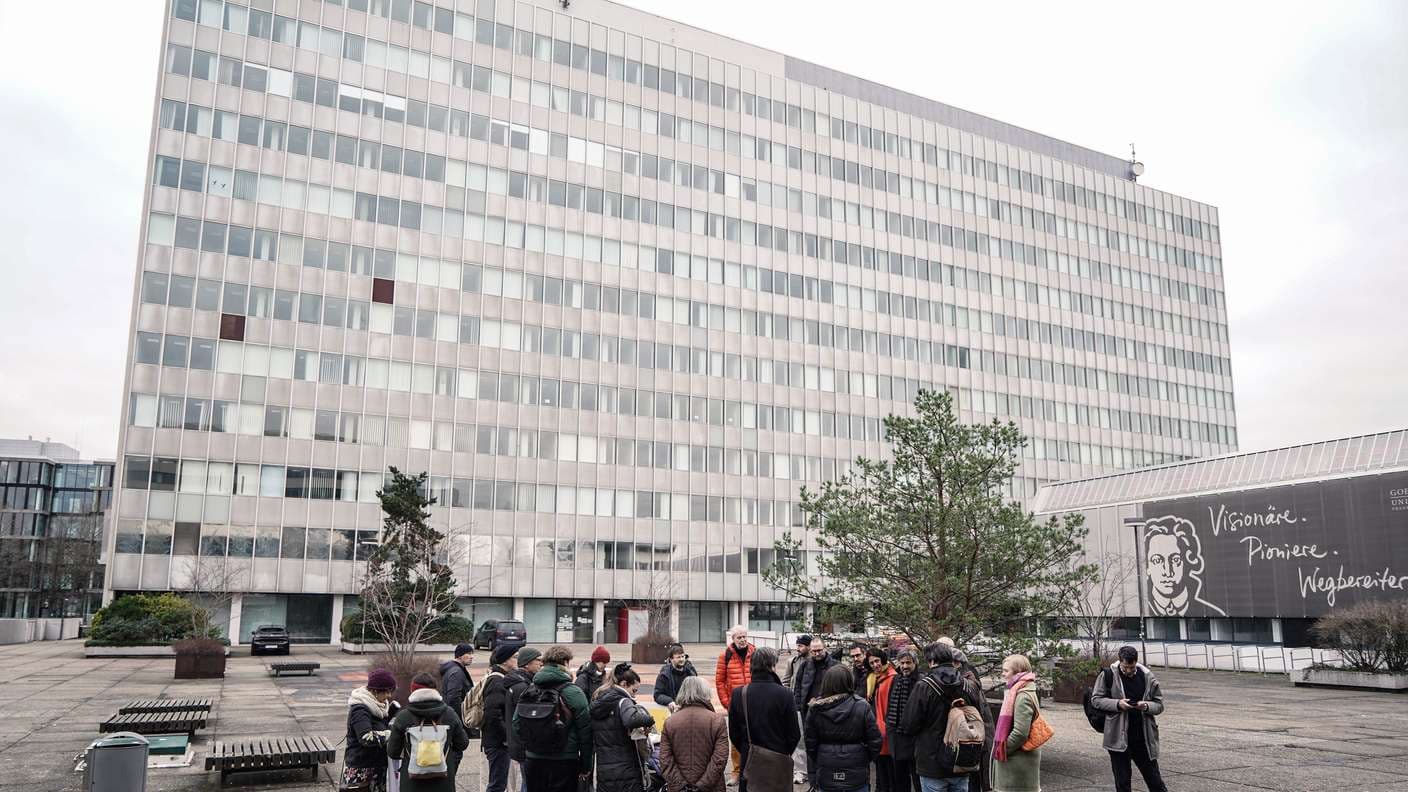
Kulturcampus Bockenheim is a long-running urban and cultural redevelopment project in Frankfurt am Main, Germany, centered on the former university campus in Bockenheim. The project combines preservation, interim use, and new construction to transform a large post-university site into a mixed urban quarter with culture, housing, workspaces, education, and public uses.14
The project is closely linked to the transition of the former Goethe University campus. According to Frankfurt’s planning department, the idea of the KulturCampus emerged after the decision to relocate the Hochschule für Musik und Darstellende Kunst to the former university grounds, with the aim of creating a place where dancers, musicians, and other cultural professionals can study and work.1 The redevelopment area covers 16.7 hectares and the plan for the site was formally completed in 2022.1
On the ground, the project is already shaped by a network of institutions and initiatives around the former Studierendenhaus, now developing into the Offenes Haus der Kulturen.46 The site hosts or references institutions such as the Akademie der Arbeit, Dondorf-Druckerei, Institut für Sozialforschung, Kunstbibliothek, Labsaal, Garten der Pionier*innen, and Juridicum.4 The project’s own materials describe this as an evolving network of social and political initiatives, artists, and cultural workers, with additional institutions still being added.4
A key organizer is Offenes Haus der Kulturen e.V., which is named in the project’s imprint and is the legal operator behind the Offenes Haus.56 The association’s board includes Michael Grimm, Margret Heym-Schmitt, Axel Klaudius, and Bianca Riemann, and its managing director is Dr. Tim Schuster.5
The project also emphasizes temporary and participatory uses. For example, the Kunstbibliothek is being prepared as a provisional rehearsal and experimentation space, with a participatory process and a planned start of interim use from autumn 2025.3