Overview of the Study and Its Context
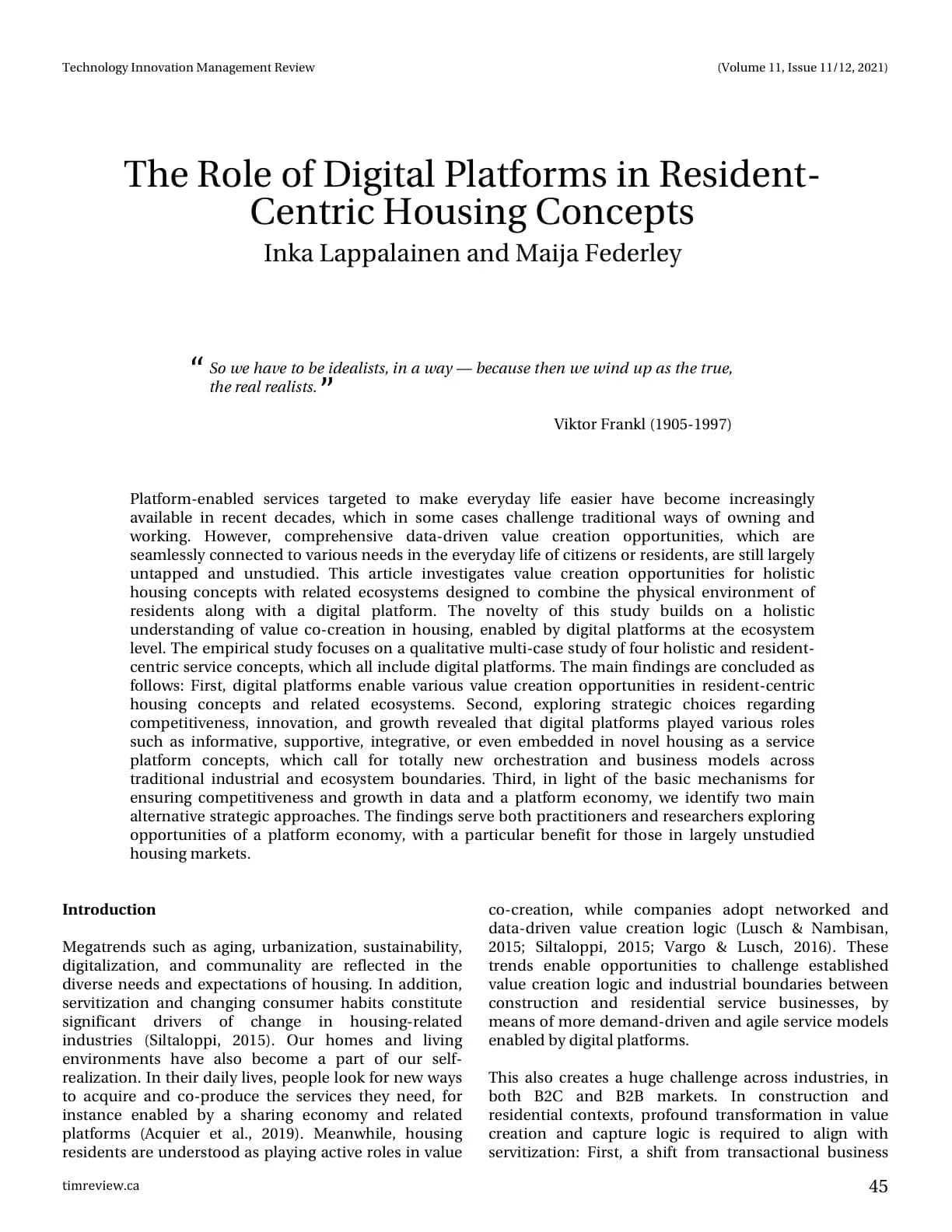
The article, published in Technology Innovation Management Review (Vol. 11, Issue 11/12, 2021), investigates how digital platforms create value in resident‑centric housing concepts. Authors Inka Lappalainen, a senior scientist at VTT’s Foresight and Data Economy research area, and Maija Federley, senior scientist at VTT Technical Research Centre of Finland, draw on service‑dominant logic and platform ecosystem literature to frame their analysis. The research focuses on four Finnish pilot projects that integrate physical, social, and digital elements to offer “housing as a service” ecosystems.
Research Methodology and Case Selection
A qualitative multi‑case study design, based on Eisenhardt’s (1989) approach, was employed. Purposeful sampling identified four pioneering housing projects (Cases A‑D) developed between 2017 and 2020. Data sources include public case documentation, eight in‑depth interviews with project representatives (e.g., builders, service coordinators, developers), and systematic content analysis using platform‑design frameworks from Tura et al. (2018) and related literature.
Core Findings: Platform Roles and Design Choices
The study finds that digital platforms in these cases serve varied roles: two‑sided communication and resource booking (Cases C and D) to multi‑sided value creation (Cases A and B). Platform design choices differ across four dimensions—architecture, value‑creation logic, governance, and competition. Closed models (Cases A and C) feature centralized ownership and clear access rights, while networked (Case B) and open (Case D) models share risks and encourage bottom‑up participation. Revenue models remain emergent, with most pilots relying on fixed monthly fees plus per‑use charges.
Key Quantitative Insights
- All four cases are in pilot phase, limiting resident numbers and data volume.
- Platform openness correlates with strategic orientation: closed models align with entry‑strategy, open models with living‑lab approaches.
- Cases A and B report early data‑driven KPIs guiding service development; Case A plans AI‑enabled analytics, while Case B adopts a minimum viable product strategy.
- Scalability approaches differ: block‑concept scalability (Case A) versus modular scalability (Case B).
Implications for Sustainable Housing Across Europe
The research highlights that digital platforms can enhance sustainability by enabling shared resources (e.g., communal spaces, shared mobility, energy‑efficient building systems) and reducing duplicated services. However, scalability and competitiveness depend on three conditions: sufficient resident users, platform openness to third‑party providers, and replication of the housing concept in new locations. The authors suggest that coordinated ecosystem orchestration—combining construction, service provision, and digital platform management—can accelerate sustainable housing transitions in European cities.
Practical Recommendations for Stakeholders
- Builders and developers should consider early integration of platform governance structures to balance control and openness.
- Municipal planners can facilitate pilot deployments by providing regulatory support for shared‑resource models and data‑privacy frameworks.
- Service providers are encouraged to engage in co‑development partnerships to leverage network effects and achieve economies of scale.
- Investors should assess pilot‑phase KPIs and scalability pathways (block‑level vs. modular) when allocating resources to platform‑enabled housing projects.
Conclusions and Future Research Directions
The study confirms that digital platforms enable diverse value‑creation opportunities in resident‑centric housing, yet their impact remains limited by pilot‑scale user bases and evolving business models. Future research should expand beyond Finland to other European contexts, incorporate resident perspectives, and conduct longitudinal analyses of platform maturity, sustainability outcomes, and ecosystem evolution.