Overview of the Initiative
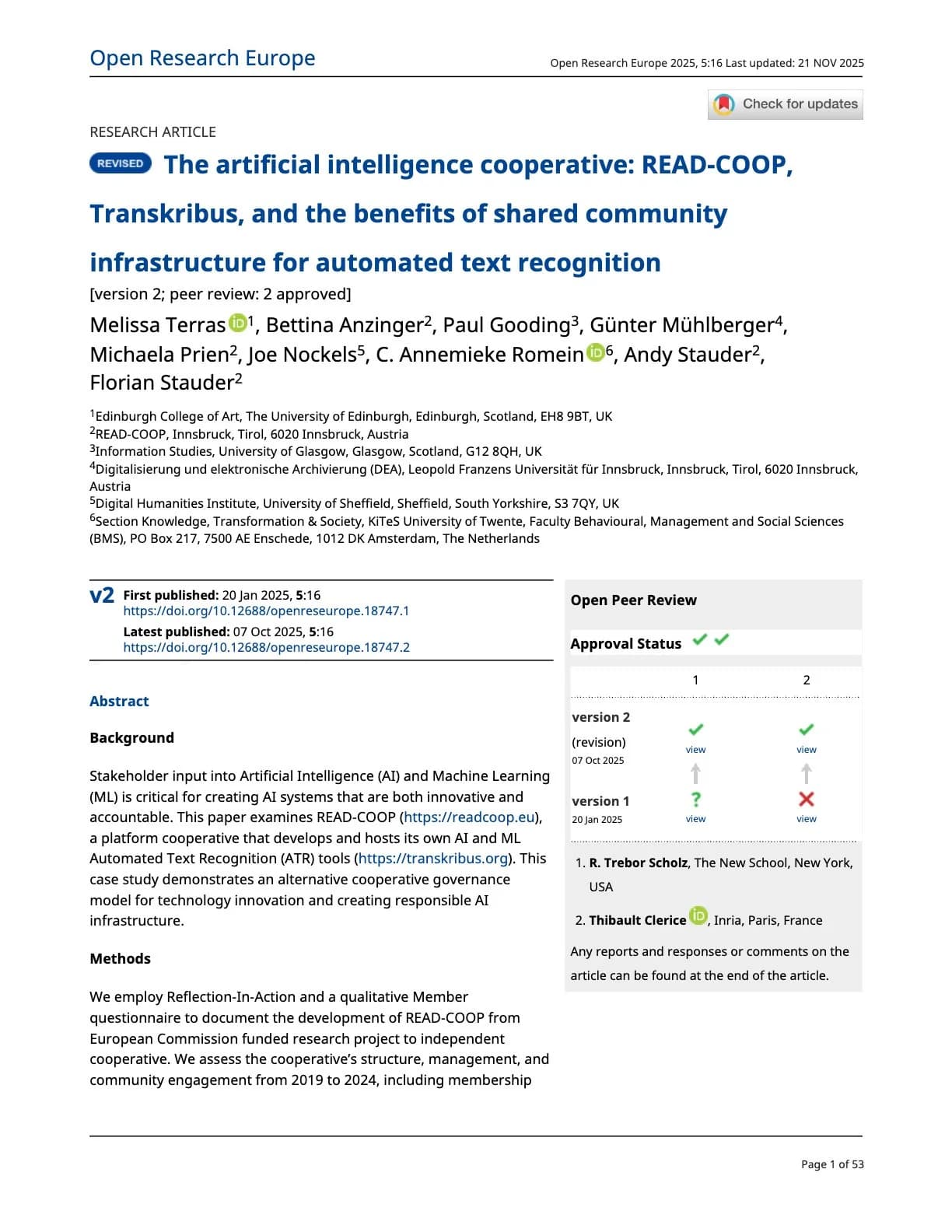
The paper, published by Open Research Europe, presents a detailed case study of READ‑COOP, a European platform cooperative that develops and hosts the Transkribus automated text recognition (ATR) service. Authored by a multidisciplinary team—including Melissa Terras, Bettina Anzinger, Paul Gooding, Günter Mühlberger, Michaela Prien, Joe Nockels, C. Annemieke Romein, Andy Stauder and others—the work documents the cooperative’s evolution from EU‑funded research projects (TranScriptorium and READ) into an independent, member‑owned entity. The study emphasizes how cooperative governance can support sustainable digital infrastructure, echoing broader interests in sustainable, community‑driven models such as those relevant to housing cooperatives across Europe.
Cooperative Structure and Membership
READ‑COOP is registered as a European Cooperative Society (SCE) with a minimum capital of €30 000. As of October 2024, it has 227 members from 30 countries, representing 45 % private individuals, 17 % universities, 10 % libraries, 10 % archives and 6 % companies. Membership fees provide discounts on Transkribus credits (e.g., €250 for a private share, €62.50 annual fee) and voting rights limited to one per person or institution. The cooperative’s board comprises 2‑5 directors, at least two of whom are employees, ensuring democratic member control while maintaining operational expertise.
Scale of Impact and Usage
Since its inception in 2019, READ‑COOP has processed over 90 million document images, with 235 000 registered user accounts as of October 2024. In October 2024, the platform hosted 227 members and reported 227 % growth in both member numbers and document processing volumes compared to its launch. The service supports a wide range of cultural heritage institutions, enabling accurate handwritten and printed text transcription with an average character error rate of 5 % for handwritten material.
Financial Model and Sustainability
The cooperative operates on a mixed revenue model: subscription‑based credit purchases, freemium access, and large‑scale processing contracts. Member discounts and the reinvestment of profits into infrastructure upgrades (e.g., new transformer‑based HTR models, web‑app migration) underpin financial sustainability. Despite high operating costs, only four members have withdrawn since 2019, indicating strong retention. The cooperative also benefits from external grants, such as a Bill & Melinda Gates Foundation award for digitising Nigerian health records.
Community Engagement and Governance
Member engagement is high: 84 % attended at least one monthly meeting, 69 % participated in the annual general meeting, and 94 % reported feeling “engaged.” Surveys reveal that members value networking, technical support, and the ability to influence development priorities. The cooperative’s transparent communication—via Slack channels, newsletters, and regular meetings—facilitates democratic decision‑making and aligns with cooperative principles of voluntary open membership and concern for community.
Technological Advancements
READ‑COOP has continuously upgraded Transkribus, launching a web‑based app (2021) and integrating transformer‑based HTR models (TrHTR) with a median character error rate of 5 %. It offers over 230 publicly available AI models for member use, while maintaining proprietary core infrastructure to protect competitive advantage. New features include layout analysis, table recognition, and multilingual support for 17 languages, expanding the platform’s applicability beyond cultural heritage to sectors such as healthcare, finance and legal services.
Lessons for Sustainable Housing Cooperatives
The READ‑COOP experience illustrates how cooperative ownership, member‑driven financing, and democratic governance can sustain complex digital services. Key takeaways for housing cooperatives include: (1) establishing clear membership structures with equitable voting rights; (2) reinvesting surplus revenues into service improvements rather than profit distribution; (3) leveraging external funding while maintaining community control; and (4) fostering strong member engagement through transparent communication channels. These principles mirror the cooperative housing sector’s goals of affordability, shared ownership and long‑term sustainability.
Outlook and Future Directions
READ‑COOP plans to expand its member base, increase AI model diversity, and explore decentralized storage solutions to further reduce environmental impact. Ongoing challenges include managing rising operational costs and balancing openness with proprietary technology protection. The authors recommend that research funders and policymakers support cooperative models for AI and other digital infrastructures, recognizing their potential to deliver sustainable, community‑centric services across Europe.