Resource context
This article (“So bauen und wohnen wir 2040”) is published by Good Impact and authored by Miriam Petzold. It presents a forward-looking, scenario-style visit to a “utopian” construction site in Germany and uses interviews and research sources to explore what a circular, low-emission building sector could look like by 2040, with implications for European cities, housing supply, and resource use.
From demolition to “harvesting” buildings
A central theme is the shift from conventional demolition to careful deconstruction, described as “harvesting” buildings so components and materials can be reused. Buildings are framed as “urban mines” rather than waste. The article links this to land-use limits: new construction permits are scarce and allowed mainly when sites become available through deconstruction, or when sealed surfaces elsewhere are restored to nature. It highlights past pressures on land take, citing that in 2021 land consumption for new settlements and roads in Germany was about 55 hectares per day (around 78 football fields).
Design by availability and material passports
Architect Christina Fuchs describes a practice called “design by availability,” where the design is determined by what reclaimed elements can be sourced—similar to assembling with uneven “Lego” pieces of different sizes, weights, and ages. Digital building scans and “material passports” are presented as enablers of this approach, helping identify and reserve reusable parts (e.g., steel beams, ceiling elements, frames, and non-load-bearing walls) for renovation projects.
Cleaner sites and additive manufacturing
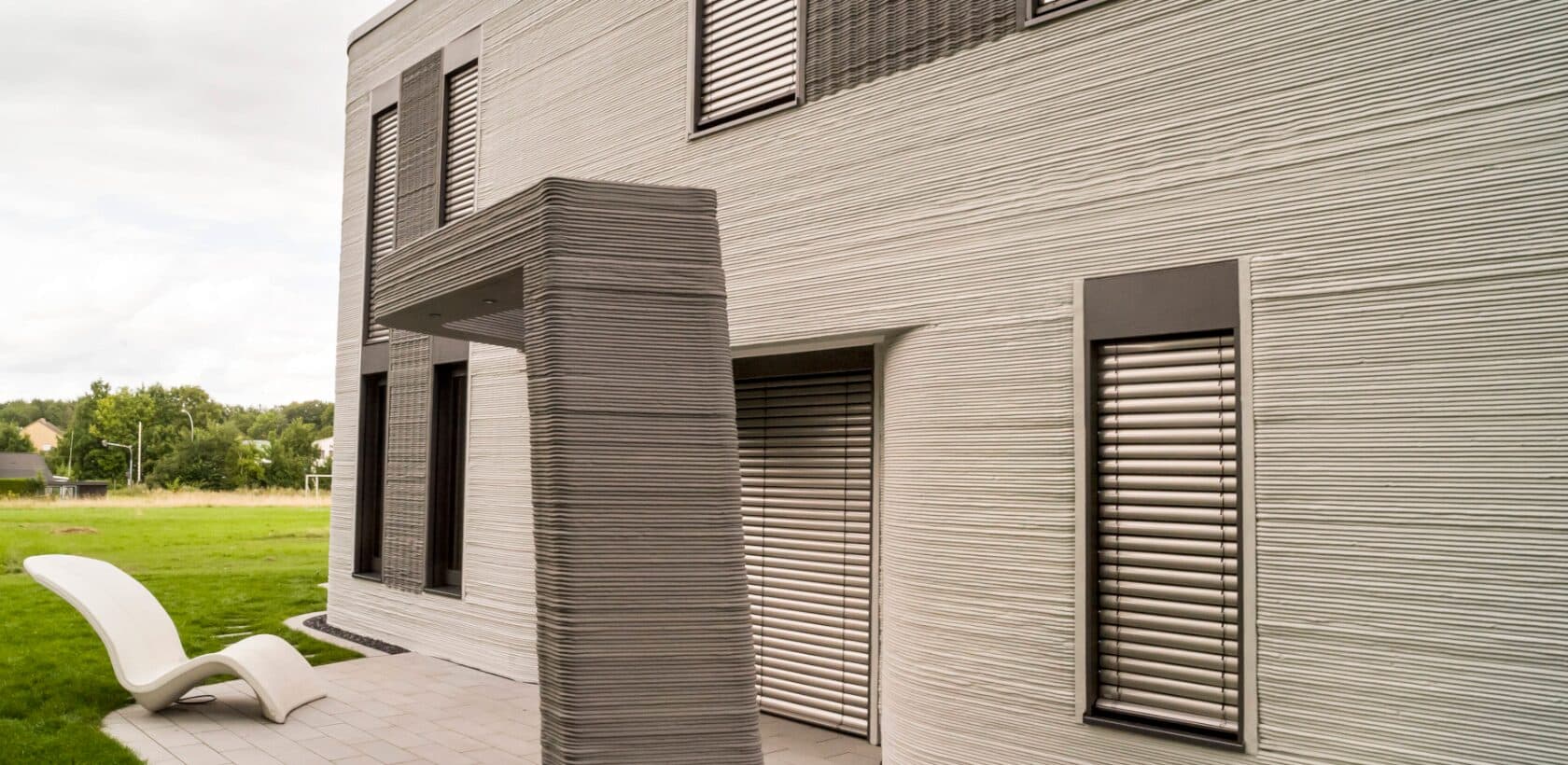
The article describes technological changes aimed at reducing emissions and waste: heavy construction machinery operating electrically rather than on diesel, improving air quality on sites. For materials that cannot be reused as intact components, it outlines processing pathways such as crushing and turning material into feedstock for computer-controlled 3D printing. It notes progress in printing horizontal elements like ceilings and describes prefabrication in factory halls for renovation, refurbishment, and vertical extensions.
Repurposing existing buildings and limiting virgin materials
A second storyline follows architect Luis Elbaz working on converting a former cable factory (and other underused buildings such as churches or parking garages) into housing. The article describes regulatory conditions: primary (virgin) raw materials are only permitted when recycled materials are insufficient, and should come from renewable sources. It also emphasizes design for disassembly—components must be removable and trackable.
“Room as a service” and space sufficiency
Construction transition activist Valerie Schott argues for more efficient use and sharing of space. The article cites a sufficiency benchmark of about 25 m² per person as adequate if supported by abundant public and semi-public spaces (cafés, parks, shared amenities). It claims that such approaches could create housing reserves for up to 30 million people without new construction, and references compact living norms (e.g., 20 m²) already common in dense global cities.
Materials, circularity targets, and urban climate co-benefits
The article projects an ambition that the sector could become 100% circular and emission-free within about a decade, calling it tight but possible. It points to the Netherlands as a forerunner and mentions a CO2 tax on building materials as a driver of innovation, including “sustainable concrete” using geopolymers instead of cement. It also portrays building envelopes that generate and manage energy (e.g., transparent films with solar cells) and green façades that cool and clean city air while supporting urban biodiversity.
Sources and expert inputs
The piece references conversations with academics and researchers (including TU Munich, TU Eindhoven, and KIT) and cites studies such as Home Report 2022 (Zukunftsinstitut), Scenario Process Construction 2030 (Fraunhofer), Bauhaus Earth, and Germany-focused studies (TU Darmstadt).