Overview of the Report and Its Origin
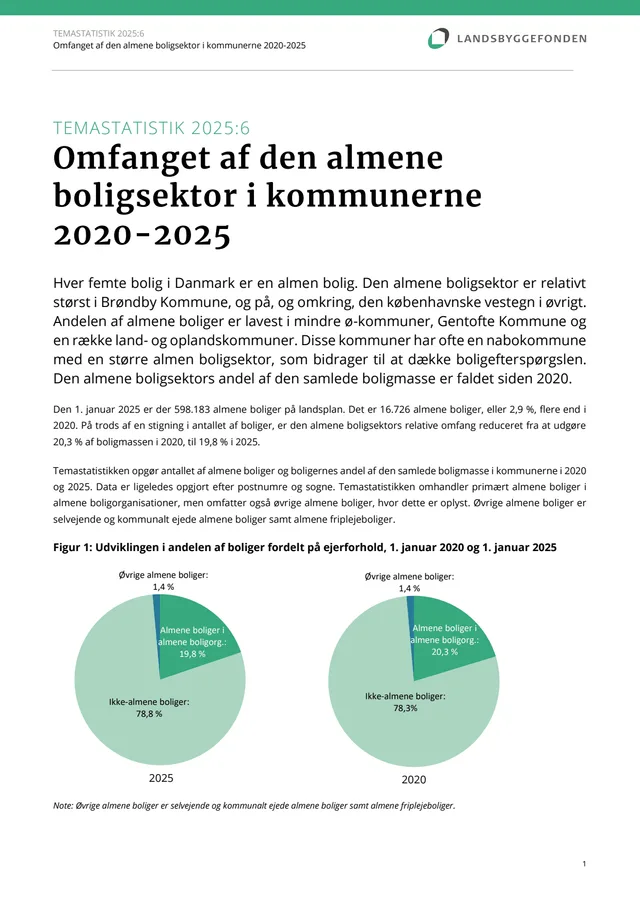
The publication titled “Omfanget af den almene boligsektor i kommunerne 2020‑2025 (Temastatistik 2025:6)” is a statistical study produced by Landsbyggefonden, a Danish foundation dedicated to research and development in the housing sector. Compiled from national building registers and the foundation’s own database, the report presents a comprehensive analysis of public (almene) housing across all Danish municipalities, comparing data from 1 January 2020 and 1 January 2025. The study is part of an ongoing series of temastatistik reports that track the evolution of the social housing market in Denmark.
Key National Figures and Trends
In 2025 Denmark counted 598 183 public homes managed by housing organisations and 42 625 additional public homes (self‑owned, municipal or charitable), totalling 640 808 public dwellings – 21.2 % of all housing stock, down from 21.7 % in 2020. The overall number of homes rose to 3 025 074, an increase of 155 262 dwellings, of which public homes grew by 16 726 (2.9 %). Non‑public homes grew faster, by 136 402 (6.1 %), leading to a slight reduction in the public‑housing share from 20.3 % in 2020 to 19.8 % in 2025.
Municipal Variations and Leaders
The report highlights stark regional disparities. Brøndby Kommune remains the municipality with the highest public‑housing share (55.1 % of its housing stock in public organisations). Other western‑Copenhagen suburbs such as Albertslund, Ballerup, Herlev, Ishøj, Rødovre, Hvidovre, Glostrup and Gladsaxe also exceed 50 % shares. Conversely, island municipalities Samsø, Gentofte and Læssø sit at the low end, with public‑housing proportions below 5 %. Across the country, 15 municipalities have public‑housing shares under 10 %, often bordering areas with higher shares.
Growth Patterns by Housing Type
Public homes owned by housing organisations increased by 16 726 units (2.9 %). Other public homes (self‑owned, municipal or charitable) rose by 2 134 units, a 5.3 % increase, yet they still represent only 1.4 % of the total housing stock. The fastest absolute growth was observed in Aarhus Kommune, which added 2 906 public homes between 2020 and 2025, followed by Copenhagen (+1 672) and Aalborg (+1 219). Despite these gains, the relative share fell because the total housing stock expanded more rapidly.
Decline in Public‑Housing Share in Major Cities
Major urban areas saw modest reductions in public‑housing percentages. Aarhus, Odense and Aalborg each experienced declines of 0.6–1.2 percentage points. Copenhagen fell by 0.7 points, ending with 18.8 % – the 34th largest share nationally. The most pronounced drop occurred in Brøndby, where the share fell by 8.9 percentage points, driven by demolition of public homes and substantial growth in the overall housing stock.
Geographic Distribution Across Postcodes and Parishes
Beyond municipal borders, the study maps public‑housing concentration at postcode and parish levels. Areas surrounding the western Copenhagen belt and several large Danish cities exhibit concentrations above 40 % of dwellings being public. Conversely, many rural and peripheral postcodes display shares below 10 %, often adjacent to higher‑share neighbours, illustrating a patchwork pattern of availability.
Implications for Sustainable Housing Policy
The data underscore the vital role of public housing in Denmark’s affordable‑housing framework, contributing to social equity and urban sustainability. While the absolute number of public homes has risen, their relative share has contracted, indicating that future policies may need to accelerate the construction of socially‑priced dwellings to keep pace with overall housing growth. The detailed municipal breakdown offers policymakers a granular view to target interventions where public‑housing share is declining most sharply.
Summary of Quantitative Highlights
- Total dwellings (2025): 3 025 074
- Public homes in organisations: 598 183 (+2.9 %)
- Other public homes: 42 625 (+5.3 %)
- Public‑housing share of total stock: 21.2 % (down from 21.7 %)
- Highest municipal share: Brøndby – 55.1 %
- Lowest municipal shares: Samsø, Gentofte, Læssø – ≤4.9 %
- Largest absolute increase: Aarhus – +2 906 homes These figures provide a factual foundation for pan‑European audiences examining how Denmark balances housing expansion with the maintenance of a robust public‑housing sector, a key component of sustainable urban development.