Overview of Study and Authors
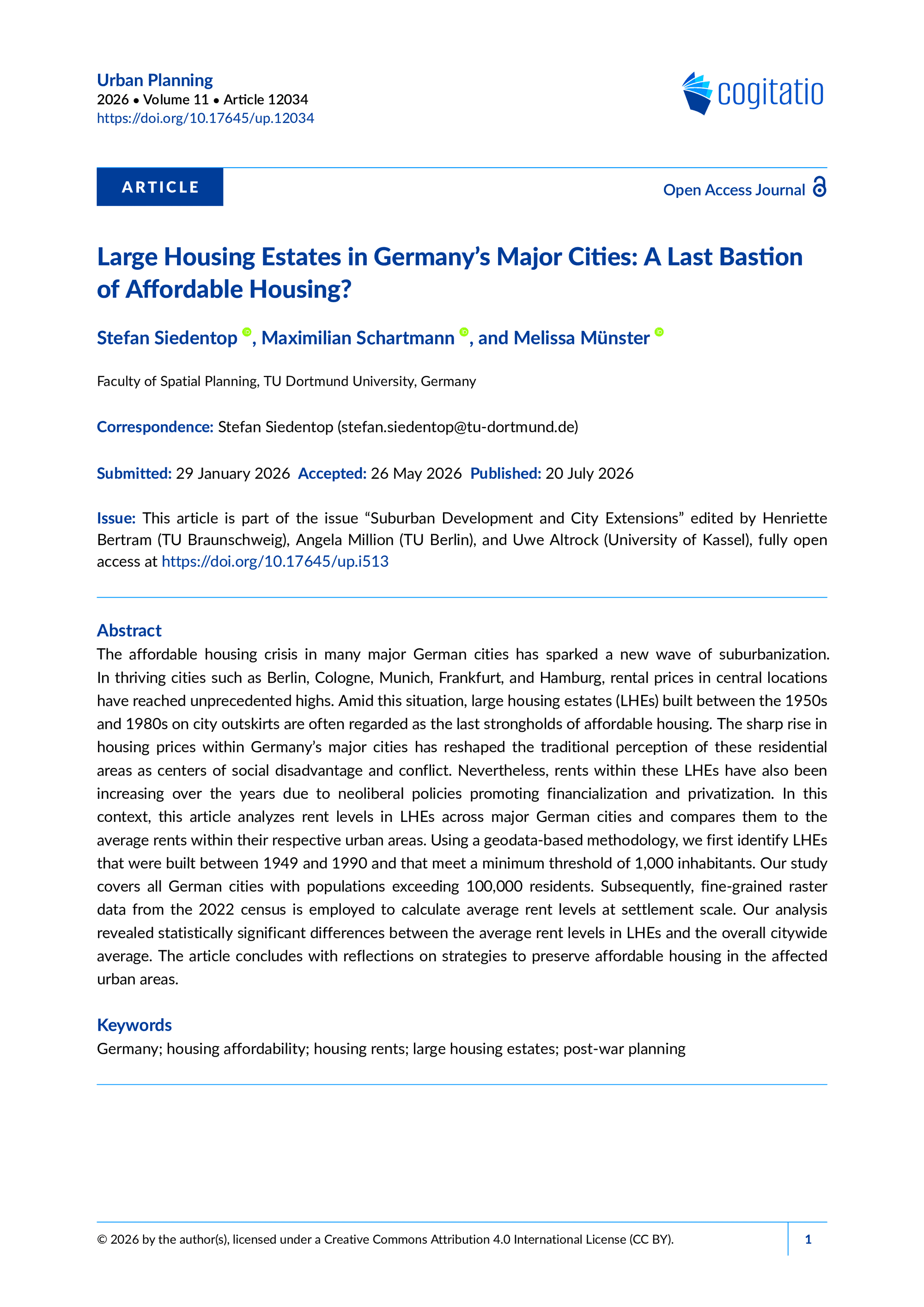
The article “Large Housing Estates in Germany’s Major Cities: A Last Bastion of Affordable Housing?” is published by Cogitatio Press in the Urban Planning journal (Volume 11, 2026). It is authored by Stefan Siedentop, Maximilian Schartmann and Melissa Münster, researchers at the Faculty of Spatial Planning, TU Dortmund University. Their expertise spans urban development, spatial analysis, and housing policy, providing a solid academic foundation for the investigation of post‑war large housing estates (LHEs) across Germany’s major metropolitan areas.
Methodology and Data Sources
The researchers employ a novel geodata‑based approach, combining 2022 census raster data with 2011 construction‑year information. LHEs are defined as dense settlements built between 1949 and 1990, housing at least 1 000 residents and comprising a minimum of 4 ha. Grid cells with ≥50 housing units per hectare and ≥90 % of units constructed in the target period are filtered, excluding cells within 3 km of city centres. Adjacent qualifying cells are aggregated to delineate estates, requiring at least four cells and a population of 1 000. Rent data are incorporated where available for at least 75 % of cells. This systematic procedure yields 353 LHEs in 80 major German cities, covering 790 000 dwellings and 1.38 million inhabitants.
Key Findings on Size and Demographics
The average LHE spans 21.9 ha, hosts 3 912 residents and contains 2 242 housing units, resulting in a population density of roughly 179 inhabitants per hectare. East‑German estates are larger (average 39.4 ha) and denser (182.8 inh/ha) than their western counterparts (15.9 ha, 175.1 inh/ha). Ownership rates are low overall (13.3 % owner‑occupied), with a stark East‑West divide: 1.6 % in the east versus 17.3 % in the west. Foreign‑born residents constitute 20.6 % of the total LHE population, higher in the west (25.3 %) than the east (15.2 %).
Rent Differentials and Affordability
In 2022, average cold rents in LHEs were €6.27 per m², compared with €7.77 €/m² city‑wide, yielding a rent price ratio of 0.81 (19 % cheaper). The gap is larger in the east (ratio 0.77, 23 % cheaper) than in the west (ratio 0.87, 13 % cheaper). Larger estates (population > 5 000) exhibit a greater advantage (22 % cheaper) than smaller ones (12 % cheaper). The median rent ratios are slightly lower than the means, indicating a right‑skewed distribution with some high‑rent outliers.
Regional and Policy Context
The study situates LHEs within Germany’s post‑war housing boom, noting that they were initially built to address acute shortages and to provide high‑quality, affordable rentals for low‑ and middle‑income households. Over time, privatisation, rent‑control expiry and demographic shifts have altered their role. East‑German estates, formerly state‑built, now face low ownership and modest rent increases, while western estates, once subsidised social housing, have experienced higher ownership rates and modest rent growth.
Implications for Sustainable Housing
The authors argue that LHEs remain critical for delivering affordable housing in high‑pressure urban markets, especially as rents in central areas have surged by roughly 83 % since 2010. Preserving the affordability of these estates requires targeted rent‑protection measures, socially balanced regeneration, and cross‑subsidisation strategies that integrate lower‑ and higher‑priced units. Investment needs are substantial; estimates suggest €90 billion required for modernisation by 2030, exceeding current public and private financing capacities.
Future Directions and Limitations
The paper highlights methodological constraints, including reliance on threshold values, the 100‑m grid resolution and incomplete rent data, which may affect the precision of estate boundaries. It calls for further research on the specific drivers of rent dynamics, ownership structures, and the social impacts of renewal programmes. Nonetheless, the authors conclude that large housing estates constitute a vital component of Germany’s affordable housing stock and offer valuable lessons for pan‑European sustainable housing strategies.