Overview of the Study
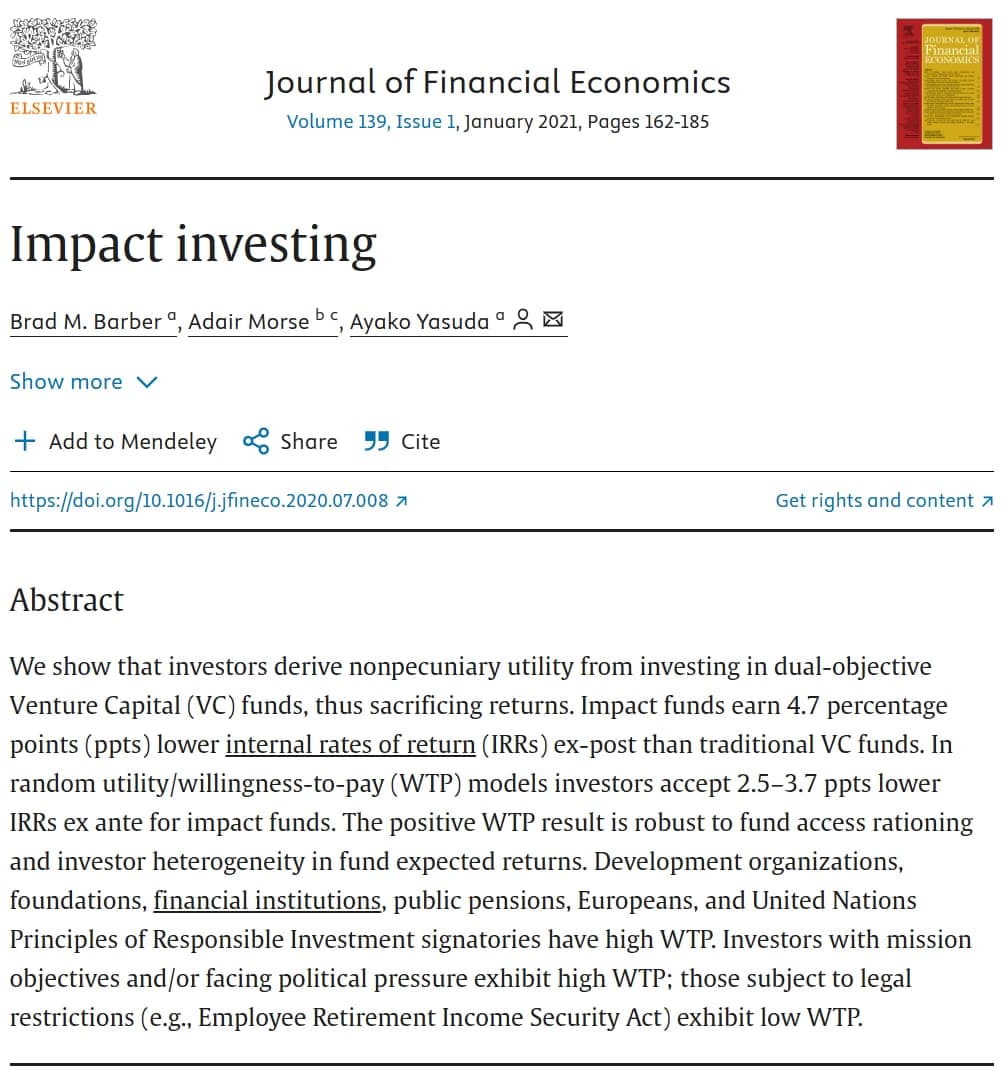
Brad M. Barber, Adair Morse and Ayako Yasuda ask whether investors knowingly accept lower expected financial returns in exchange for social or environmental impact. Their setting is venture capital and growth-equity funds that explicitly state a dual financial and impact objective. The paper appeared in the Journal of Financial Economics (vol. 139, no. 1, 2021, pp. 162–185).
Data and Method
Using Preqin data, the authors assemble about 24,000 investments by some 3,500 investors in 4,659 funds between 1995 and 2014; 159 of those funds are coded as impact funds under a strict dual-objective test, and each investor's ultimate source of capital is coded into ten types. Because VC investors commit their capital once, when a fund is raised, the study can model each investor's choice among the funds raising money in a given year. A discrete-choice (hedonic) model then converts the pull of the impact label into a willingness to pay, measured in expected return.
Key Findings
Ex-post returns: impact funds' annualised IRRs are 4.7 percentage points lower than those of traditional VC funds, after controlling for industry, vintage year, fund sequence and geography. Willingness to pay: in aggregate, investors accept 2.5–3.7% lower expected IRR in order to invest in impact. Who pays: development organisations, banks and insurers (plausibly responding to community-reinvestment obligations), public pension funds, and investors in Europe, Latin America and Africa show the highest willingness to pay; foundations show a small positive one in some specifications. Why they pay: a mission focus is associated with 3.4–6.2 points of expected excess IRR, and political or regulatory pressure with 2.3–3.3 points. Legal restrictions on investing for non-financial motives, such as ERISA and UPMIFA in the United States, are associated with less. Which impact: preliminary evidence suggests funds targeting environmental impact, poverty alleviation and women- or minority-owned firms attract the most; SME and social-infrastructure funds do not reliably differ from conventional VC.
Relevance
The paper is not about housing. Its value here is as evidence that identifiable groups of investors — mission-driven organisations, those under regulatory or political pressure, and European investors — will knowingly accept below-market returns for intended impact, which bears on how patient capital for cooperative housing might be sourced and priced.