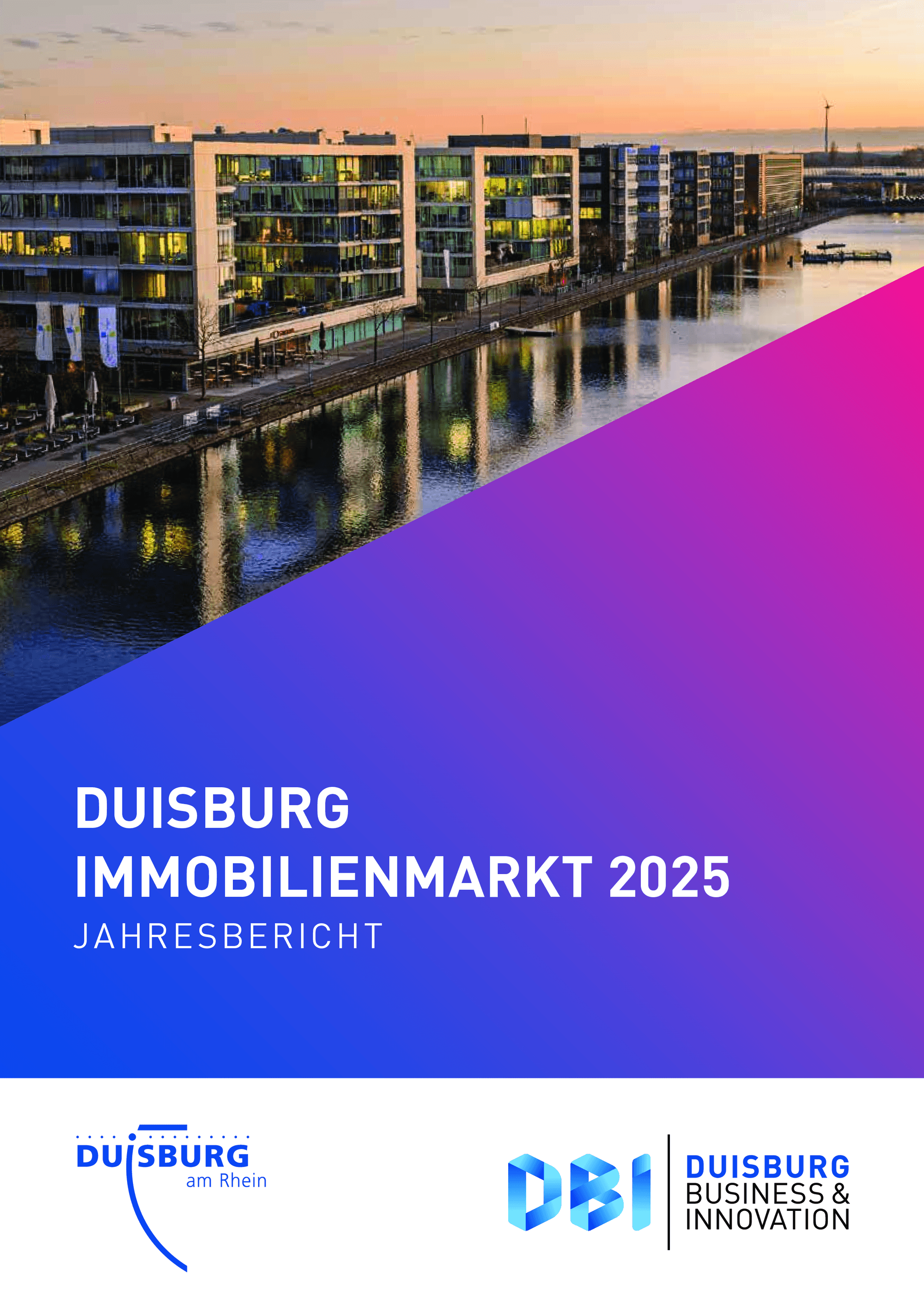
Overview of the Report and Its Origin
The Immobilienmarktbericht Duisburg 2025 is an annual property market study produced by Duisburg Business & Innovation GmbH, a regional economic development agency. It is authored by Rasmus C. Beck and Michael Rüscher, who are senior analysts within the organisation. The report synthesises data extracted from the 2025 market and presents a comprehensive view of the housing and commercial property sectors in Duisburg, a city in the Ruhr region of Germany.
Key Findings on Residential Housing
The residential segment in 2025 shows a total stock of approximately 19.3 million m² of living space, with only 20,700 m² of new construction completed during the year. Average new‑build rent stands at €12.00 per m² (peak €15.00 per m²), while the secondary market rent averages €7.80 per m² (peak €10.20 per m²). Purchase prices for new‑build apartments reach up to €4,600 per m², with premium locations exceeding €6,000 per m². Existing apartments trade at around €1,900 per m². The report notes a persistent shortage of affordable housing, which limits supply growth and pressures rental levels.
Sustainability Aspects of New‑Build Housing
Although the report does not provide explicit sustainability ratings, it highlights that modern developments are increasingly required to meet energy‑efficiency standards and ESG considerations. The limited new‑build volume (20,700 m²) reflects cautious investment in projects that can achieve higher environmental performance, aligning with broader European goals for low‑carbon housing.
Investment Climate and Returns
Overall investment volume in Duisburg’s property market totals €169 million, with the logistics and production segment absorbing roughly €130 million (≈ 75 %). Net initial yields vary by asset class: logistics 5.2 %, office 5.5 %, and retail 6.7 %. The average net yield across the market is 6.5 %, indicating a relatively stable but selective investment environment. The low‑yield office market (≈ 5.5 %) suggests strong demand for high‑quality, energy‑efficient office space.
Logistics and Light‑Industrial Sectors
Logistics assets dominate the market, with a modern stock of about 729,850 m², a 2.2 % increase over the previous year. Average rent for logistics space is €5.20 per m² (peak €8.00 per m²). Light‑industrial space grew to 228,000 m², a 7.5 % rise, driven by flexible industrial parks that can accommodate sustainable production and distribution models.
Retail and Office Market Highlights
Retail space maintains a centrality index of 107.3, underscoring Duisburg’s role as a regional shopping hub. Prime‑location retail rents range from €35.00 to €37.00 per m², while secondary locations sit at €13.00 to €23.00 per m². Office vacancy is 4.6 % (≈ 107,000 m²), below the Ruhr average of 5.3 %. Average office rent rose to €12.40 per m², with peak rents between €18.50 and €22.00 per m².
Outlook for Sustainable Housing Development
The report foresees a continued need for affordable, energy‑efficient housing in Duisburg. Future investment is expected to focus on retrofitting existing stock to meet ESG standards and on selectively expanding new‑build projects that can deliver high sustainability performance. The city’s strong logistics base and stable office market provide a supportive economic backdrop for such housing initiatives.