Overview of the Guide
The London Energy Transformation Initiative (LETI) produced this Climate Emergency Retrofit Guide to help professionals and homeowners understand how existing UK homes can be adapted to meet national climate targets. LETI, established in 2017, is a network of over 1,000 built‑environment experts—including architects, engineers, housing‑association staff and local‑authority planners—working to accelerate the transition to net‑zero carbon buildings.
Scope and Scale of the Housing Stock
The UK contains roughly 28 million dwellings, 80 percent of which were built before 2050. Existing homes account for 69 percent of operational emissions from the building sector and 18 percent of national emissions. Space‑heating demand averages 130 kWh / m² /year, with a wide distribution from 10 to 200 kWh / m² /year across building types.
Potential Energy Reductions
LETI’s modelling shows that best‑practice retrofits can cut space‑heating demand by 56‑83 percent, depending on constraints, and hot‑water demand by about 58 percent. A deep retrofit (including fabric upgrades, airtightness, high‑performance glazing and heat‑pump integration) can achieve a space‑heating demand of 20‑30 kWh / m² /year—up to a 70 percent reduction from the baseline. Unconstrained retrofits typically target 50 kWh / m² /year, with an additional 10 kWh allowance for heritage or space‑constrained homes.
Energy Use Intensity (EUI) Targets
LETI defines a best‑practice EUI of 50 kWh / m² /year (up to 60 kWh / m² /year for constrained cases). These figures are based on modelling that assumes heat pumps with a seasonal coefficient of performance (SCOP) of 2.5 or higher, and they replace the traditional EPC cost‑based metric. The exemplar target pushes EUI down to 25 kWh / m² /year, comparable with Passivhaus EnerPHit standards.
Renewable Integration and Fossil‑Fuel Free Homes
The guide recommends maximising on‑site renewables where feasible, aiming for 40 percent roof coverage with photovoltaic panels on homes that can accommodate them. Fossil‑fuel‑free homes are defined as those that eliminate gas or oil boilers and rely on electric heat pumps powered by an increasingly decarbonised grid.
Retrofit Process and Standards
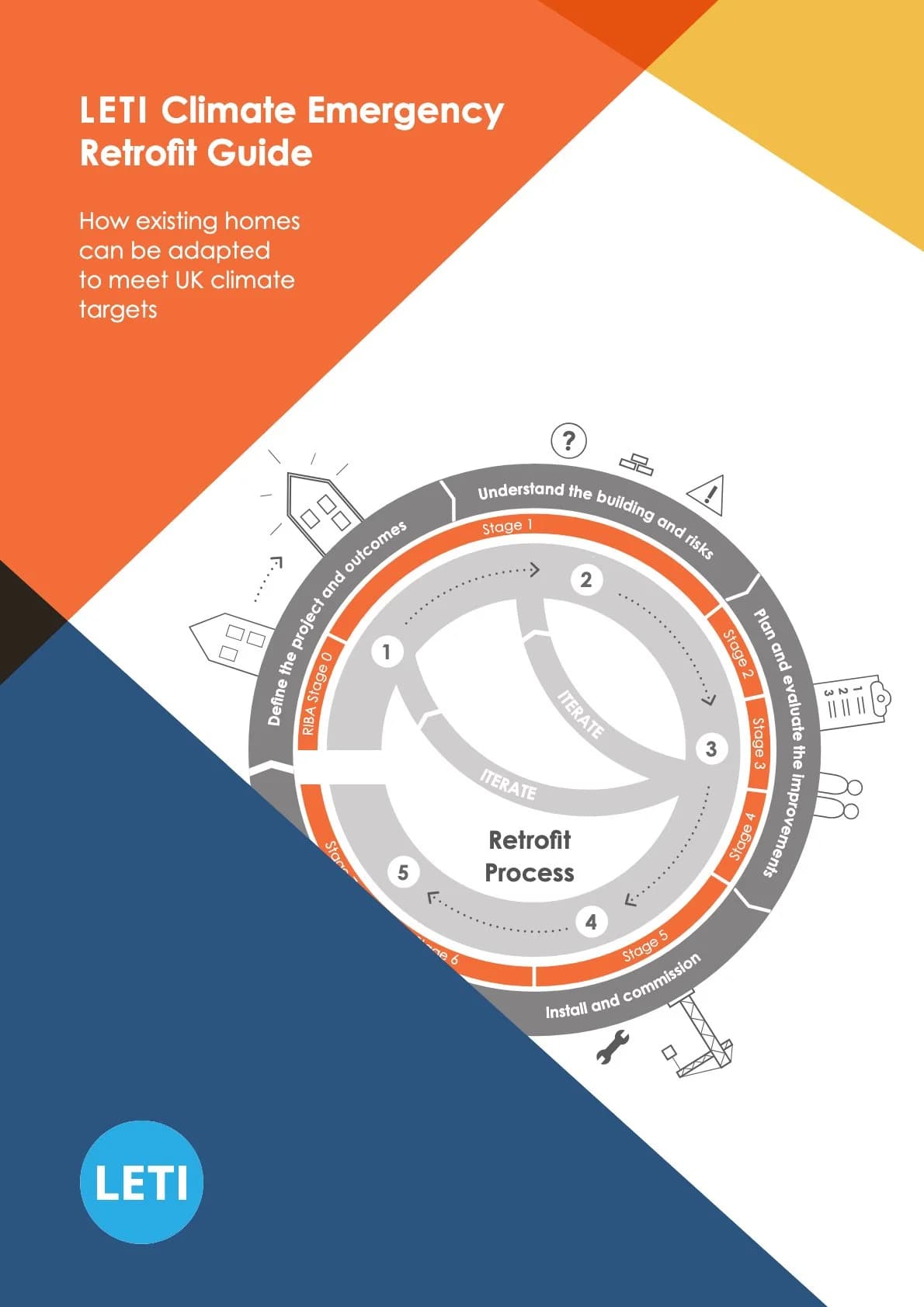
LETI outlines a six‑stage retrofit process: define project outcomes, understand the building, plan improvements, install and commission, and check outcomes. It maps directly onto PAS 2035 and the RIBA Plan of Work, encouraging the use of recognised standards such as the AECB Retrofit Standard, PAS 2035, and Passivhaus EnerPHit for deeper retrofits. The constituent‑element method provides U‑value and airtightness targets for walls, roofs, floors, windows, doors and ventilation when detailed energy modelling is not feasible.
Economic and Social Benefits
A nationwide retrofit programme could generate up to 500,000 new jobs by 2030 and add £309 billion to the economy. Reducing space‑heating demand by 50 percent could lower average fuel bills by £390 per household, helping to lift 11 percent of UK homes out of fuel poverty. Health improvements, reduced carbon emissions and increased property values are also highlighted.
Case Study Evidence
LETI presents several illustrative case studies, including a semi‑detached retrofit on Zetland Road that achieved an EUI of 32 kWh / m² /year (modelled) and measured 42 kWh / m² /year in the first year, dropping to 34 kWh / m² /year after full occupancy. Other examples span detached villas, high‑rise blocks and listed terrace houses, demonstrating that both constrained and unconstrained retrofits can meet the defined targets when tailored to building form, heritage status and occupant needs.
Access and Further Information
The full guide is available on LETI’s website and can be downloaded for deeper technical detail, including annexes on U‑value sweet spots, moisture risk mitigation, and a library of retrofit tools. Stakeholders across Europe can apply the same methodology to assess their own housing stocks, adapt the targets to local climate conditions, and contribute to the collective goal of a net‑zero built environment.