
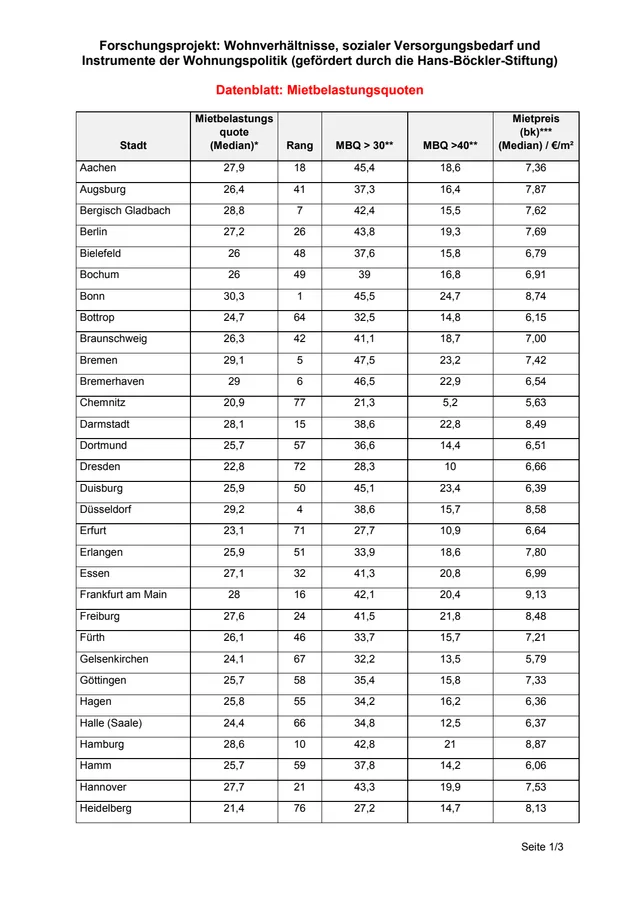
Overview of the Data Sheet
This data sheet comes from a Hans‑Böckler‑Stiftung research project on housing conditions, social housing need and the instruments of housing policy. For 77 German cities it lists four measures: the median rent‑burden ratio (Mietbelastungsquote, the share of net household income spent on gross cold rent), the city's rank on that median, the share of households spending at least 30% and at least 40% of net income on gross cold rent, and the median gross cold rent per m². Rank 1 is the heaviest burden and rank 77 the lightest.
Median Rent Burden
Across all 77 cities the median household spends 26.8% of net income on gross cold rent. The heaviest burdens are in Bonn (30.3%, rank 1), Neuss (30.1%), Köln (29.3%), Düsseldorf (29.2%) and Bremen (29.1%). The lightest are in Chemnitz (20.9%, rank 77), Heidelberg (21.4%), Wolfsburg (21.9%) and Leipzig (22.6%).
Households Spending 30% or More
Overall, 40% of households spend at least 30% of net income on gross cold rent. The highest shares are in Neuss (49%), Bremen (47.5%), Bremerhaven (46.5%), Köln (46.4%) and Krefeld (46.3%). The lowest are in Wolfsburg (21.2%) and Chemnitz (21.3%), followed by Heidelberg (27.2%) and Erfurt (27.7%).
Households Spending 40% or More
On the stricter 40% line, 18.7% of households are affected overall. The highest shares are in Köln and Neuss (both 25.8%), Mainz (25.3%), Bonn (24.7%) and Potsdam (24.2%). The lowest are in Chemnitz (5.2%), Wolfsburg (7.2%), Leipzig (9.5%) and Dresden (10%).
Median Gross Cold Rent
The median gross cold rent is €7.69/m² across all cities. It ranges from €5.63/m² in Chemnitz (the lowest), Gelsenkirchen (€5.79) and Hamm (€6.06) up to €10.25/m² in München, €9.13 in Frankfurt am Main and €8.87 in Hamburg.
Regional Patterns
The eastern German cities in the sample cluster at the light end of the ranking: Chemnitz (77), Leipzig (74), Jena (73), Dresden (72), Erfurt (71), Magdeburg (69) and Halle (66) all combine low rents with below‑average burdens. Potsdam (rank 29) and Rostock (44) are the eastern exceptions. The heaviest burdens sit in Rhineland cities such as Bonn, Neuss, Köln and Düsseldorf and in the north‑western port cities of Bremen and Bremerhaven. A high rent does not by itself mean a high burden: München has the highest rent but ranks 14th, while Heidelberg (rank 76) pairs above‑average rents with one of the lightest burdens.
Method and Limits
The sheet reports medians, so the figures describe the typical household rather than the extremes. It measures gross cold rent (rent plus cold service charges, without heating) against net household income. The sheet itself gives no survey year; treat it as a snapshot from the project period rather than a current reading.
Relevance for Housing Policy
The data shows where rent is a heavy load for ordinary households and where it is not. Cities at the top of the ranking face affordability pressure that reaches well into the middle of the income distribution; cities at the bottom, such as Chemnitz, face a different problem, where low rents sit beside vacancy and low incomes. Both situations matter for decisions about new supply, subsidy and cooperative housing.