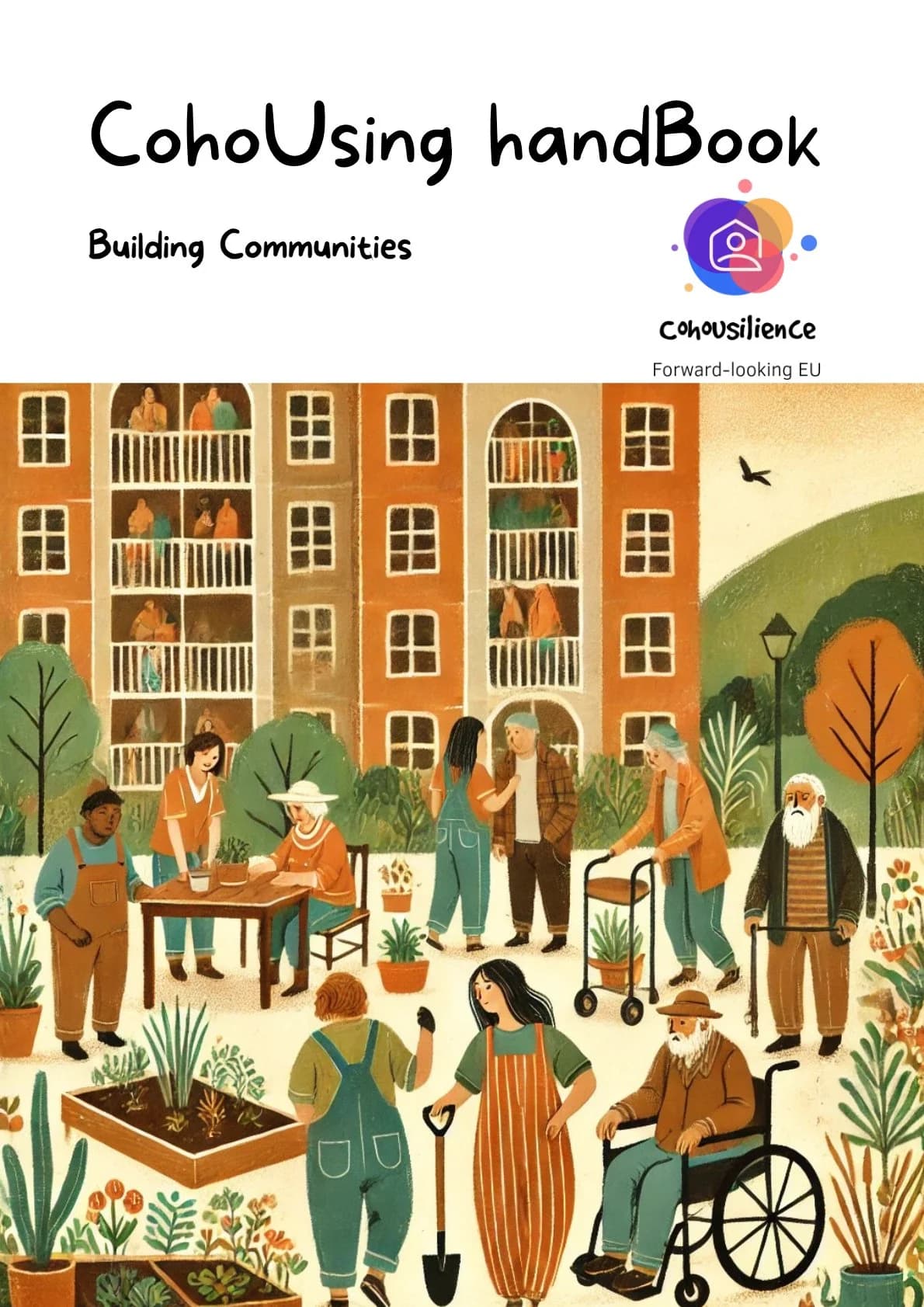
Overview of the Handbook
The CohoUsing Handbook is a comprehensive guide produced by the Cohousilience consortium, a European project funded by Erasmus+. It gathers practical tools, case studies and methodological reflections to support individuals, community leaders, public administrations and NGOs interested in developing cohousing initiatives across Europe. The publication is publicly available through the Cohousing‑Pioneers website and reflects contributions from a diverse network of partners, including FAI Padova (Italy), Associazione Atypica (Italy), Community Land Trust Brussels (Belgium), Association Caracol (France), Consorcio Andaluz de Impulso Social (Spain), Odisee University (Belgium), Animam Viventem (Portugal), MDAT (Greece) and others.
Vision for Resilient Communities
Cohousing is presented as a model that goes beyond conventional housing by fostering collaboration, social inclusion and environmental sustainability. The handbook emphasizes that cohousing can address demographic ageing, social exclusion and the housing crisis by creating shared spaces that promote mutual care, equity and participation. It positions cohousing as a catalyst for building resilient, inclusive neighborhoods that can adapt to urban or rural contexts throughout Europe.
Core Components of the Guide
The document is organized around practical topics such as co‑design, material selection, energy strategies, progressive spaces, budgeting, financing, legal forms, governance, entry‑exit procedures and partnership building. Each section provides concrete tools—workshops, decision‑making matrices, budgeting worksheets and templates for community agreements—enabling users to move from concept to implementation while maintaining a focus on sustainability and social impact.
Illustrative Pilot Projects
Four flagship pilots are highlighted:
- Casa GAIA (Padua, Italy) – a mixed‑age cohousing offering private flats, shared amenities (gym, kitchen, garden) and integrated health services. The project’s budget of €1.5 million was financed 63 % by the IAF, 13 % by European and private foundations, and 17 % by additional construction funds.
- Luoghi Comuni San Salvario (Turin, Italy) – a temporary cohousing providing 24 furnished flats with communal kitchens and cultural spaces, targeting students, mobile workers and people in housing stress.
- Spazio Ca.S.A. (Milan, Italy) – a social housing project combining accommodation with job‑desk, legal advice and cultural mediation for migrants and vulnerable families.
- Colocation ELSAU (Strasbourg, France) – a refugee‑focused temporary cohousing delivering 12 shared flats, communal areas and low‑cost rent (≈ €142 + €141 utilities per month). These cases demonstrate diverse ownership models, financing schemes and target groups, illustrating the adaptability of cohousing to various European contexts.
Financial Sustainability and Funding
The handbook details two budgeting concepts: the Material Execution Budget (PEM) covering construction costs and the Contract Execution Budget (PEC) which adds typical overheads (13‑15 %) and profit margins (6‑8 %). It provides cost ranges per square metre for basic, Passivhaus‑standard and common‑space constructions (≈ €1,100‑€1,800 /m²). Financial sustainability is addressed through collective ownership structures (cooperatives, community land trusts), solidarity funds, progressive contributions and mixed financing (equity, bank loans, public subsidies, ethical investors). Scenarios for member contributions, repayment capacities and risk mitigation are included.
Legal Forms and Governance
A comparative table outlines the advantages and limitations of associations, limited companies, foundations, cooperatives, community of property and mixed models. The cooperative with transfer of use is identified as the most common legal vehicle for European cohousing, allowing separation of land ownership from residential use and facilitating access to ethical financing. Governance models such as sociocracy, TEAL and spiral dynamics are presented, with guidance on assemblies, circles, consent‑based decision‑making and role rotation to ensure inclusive participation.
Partnerships and Ecosystem Integration
The guide stresses the importance of alliances with NGOs, municipalities, educational institutions and local businesses. It proposes mapping tools to identify existing relationships, assess partnership strength and design a roadmap for strategic collaborations. Emphasis is placed on connecting cohousing projects to neighbourhoods through shared gardens, cultural events, open workshops and joint sustainability initiatives.
Monitoring Impact and Continuous Learning
A dedicated section on impact assessment outlines methods for measuring social, economic and environmental outcomes, including qualitative indicators (sense of belonging, inclusion) and quantitative data (energy savings, cost reductions). The handbook encourages iterative learning, documentation of best practices and dissemination of results to influence public policy and replicate successful models across Europe.
Conclusion for Sustainable Housing Stakeholders
The CohoUsing Handbook offers a fact‑based, methodical resource for pan‑European audiences seeking sustainable housing solutions. By integrating design, finance, legal, governance and community‑building dimensions, it equips practitioners with the knowledge to develop resilient, inclusive cohousing projects that contribute to the broader European objectives of social equity, environmental stewardship and affordable housing.