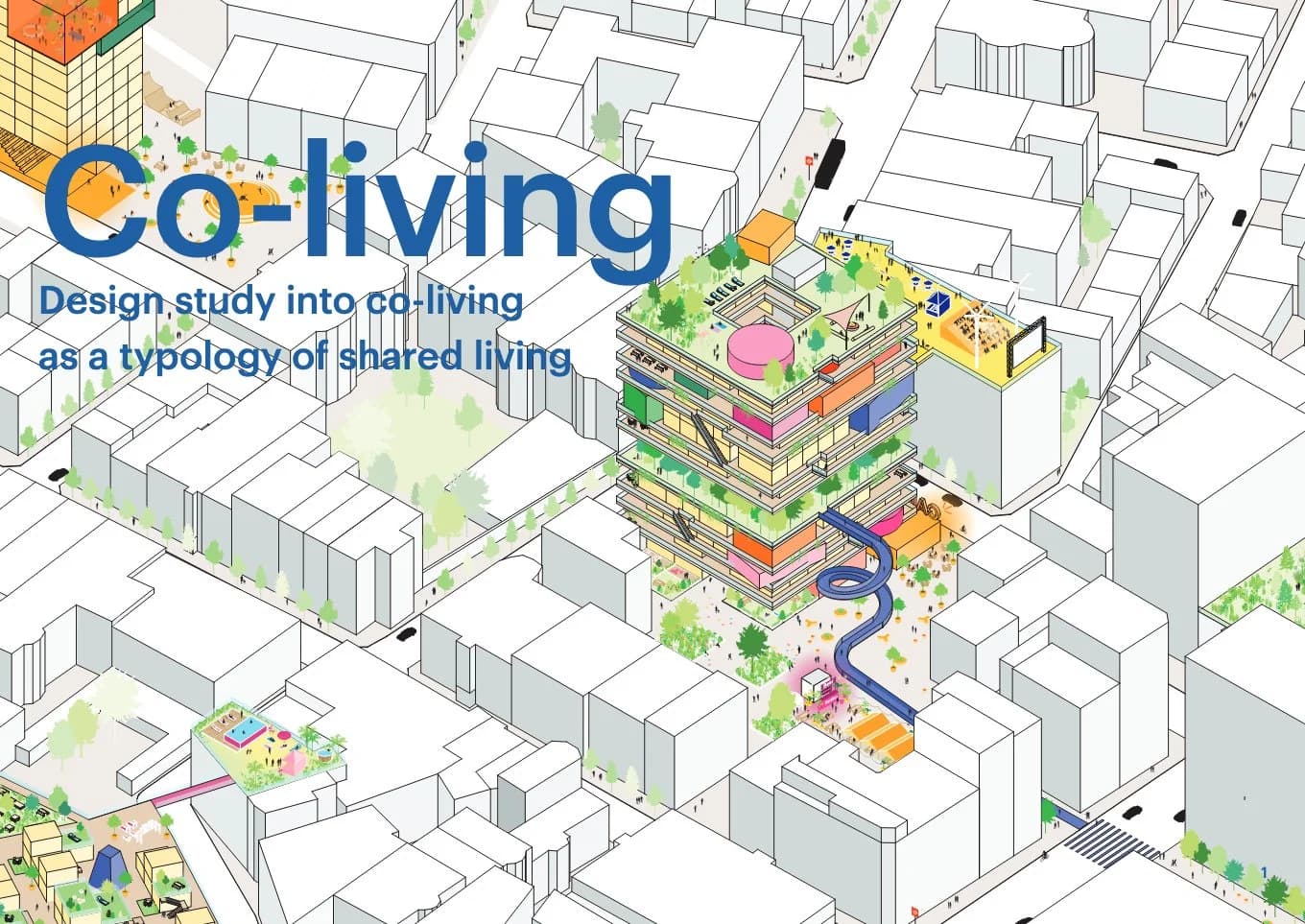
Overview of the Design Study
The resource is a comprehensive design study on co‑living produced by the internationally recognised architecture firm MVRDV in partnership with HUB and Bridges Fund Management. Authors include senior architects and designers such as Winy Maas, Sanne van Manen, Damien Sharkey, Kate Brown, Celia Harrison and Peter Murray. The study, published in early 2024, investigates co‑living as a typology that can address housing shortages, climate change and social isolation across Europe.
Scope and Structure of the Book
The booklet contains a foreword, an introduction, eleven themed chapters and a conclusion, each exploring aspects such as social spaciousness, typology catalogues, vibrant community creation and future challenges. It combines qualitative insights from interviews (Q&A) with quantitative data on space utilisation, carbon reduction and demographic trends.
Key Statistics and Data
- Total pages: 140 + , ISBN 978‑90‑90‑38170‑1.
- Published by MVRDV, HUB and Bridges Fund Management, both known for sustainable urban projects.
- The study cites that 5‑10 % of the European population would prefer communal living arrangements.
- Co‑living can reduce embodied carbon by re‑using existing office or parking structures, potentially cutting operational emissions by up to 30 % compared with new builds.
- Typical floor‑area allocations range from 600 m² to 4 800 m² per typology, with communal spaces accounting for 20‑35 % of total built area.
- Target groups include young professionals, students, expats, older downsizers and digital nomads, reflecting the diverse demographic shift toward single‑person households in Europe.
Typologies Presented
The study outlines several scalable models:
- Stacked Village – vertical stacking of private homes around shared courtyards and green roofs.
- Inside‑Out – external corridors with front‑door access and communal gardens.
- Grotto – interior “grotto” space linking private units to collective facilities.
- Vertical Neighbourhood – mixed‑size blocks creating varied unit types and shared amenities.
- Rooftop Village – conversion of flat rooftops into additional residential and communal layers. Each typology includes floor‑plan dimensions, suggested material palettes (e.g., timber, recycled steel) and potential carbon savings.
Sustainability Focus
Environmental performance is a core theme. The authors advocate:
- Re‑purposing stranded assets (office buildings, parking grids) to avoid new construction.
- Integrating renewable energy (solar panels, wind turbines) and rain‑water harvesting on rooftops.
- Designing flexible interiors that can be re‑configured for changing household sizes, extending building lifespan.
- Incorporating green roofs and vertical farms to improve biodiversity, reduce heat‑island effects and provide on‑site food production.
Social Impact and Community Building
The study emphasizes “social spaciousness” – designing accidental encounter zones akin to streets and squares within buildings. Findings show that shared amenities such as kitchens, co‑working spaces, gyms and gardens increase resident satisfaction and reduce loneliness, especially among older adults and newcomers. The research highlights case studies where co‑living projects have fostered mixed‑tenure communities, supporting affordable housing while maintaining social cohesion.
Future Outlook and Recommendations
The authors identify three strategic directions for European policymakers and developers:
- Regulatory Adaptation – simplify planning for mixed‑use conversions and encourage flexible tenancy models.
- Investment in Modular Construction – enable rapid deployment of typologies on existing structures.
- Integration with 15‑Minute City Concepts – locate co‑living sites within walking or cycling distance of essential services, reinforcing sustainable mobility.
Conclusion for a Pan‑European Audience
Overall, the design study provides a data‑driven roadmap for scaling co‑living across Europe’s urban landscape. By leveraging existing building stock, incorporating renewable technologies and prioritising communal spaces, co‑living can contribute significantly to sustainable housing targets, carbon reduction goals and the creation of resilient, inclusive neighbourhoods.