Overview of the Lublin Housing Report
The report “Budownictwo mieszkaniowe w województwie lubelskim w 2025 roku” is produced by the Urząd Statystyczny w Lublinie, the regional statistical office responsible for collecting and analysing demographic and economic data in the Lublin province. It presents a detailed statistical review of new residential construction completed in 2025, offering insight into trends that are relevant for sustainable housing policy across Europe.
Scale of New Housing in 2025
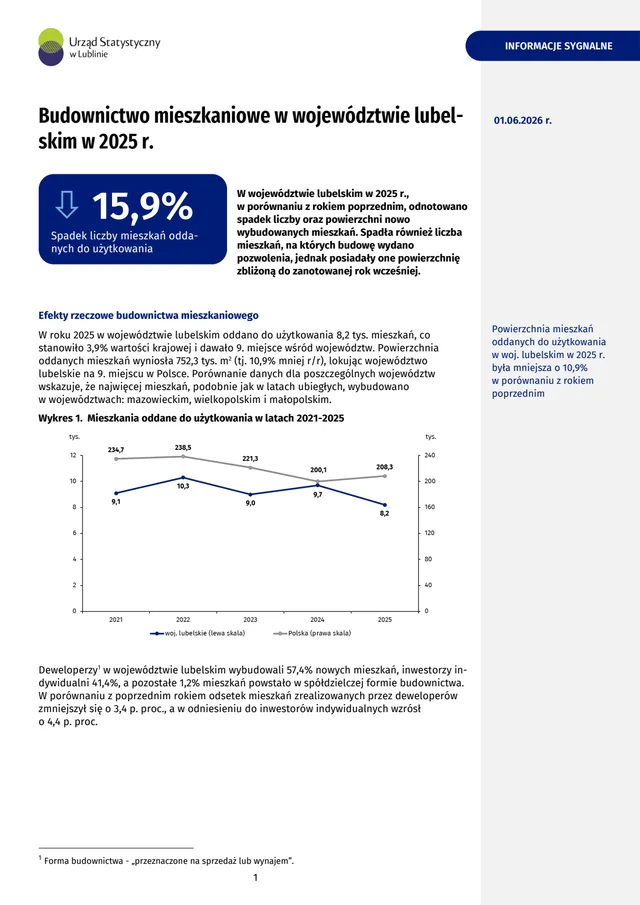
In 2025, the Lublin region delivered 8 200 new dwellings, representing 3.9 % of the national total and placing the region eighth among Polish voivodeships. The total floor area of these units was 752 300 m², a decline of 10.9 % compared with the previous year. The average size of a new flat was 92.1 m², exceeding the Polish average of 87.0 m² by 5.1 m².
Construction Forms and Market Share
Developers built 57.4 % of the new homes, individual investors accounted for 41.4 %, and cooperative housing contributed 1.2 %. The share of developer‑built units fell by 3.4 percentage points year‑on‑year, while the share of individual investors rose by 4.4 points. Housing intended for sale or rent comprised 15.9 % of the total, with a modest increase in the proportion of rental units.
Building Types and Sizes
New dwellings were almost exclusively constructed in new buildings (99.4 % of the total). Single‑family houses accounted for 4.1 thousand units and multi‑family blocks for a similar number, with 3.9 thousand units destined for sale or rent. The average floor area of a single‑family home was 132.5 m², whereas multi‑family units averaged 50.7 m². Individual‑investor homes were the most spacious (138.8 m²) and cooperative units the smallest (50.0 m²).
Energy and Utilities Infrastructure
Technical infrastructure coverage was high: 93.9 % of the new flats had connection to the public water supply, 70.3 % to sewerage, 35.1 % to natural gas and 34.3 % to district heating or central hot‑water systems. Individual heating was present in 65.7 % of the units, with gas boilers used in 39.2 % of those installations. Urban dwellings showed higher utility connections than rural ones, mirroring national patterns.
Construction Duration and Building Techniques
The average construction period for a new residential building in 2025 was 47.2 months, 3.5 months longer than in 2024. Multi‑family projects were completed faster (27.1 months) than single‑family houses (55.3 months). Traditional masonry (brick, block or hollow‑brick walls) remained the dominant structural system, used in 98.0 % of new buildings. Wooden construction accounted for 0.7 % of projects, with monolithic and large‑panel methods each below 0.4 %.
Regional Disparities and Demographic Context
Urban areas supplied 59.7 % of the new homes, a slight decrease from the previous year, while rural construction contributed a larger share of total floor area (55.6 %). Lublin city alone delivered 35.6 % of the regional total, followed by Lublin County with 14.4 %. The region’s housing density was 4.1 units per 1 000 inhabitants, placing it 11th nationwide.
Outlook for Future Development
In 2025, construction activity started on 8.6 thousand dwellings, 20.5 % fewer than in 2024, indicating a slowdown in market momentum. Building permits were issued for 8.9 thousand units, down 11.9 % year‑on‑year. Nonetheless, the data suggest a continued emphasis on larger, individually owned homes and a persistent reliance on conventional construction methods, factors that will shape the sustainability profile of future housing in the Lublin region and provide useful benchmarks for pan‑European housing strategies.