
High ownership, and almost nothing to rent below the market
Greece built its housing settlement around the family and the title deed, not the state. After the 1922 refugee influx and the post-war decades, homes were produced largely through αντιπαροχή — the land-for-flats exchange, in which a landowner handed a plot to a small builder and was repaid in finished apartments rather than cash. It put millions into ownership without a mortgage market or a public landlord, and it left housing, as the urban sociologist Thomas Maloutas puts it, an individual or family concern rather than a public one. That history is why the country today argues about prices and supply far more than about who governs the stock.
The tenure mix shows the result in numbers. About 74.4% of Greeks are owner-occupiers — one of the highest shares in Western Europe — and 25.6% are tenants. Almost all of that rental is private: the private-rental segment is around 25.2% of stock, while the non-market tier of public and social housing comes to just 0.4%. The cooperative share is 0% — Greece is the rare large European economy with no cooperative-housing sector at all. The non-market segment is therefore essentially the whole story of what is missing.
- Owners
- Owner-occupier74.4%
- Renters
- Public & non-profit rental0.40%
- Cooperative0.00%
- Private rental25.2%
What passes for social housing is a thin regulatory layer rather than a tenure. The social-housing share of stock is about 0.8%, and public housing about 35000.0% — roughly 35,000 units — most of it the residue of the Οργανισμός Εργατικής Κατοικίας (the Workers Housing Organisation, or OEK) before it was abolished in 2012. There is no standing public landlord to allocate it. Means-tested support runs instead through Στέγαση (the housing allowance), for which around 80% of households would qualify on income grounds — a measure of how far need outruns any bricks-and-mortar provision.
The rent ladder has almost no bottom rung. Where a public or cooperative floor would sit, Greece has only a sliver of OPEKA-benchmarked social rents at about €2.00 per square metre. Above that the all-stock median runs at €7.20, newly-signed contracts at €9.50, and furnished or serviced lets at about €12.00. A new lease therefore costs nearly five times the social benchmark — but with so little social stock, that benchmark protects almost no one.
- Public / social housing
- All-stock median
- New contracts
- Furnished / serviced
Net monthly rent per square metre by tier (national median; furnished is gross, all-in). With almost no public or cooperative floor, the bottom of the Greek ladder is occupied by a sliver of OPEKA-benchmarked social rents — newly-signed private contracts run nearly five times that rate.
Underused space sits oddly beside the squeeze. Residential vacancy runs at about 26.5% — among the highest rates in Europe — but much of it is second homes, island and rural properties, and ageing stock far from the tight Athenian and Thessalonian markets where demand actually concentrates. Office vacancy adds another 14%, some 672,000 square metres of empty floor. And short-term rentals have pulled habitable flats out of the long-term market in exactly the central districts where rents bite: across the two Greek cities the atlas covers in detail, at least 10,464 whole-home listings run effectively full-time on the platforms — a lower bound that understates the national pull.
Affordable housing is a right for everyone and an obligation of the State.Demand keeps building against a thin pipeline. Greece records around 130,000 inbound migrants a year against roughly 13,000 residential building permits, spread across a total stock of about 6.38 million dwellings — and the new construction that does happen skews toward the high end rather than the affordable middle.
The burden is now among the heaviest in the European Union. The housing-cost overburden rate — the share of people spending more than 40% of disposable income on housing — reaches about 26.4%, more than three times the EU average and the highest in the bloc. Energy poverty compounds it: roughly 19.2% of Greeks cannot keep their home adequately warm. The pressure has long since climbed past the poorest. Five years of rent rises of up to 40% in Athens and Thessaloniki have caught salaried professionals and young families, the very groups the post-war ownership model was supposed to absorb; the financial study Housing as investment in Greece and Southern Europe reads this as the predictable outcome of treating homes as an asset class rather than a social good. At the sharp end, an estimated 18,000 people are homeless and courts order roughly 6,000 residential evictions a year. The fear is widespread enough that the government now calls housing the defining problem facing the country's young.
Building cooperatives that dissolved: why Greece never grew a tenure sector
Greece is the European outlier where the cooperative thread, in the sense the rest of this atlas uses it, was never spun. The catalogue records a cooperative share of 0%, with 0 cooperative units across 0 registered cooperative housing organisations, and effectively no one living in a cooperative home. That blank is not an oversight — it is the legacy of a particular institutional history, and the gap that a small contemporary movement is now trying to fill.
There was an early cooperative impulse. From the interwar period, οικοδομικοί συνεταιρισμοί (building cooperatives) borrowed the garden-city and cooperative models then spreading from France and Germany, helping settle refugees and, later, groups of civil servants on peri-urban land. But the Greek form was a construction mechanism, not a tenure: a building cooperative pooled members to acquire a plot and put up flats, then dissolved once the apartments were handed over as individual freeholds. Nothing in it held the asset in common or at cost rent across generations. The model produced owners and then disbanded — the opposite of the continuing cost-rent cooperative that defines the Austrian, German or Swiss sectors.
The form then curdled. By the time PD 93/1987 codified building cooperatives, many had acquired land later designated as protected under the 1975 Constitution, freezing their projects. By recent estimates more than 200 cooperatives sit in suspension, tangled up with over 150,000 members — disconnected, as the Heinrich-Böll analysis of whether cooperative housing in Greece is possible puts it, from any genuine cooperative principle. The word συνεταιρισμός came to carry a whiff of stalled speculation rather than mutual aid, which is part of why a durable tenure sector never took root.
What stood in for a social-housing sector was the Οργανισμός Εργατικής Κατοικίας, and it too was ownership-oriented rather than cooperative. Founded in 1954 and funded by payroll contributions worth close to €650 million a year at its peak, the OEK built or helped finance some 610 settlements and assisted around 700,000 households — but it built homes for individual workers to own, not a standing stock to let. When the 2012 bailout abolished it without a successor, even that ownership-ladder disappeared, and Greece was left with neither a public landlord nor a cooperative one.
The contemporary push is small but deliberate. CoHab Athens, founded in 2016 as an open research-and-action platform by the urban researchers Dimitra Siatitsa and Maria Karagianni, set out to import the cost-rent, common-ownership cooperative model that the rest of Europe takes for granted, and has since linked members across Thessaloniki, Berlin and Zurich. It studies the Housing Europe survey of European cooperative housing — the knowledge resource Housing Cooperatives in Europe - Resilience and Adaption to Changing Need — precisely to learn how a tenure cooperative is structured, financed and governed, because there is no living domestic template to copy. Its conclusion is blunt: cooperative housing in Greece is not only possible but necessary.

Honest about scale, the Greek cooperative sector is a movement rather than an industry — closer to a handful of pioneers and philanthropic backers, such as the Bodossaki Foundation in the social-economy space, than to a federation. There is no national cooperative-housing federation to gloss, no standing stock, and no legal form purpose-built for continuing tenure cooperatives. What exists is a clear diagnosis, a small organised network, and a policy moment in which, for the first time since the OEK, the state is talking about non-market supply at all.
Building a non-market tier from zero: the 2025 housing package
It would be easy to read Greece's housing politics as a simple supply problem, solved by building more. The government's own framing resists that. After a decade in which the state withdrew almost entirely from housing, the administration that returned to the question in 2025 has had to concede that price and supply alone do not explain a market where a quarter of the population overspends on housing while a quarter of the stock sits empty. The result is the most active housing agenda Greece has seen since the OEK — and an open argument about whether ownership subsidies or a rebuilt non-market tier should anchor it.
Housing in Greece is governed almost entirely from the centre, which makes the stack legible. The Σπίτι μου (My Home) scheme, run through the Recovery Fund, offers young buyers low-interest loans with a large interest-free tranche; Spiti Mou 2 widened the income criteria and runs its application window to 31 May 2026. Alongside it the government has announced a €1bn housing package, a six-point plan of tax breaks for long-term lets and short-term-rental curbs, and a €400m Ανακαινίζω (Renovate) subsidy covering up to 90% of the cost of bringing old and vacant homes back into use. The Ministry of Social Cohesion and Family co-ordinates the social-supply side.
The genuinely new element is an attempt to manufacture a non-market tier where none exists. The state is converting three former military camps in Athens, Thessaloniki and Patras into 1,500–1,700 affordable units for middle-income households, and has launched a social-rent partnership in which private investors redevelop underused public buildings and return at least 30% of the new homes to the state. These are the closest thing Greece has had to public housing supply since 2012 — modest in scale, but a reversal of the long retreat.
Our goal is to be able to have increased housing stock very quickly, exactly where it is needed, in the heart of urban centres in Athens, Thessaloniki and Patras.Nothing in the package is aimed squarely at cooperatives, which is the gap the cooperative advocates point to. There is no dedicated cooperative-housing finance line, no legal form for continuing tenure cooperatives, and no allocation of public land to mutual-ownership vehicles of the kind that Konzeptverfahren tenders or ground leases provide elsewhere. The social-rent model's public-private structure could in principle host a cooperative operator, but the instruments to make that routine do not yet exist — the support runs to individual buyers and to private developers, not to a non-market sector that has still to be built.
Sustainability is wired into the supply side through reuse rather than retrofit ambition. With residential vacancy near 26.5% and a renovation rate of barely 0.5% a year, the Ανακαινίζω subsidy and the commercial-to-residential conversion fast-track both bet on bringing the existing stock back into use rather than building greenfield — the lower-carbon path, and the one best suited to a country with this much empty floor. The land-take and embodied-carbon case for reuse is, here, also the affordability case.
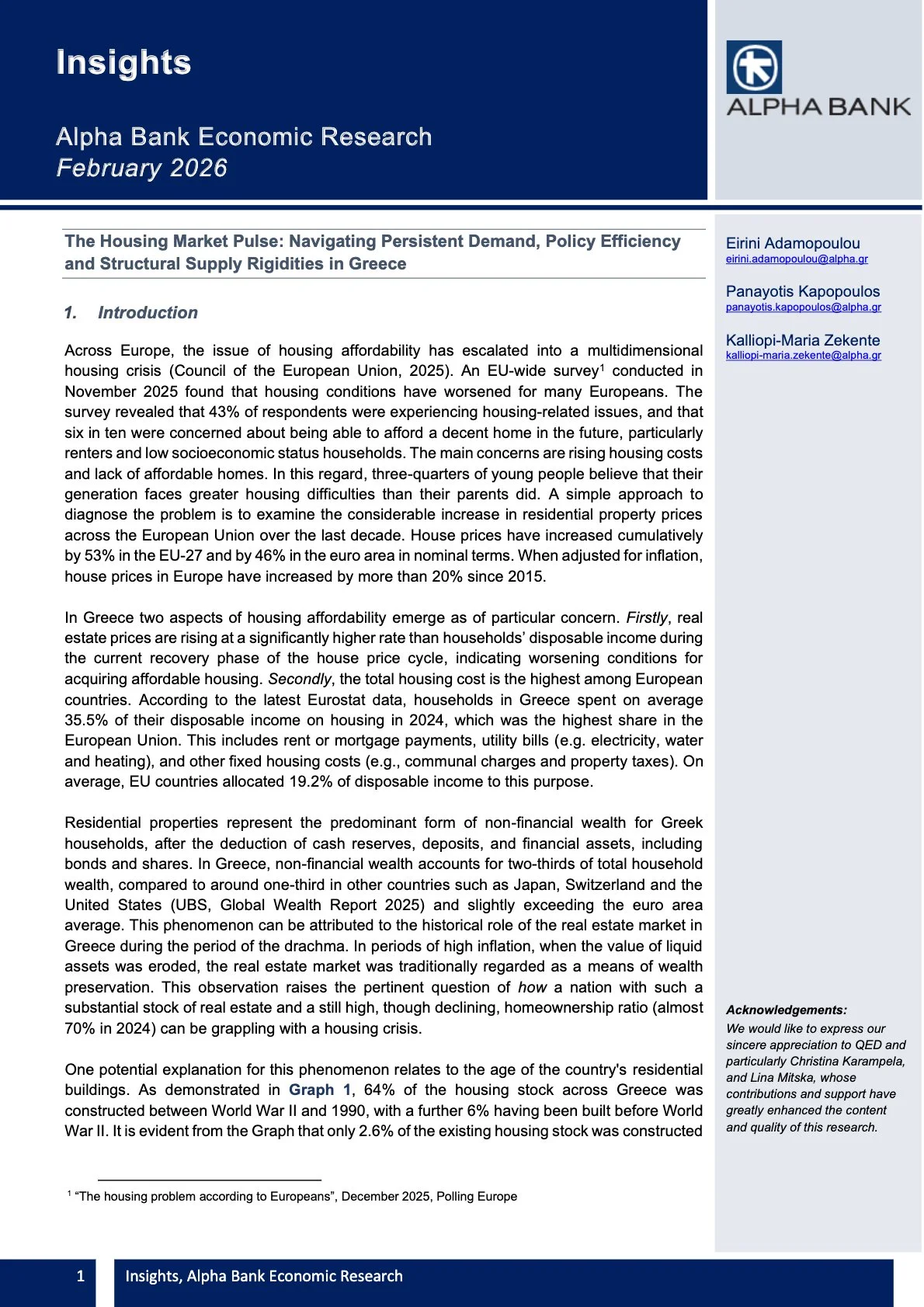
Two camps frame the argument. The government, voiced by Prime Minister Kyriakos Mitsotakis, casts affordable housing as a right and a state obligation and stakes its answer on ownership support plus targeted social supply — Spiti Mou loans, renovation subsidies, the military-camp conversions. Against it, researchers and the small cooperative movement around CoHab Athens argue that subsidising buyers into a market this tight mostly pushes prices up, and that the only durable fix is a standing non-market tier — public, social or cooperative — that Greece has never built. The Housing Market Pulse study of Greek demand and supply rigidities frames the same split in market terms, weighing policy efficiency against structural under-supply. Both sides agree the status quo is untenable; they disagree on whether the answer is more owners or, at last, a sector that holds homes out of the market for good.
- 1922[source]
Refugee resettlement + early cooperatives
The 1922 population exchange brings over a million refugees; the state and early οικοδομικοί συνεταιρισμοί (building cooperatives) borrow the garden-city model from France and Germany to settle them on peri-urban land.
- 1954[source]
Οργανισμός Εργατικής Κατοικίας (OEK) founded
The Workers Housing Organisation is established as a self-financed agency funded by employer (0.75%) and employee (1%) payroll contributions — it would build some 610 settlements nationwide and assist roughly 700,000 households over 58 years.
- 1987[source]
PD 93/1987 codifies building cooperatives
A presidential decree formalises the organisation and operation of οικοδομικοί συνεταιρισμοί — but as one-off land-and-build vehicles dissolved on completion, not durable tenure cooperatives.
- 2012[source]
OEK abolished under the bailout
The second memorandum agreed with the EU and IMF abolishes the OEK with no successor body; new loans, rate subsidies and rent allowances all stop, leaving Greece with no rent allowance at all until 2017.
- 2016[source]
CoHab Athens founded
An open research-and-action platform for collaborative and cooperative housing forms is set up in Athens, later linking members in Thessaloniki, Berlin and Zurich — the first organised contemporary push for tenure cooperatives.
- 2023[source]
Σπίτι μου low-interest home loans
The Recovery-Fund-backed Spiti Mou scheme offers young buyers loans with a large interest-free tranche — ownership support rather than rental or cooperative supply.
- 2025[source]
€1bn package + social-rent + military-camp conversions
A €1bn housing package, a six-point plan and a social-rent partnership are announced; 1,500–1,700 affordable units are planned on three former military camps in Athens, Thessaloniki and Patras, with Spiti Mou 2 expanding the income criteria.
- 2026[source]
€400m renovation subsidy launches
The Ανακαινίζω (Renovate) subsidy launches, covering up to 90% of costs (capped at €36,000 per property) to bring old and vacant homes back into use; the Spiti Mou 2 application window runs to 31 May 2026.
- 2030[source]
Social-housing build-out horizon
The military-camp and social-rent conversions are meant to deliver their first tranches of state-returned and affordable homes by the end of the decade — the test of whether Greece can build a non-market tier essentially from zero.
From the refugee-settlement cooperatives of the 1920s through the abolition of the Workers Housing Organisation in 2012 to the Spiti Mou loans and the 2030 social-housing horizon.
CoHab Athens and the social-rent pilots: a sector being drawn up
Greece cannot point to a portfolio of cooperative demonstrators, because it does not yet have one. What it has instead is a set of pilots, platforms and partnerships that, taken together, sketch the sector that might exist — and they cluster in the two cities where the squeeze is sharpest, Athens and Thessaloniki.
CoHab Athens is the closest thing to a flagship: not a building but the organising platform that has spent since 2016 translating the European cooperative model into a Greek context, running design studies, convening prospective members, and linking the Athens core to counterparts in Thessaloniki, Berlin and Zurich. Its work is the reference point for almost every serious conversation about how a first Greek tenure cooperative would actually be financed and governed.
On the state side, the lighthouses are the conversions. The three former military camps earmarked in Athens, Thessaloniki and Patras are the first purpose-built affordable-housing schemes in over a decade, and the social-rent partnership — private redevelopment of public buildings, with a guaranteed share returned to the state — is the mechanism meant to make that repeatable. The City of Athens has also entered a strategic partnership with Housing Europe to import know-how it does not have in-house, a tacit admission that the expertise to run a non-market sector has to be learned from abroad.
Behind the pilots sits a thin institutional layer. Philanthropic backers such as the Bodossaki Foundation seed social-economy initiatives; research bodies like diaNEOsis and the Athens Social Atlas map the gap; and the property-owners' federation POMIDA represents the small landlords who own the bulk of the rental stock and whose buy-in any reform needs. It is a far cry from the federations that anchor cooperative housing elsewhere — but it is the scaffolding from which a Greek non-market sector, if it comes, would be built.

The open question is starker in Greece than almost anywhere in this atlas. Every other country here is arguing about how fast to grow a cooperative or social sector it already has. Greece is asking whether it can conjure one into existence at all — from a market built for owners, a stock full of empty homes, and a public memory in which the word cooperative still means a project that stalled.
References
Statistics16Click on any number to see the source
Housing market
Tenure & affordability
Cooperative, social & public
Adaptive reuse & vacancy
Population & migration
From our library4
- Housing as investment in Greece and Southern Europe - Private profit versus social value — Knowledge
- Housing Cooperatives in Europe - Resilience and Adaption to Changing Need — Knowledge
- Bodossaki Foundation (Ίδρυμα Μποδοσάκη) — Organisation
- The Housing Market Pulse: Navigating Persistent Demand, Policy Efficiency and Structural Supply Rigidities in Greece — Knowledge
Further sources15
- diaNEOsis — Housing Policies Across Greece and Europe — diaNEOsis
- Heinrich-Böll-Stiftung — Is cooperative housing in Greece possible? — Heinrich-Böll-Stiftung Thessaloniki
- CoHab Athens — CoHab Athens
- housinginternational.coop — Greece co-ops profile — ICA Housing
- Greece 2.0 — Spiti Mou (My Home) home loans — Hellenic Republic — Greece 2.0
- Euronews — Greece acts on housing crunch (2025) — Euronews
- Business Daily — Government announces 6+1 measures (Mitsotakis) — Business Daily
- GreekReporter — Six-point housing plan (2025) — GreekReporter
- Greek City Times — Spiti Mou 2 + Anakenizo subsidies — Greek City Times
- To Vima — €1bn renters benefit — To Vima
- Housing Europe — strategic partnership with the City of Athens — Housing Europe
- Athens Social Atlas — Social policy and homelessness services — Athens Social Atlas
- POMIDA — Hellenic Property Federation — POMIDA
- Eurostat — housing-cost overburden rate — Eurostat
- FEANTSA — Overview of Housing Exclusion in Europe 2024 — FEANTSA