Loading...

🇧🇪Country profile
Belgium
Three in four Belgian households own their home, and barely one in three hundred lives in a cooperative — so who builds for the renters a European court says the country has failed?
Read the profile
Loading...
Belgium tells its housing story through ownership and devolution. The post-war ideal of a brick in every Belgian belly — een baksteen in de maag — turned the country into a nation of homeowners, and a 1980 state reform then handed housing policy to Flanders, Wallonia and Brussels-Capital. There is no single Belgian housing system; there are three. That double inheritance — mass ownership plus regional fragmentation — is why the cooperative and social-rental tiers here stayed thin while neighbours built them up, and why a crisis in Brussels reads differently from one in rural Wallonia.
The tenure mix carries the rest. About 71.4% of Belgian households are owner-occupiers, against 28.6% renters — one of the higher ownership rates in Western Europe. Within the rental base, just 6.3% of all stock is public or non-profit rental, and only 0.3% is cooperative: roughly 3,500 homes across about 15 cooperative organisations. That leaves 22% in private rental. The whole non-market segment — public, non-profit and cooperative combined — comes to 6.6% of dwellings, a fraction of Austria's or the Netherlands' share and proof of how far ownership crowded out the alternatives.
Social renting is run regionally, not nationally. About 6.5% of dwellings are sociale woningen — social-rent homes — let by regional agencies: the Vlaamse Maatschappij voor Sociaal Wonen (VMSW) in Flanders, the Société Wallonne du Logement in Wallonia, and the SLRB/BGHM in Brussels. They hold roughly 290,000 social units between them. Around 45% of Belgian households would qualify on income grounds, far more than the stock can house, which is why the waiting lists run to six figures in every region.
The rent ladder shows where the squeeze bites. Social-rent homes average €5.20 per square metre a month, the cooperative and CLT tier €8.20, the all-stock median €9.50, newly-signed contracts €11.80, and furnished or serviced lets €15.50 all-in. Two things stand out. The social floor sits well below the market — but the cooperative tier, unlike Vienna's or Zürich's cost-rent stock, is no cheaper than the median, a measure of how little public subsidy the Belgian coop sector has ever had.
Net monthly rent per m² by tier (national median; furnished is gross, all-in). Belgium’s social-rent floor sits far below the all-stock median, but the cooperative tier here is no cheaper than the open market — a sign of how thin and unsubsidised the coop sector is compared with the regional social agencies.
Underused space is part of the picture, but a modest one. Residential vacancy runs at about 3% nationally, with roughly 90,000 buildings recorded as empty in the official stock register. Short-term lets add a thinner layer: across the three Belgian cities tracked here, at least 3,679 entire homes are listed full-time on short-stay platforms — a sum-of-cities lower bound rather than a national rate, concentrated in tourist-heavy central Brussels and Bruges where it bites local supply hardest.
On the demand side Belgium absorbs about 185,000 inbound moves a year — Brussels is one of Europe's most international cities, hosting the EU institutions and a rotating expatriate population — against roughly 53,000 residential building permits, a persistent gap across the country's 5,482,978 dwellings.
The burden falls hardest on private renters, and it has climbed the income ladder. Roughly half of private tenants in Belgium now spend more than 30% of income on rent, the line researchers treat as cost overload, and the squeeze increasingly reaches working households, not just the poorest. In March 2025 the European Committee of Social Rights ruled that Flanders' ownership-first housing policy was in serious breach of the European Social Charter — failing on affordability, on protection from unaffordable rents and evictions, and on homelessness data. By April 2025 the Flemish social-housing waiting list had reached a record 199,085 households, with Antwerpians and single-person households most exposed. Belgium counts about 60,000 people in homelessness and records around 13,000 court-ordered evictions a year. The verdict reframed a slow affordability problem as a rights failure — the backdrop against which every regional programme is now judged.
This ruling is a wake-up call for Belgium. Housing is a fundamental human right, yet thousands of people in the Flemish Region continue to face unaffordable rents, homelessness and discrimination.Belgium's cooperative housing is older than its memory of it. The form arrived after the First World War, when a 1919 law and a 1920 national affordable-housing agency gave cooperatives legal recognition and finance to tackle a desperate shortage. The high point came fast: in 1921–22, cooperative tuinwijken — garden-city estates modelled on British examples — were laid out around Brussels, and several, like Le Logis-Floréal and La Roue/Het Rad with nearly 700 homes, still stand and still house people. A smaller second wave followed the Second World War. The Housing Europe survey of European cooperative housing traces this same arc across the continent, and notes how rarely the inter-war momentum was sustained.
What the form did not do was grow. Today Belgium has only about 3,500 cooperative homes — roughly 0.1% of citizens live in one — across some 15 organisations, on a total stock of nearly 5.5 million dwellings. The international cooperative-housing record puts the broader figure at around 11,000 cooperative dwellings when public-authority-owned cooperatives are counted in, split heavily toward Brussels (about 6,500) and Flanders (about 3,000), with Wallonia far behind. Much of that legal-cooperative stock, the same record cautions, is owned by public authorities whose tenants are not members — only the true tenants' cooperatives, where residents are both shareholders and tenants, embody the cooperative principle fully.
The sector that exists today splits into three distinct strands rather than one federation. The first is the community-land-trust model, which Belgium pioneered for the European continent: Community Land Trust Brussels (CLTB), incorporated in 2012, and its younger Flemish counterpart Community Land Trust Gent (CLT Gent). They separate the land from the building — a trust holds the land in perpetuity, a household buys only the home, at around 40% below market, and resells with capped equity so the discount passes to the next low-income family. The second strand is the cost-rent rental cooperative: wooncoop, founded in 2017 and now running 28 projects across Ghent, Antwerp, Leuven and Hasselt, where each resident buys at least three shares of €250 and rents from the cooperative at actual cost. The third is the social-finance and support layer — Cera, the cooperative-finance group behind much of the Belgian social economy, Crédal as an ethical lender, and Habitat et Participation and vzw Samenlevingsopbouw Gent as the community-organising bodies that incubate new groups.
The community-land-trust strand is where Belgium has set a European precedent rather than followed one. CLTB is governed in equal thirds — one third resident-homeowners, one third civil-society members, one third the regional government — and was given statutory recognition in Brussels law in 2022, followed by a multi-year collaboration contract with the Region in 2023. By 2025 it had completed four buildings with about 110 homes and had roughly 100 more in development, each home sold under a long ground lease at well below market value. The model was deliberate enough that the European Community Land Trust Network grew out of these Belgian pioneers. How that CLT model sits against the limited-equity cooperative — whether the two are, in effect, the same affordable-homeownership idea wearing different legal clothes — is the subject of a comparative study of community land trusts and limited-equity cooperatives that the Belgian projects are routinely measured against.
Honesty about scale matters here. None of these strands is large: the entire cooperative-and-CLT sector houses a rounding-error share of Belgians, and the projects are counted in dozens of homes, not thousands. What they offer is a worked template — non-speculative, democratically governed, permanently affordable — at a moment when the regional social agencies cannot build fast enough. The growth of the urban-CLT idea from a handful of Belgian and English experiments into a continental movement is documented in accounts of the urban community land trust in Europe, which read the Brussels case as the proof-of-concept the rest borrowed from.
It is tempting to look for a Belgian housing minister with a national plan. There is none — and that absence is the policy story. Since the 1980 state reform, housing has been a regional competence, and the 2014 sixth state reform pushed residential-tenancy law itself down to Flanders, Wallonia and Brussels-Capital. So rent indexation, lease rules, social-housing allocation and tenant protection now differ by region, and a Belgian tenant's rights depend on which side of a linguistic border they sleep on. The federal level sets the macro frame — interest deductibility, the constitutional Article 23 right to decent housing — but builds nothing.
Flanders has just been forced to act. After the 2025 European ruling, the Flemish government under Housing Minister Melissa Depraetere committed to a multi-billion-euro construction-and-renovation push and a target of up to 56,000 additional social-rental homes by 2042, with the Bindend Sociaal Objectief (binding social objective) obliging every municipality to reach a social-housing quota — and fines of €4,000 per unbuilt unit for those that underdeliver. In 2026 the European Investment Bank backed the effort with a €1.7bn financing package for Flemish social housing. The instruments are real, but they are catching up on decades of under-building, against a waiting list that hit 199,085 households.
We urge Minister for Housing Melissa Depraetere and the entire Flemish government to engage in meaningful dialogue with organisations working on the ground.The deepest structural reform was institutional, not financial. On 1 July 2023 Flanders merged around 85 sociale huisvestingsmaatschappijen (social housing companies) and some 50 social rental agencies into a maximum of 42 woonmaatschappijen — one single-counter housing company per working area, each required to hold at least 1,000 social rental homes. The aim was scale: fewer, larger bodies that could build and renovate faster and act as the single negotiating partner for contractors. Whether consolidation actually accelerates delivery, or simply rearranges an under-resourced sector, is the live question among Flemish housing researchers.
For cooperatives and community land trusts specifically, support is patchy and regional rather than national. Brussels is the most committed: it gave CLTB statutory recognition in 2022 and signs multi-year collaboration contracts that cover land acquisition and operating costs, with homes funded roughly 60% by the buyers through social mortgages and the rest by regional subsidy. Flanders backs experimental wooncoöperaties through pilot programmes and the Vlaams Woningfonds, but at a far smaller scale. There is no federal coop-housing instrument at all — the sector depends on regional goodwill and cooperative finance from bodies like Cera rather than a durable national subsidy line.
Sustainability is reshaping the terms everywhere. Belgium's building stock is old — averaging around 60 years — and renovates slowly, at roughly 0.9% of stock a year, well short of the rate the EU Renovation Wave demands. Regional retrofit obligations and energy-performance rules now push hardest on exactly the ageing social and private-rental stock, and the worry, raised sharply in the Brussels CLT debate, is that decarbonisation costs could trigger 'renovictions' — low-income tenants displaced when a landlord upgrades. Community land trusts and non-speculative cooperatives are increasingly argued for as a shield against that, holding the land out of the market so the renovated home stays affordable.
Two camps frame the argument. One, embodied by the regional governments and now reinforced by the European ruling, holds that the answer is more social housing built faster by larger public agencies — the Flemish 56,000-home target and the EIB loan are its expression. The other, voiced by the CLT and cooperative movement and its allies in civil society, argues that public agencies alone will never catch up, and that permanently affordable, community-governed, land-trust and cooperative models must be scaled alongside them precisely because they lock affordability in forever rather than for one tenancy. The European ruling sharpened both: it is a mandate to build, and a reminder that ownership-first policy left a generation of renters exposed.
A post-war housing-shortage law and the 1920 creation of a national affordable-housing agency give Belgian housing cooperatives their first legal recognition and financing, just as the industrial cities overflow.
Cooperative tuinwijken (garden-city estates) modelled on British examples are laid out around Brussels — Le Logis-Floréal, La Roue/Het Rad — the high-water mark of the Belgian cooperative form, with hundreds of homes still standing.
Belgium’s state reform hands housing competence to Flanders, Wallonia and Brussels-Capital, splitting one national policy into three regional ones — the structural fact behind every divergence since.
After four years of organising, CLTB is incorporated to deliver permanently affordable, non-speculative homes on community-owned land — the first urban CLT on the European continent.
The sixth state reform transfers residential-tenancy law itself to the three regions, so rent indexation, lease rules and tenant protection now differ across Belgium.
On 1 July 2023, around 85 social housing companies and some 50 social rental agencies merge into a maximum of 42 single-counter woonmaatschappijen, one per working area, each required to hold at least 1,000 social rental homes.
The European Committee of Social Rights finds Flanders’ ownership-first housing policy in serious breach of the European Social Charter, after a complaint by the Woonzaak coalition — with 199,085 households on the Flemish social-housing waiting list.
The European Investment Bank and Flanders agree a €1.7bn financing package to build and renovate social housing, the regional level’s answer to the ruling and the record waiting lists.
The European Community Land Trust Network, founded out of the Brussels and Ghent pioneers, targets 500 urban community land trusts across Europe by 2030 — a horizon the Belgian CLTs are expected to help anchor.
Flanders commits to up to 56,000 additional social-rental homes by 2042, backed by a multi-billion-euro construction-and-renovation plan and penalties for municipalities that underbuild.
From the 1919 affordable-housing law and the 1920s garden-city cooperatives, through the 2014 regionalisation of tenancy law and the 2023 Flemish woonmaatschappij merger, to the 2030 European CLT goal and the 2042 Flemish social-housing target.
The clearest case for the Belgian model is not in the regional codes but in a handful of buildings, almost all of them in Brussels and Ghent. They are small — counted in dozens of homes — but each one tests a different idea about how to take housing out of the speculative market, and the sector keeps pointing visitors to the same short list.
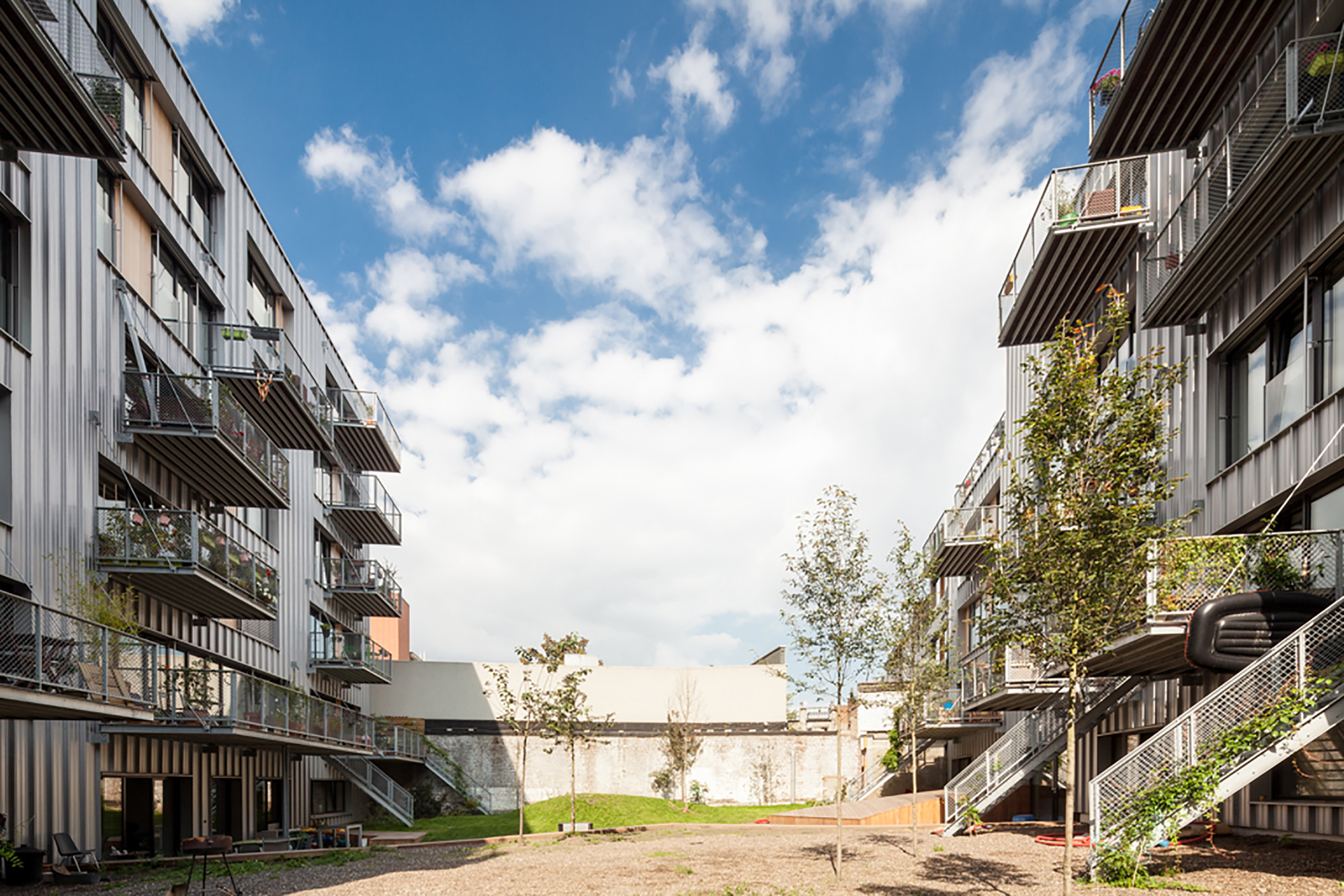
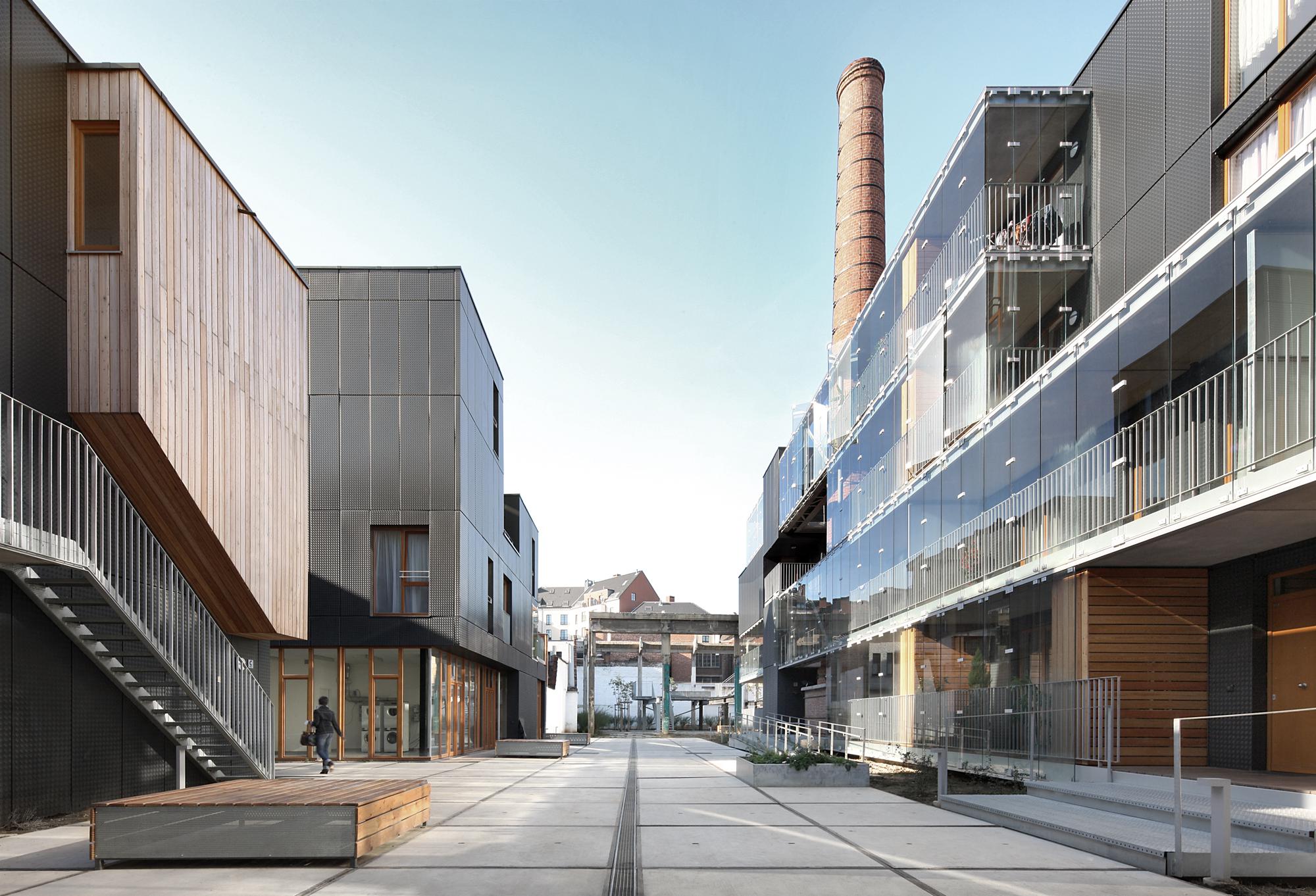
Brutopia is the one most often invoked: a resident-led cohousing development in Forest, Brussels, with shared gardens, a common house and passive-house standards, built by the future residents themselves as a co-design. Savonnerie Heymans, a former soap factory in central Brussels redeveloped by the city housing fund, turned an industrial shell into a mixed social and affordable community around a green courtyard — the adaptive-reuse case made physical. Calico, also in Brussels, is a care-and-intergenerational cohousing project delivered under the EU Urban Innovative Actions programme, pairing affordable housing with shared care for the elderly and the dying.
Usquare is the conversion story at scale: a former gendarmerie barracks on the Brussels–Ixelles border reborn as a mixed university, housing and public-space district, with cooperative and affordable homes folded into a site that sat behind walls for decades. L'Ecluse shows the community-land-trust template completed — a CLTB building where low-income families own their homes on leased land. In Ghent, the Sociale woningen Nekkersput and the Bellefleur project carry the social and cooperative strand into Flanders, around courtyards and shared facilities rather than isolated blocks.
Behind the projects sits the connective machinery that makes them repeatable. Community Land Trust Brussels and Community Land Trust Gent hold the land and the legal template; wooncoop runs the cost-rent rental cooperative across Flemish cities; Cera and Crédal supply patient and ethical finance; and the European Community Land Trust Network, grown out of these Belgian pioneers, now carries the model across the continent. The pattern that the State of the Sector account of community land trusts in Europe documents — community ownership of land, capped equity, a federating body — is, in Belgium, no longer a thought experiment but a working method, even if it is still measured in hundreds of homes rather than thousands.
What the 1920s garden cities began and the Brussels community land trust reinvented is a single, stubborn proposition: that a country which made ownership its housing religion can still keep a small but permanent share of its homes out of the speculative market, governed by the people who live in them. Belgium holds that template at modest scale, freshly validated by a European court — which leaves an open question of nerve rather than proof: not whether the model works, but whether three regions under pressure will choose to grow it.