
A city of owners, under fire
Kyiv is one of Europe's oldest capitals, a city whose traditional founding is dated to 482 CE and whose chestnut-lined boulevards run past golden-domed cathedrals older than most European states. It is also a wartime city of about 3 million people, swollen by the displaced and shaped by a single post-Soviet choice: in the 1990s it handed almost all of its housing to private owners. That choice still defines the market today — near-total ownership, a tiny rental sector, and almost no public stock to fall back on when bombs fall.
Few European capitals lean this far toward ownership. At about 92%, owner-occupation in Kyiv swamps a rental sector that houses only 8% of households. Housing cooperatives, the Soviet-era zhytlovo-budivelni kooperatyvy (construction housing cooperatives, or ZhBK), account for around 5% of dwellings as a legal tenure, some 50,000 flats across roughly 2,500 cooperatives, though most behave like ownership rather than rental. Municipal landlords hold just 2.8% of the stock — about 28,000 council flats — and the private rental sector is only about 5.2%, much of it informal and unwritten.
- Owners
- Owner-occupier87.0%
- Cooperative5.0%
- Renters
- Public & non-profit rental2.8%
- Private rental5.2%
Social housing is the gap at the centre of the picture. Effectively 0% of Kyiv's stock is dedicated social housing — a tier Ukraine, by its own researchers' account, simply never created. The thin municipal komunalne zhytlo (council-owned housing) is the nearest equivalent, allocated through a waiting list rather than as a right. Around 35% of residents would qualify on income for that kind of support, but the supply is a rounding error against the need, and the country's first national framework for social housing only became law in 2026. Housing for the Common Good, a governance study of best practice for Ukraine's recovery, sets out how far that gap runs.
Where a Kyivan pays a regulated rent at all, it is a fraction of the market — but almost nobody does. Members of the old cooperatives pay member fees, vneski, of around €0.50 per square metre, and tenants of municipal flats a symbolic €0.30. Out in the open market the all-stock figure runs near €8.50, with a newly-let apartment asking about €7.60 per square metre and furnished lets much the same. That gap between the sheltered floor and a market contract is more than tenfold, yet the floor reaches so few households that, for most of the city, the market price is simply the price.
- Public/municipal housing
- Cooperative
- New contracts
- Furnished / serviced (gross)
- All-stock median
Net-cold monthly rent per square metre by tier (furnished is gross, all-in). The Soviet-legacy cooperative fees and the symbolic municipal rent sit far below a market that re-priced sharply after the displacement of millions.
What sits empty in Kyiv is mostly a casualty of the war, not a market signal. Residential vacancy runs at roughly 8%, around 128,000 unoccupied flats, much of it owners who have fled or stock left damaged and unrepaired. Offices are emptier still: about 504,000 square metres stand vacant, roughly 26% of the office stock, as companies shrank or left. Against all that idle space, short-term letting barely registers. An estimated few thousand dwellings operate as full-time short-term rentals, concentrated in the central districts, at a median €45 a night — a tourist-market number in a city with almost no tourists.
In Kyiv it is the front line, not the labour market, that fills the flats. Most of the roughly 180,000 arrivals a year are internally displaced people from harder-hit oblasts, and against that inflow the city issues only about 4,500 building permits a year. The strain runs far above the poorest tenants. Across Ukraine an estimated 3.7 million people are internally displaced and more than half of them rent — a far higher share than among non-displaced Ukrainians — with affordability their main problem; nearly half of renters surveyed already spent a third to a half of their income on rent before the invasion. Energy poverty compounds it — around 40% of Kyiv households struggle to keep warm — and the housing question now ranks, in public debate, alongside security itself.
Money is there, but procedures do not work. Deputies, residents and working groups keep pushing, but we cannot break through this bureaucratic wall — everyone hides behind paperwork.The kooperatyv that became ownership
The Ukrainian cooperative is the zhytlovo-budivelnyi kooperatyv, a construction housing cooperative whose members paid in vneski — share contributions — to build and then occupy a flat. In practice the form sits much closer to ownership than to rental. A member's stake secured a specific apartment, and after independence that stake converted into outright private title with little resistance. This is the key difference from the rental cooperatives of Vienna or Zurich: a Kyiv cooperative flat was always, in spirit, a flat you owned.
The tradition is Soviet, not bottom-up. The ZhBK expanded from the 1960s as a semi-private route to a flat when state construction could not keep up, building a large share of the panel-block estates that ring the city. They were never independent civic institutions in the Western sense; they were a financing device inside a planned system. When the 1990s right-to-buy arrived, members simply took title, and the cooperative as a way to build something new all but vanished for a generation.
Today the picture is one of management bodies, not builders. The dominant residents' institution is now the OSBB — the association of co-owners of an apartment building, created by a 2001 law — which runs a privatised block much as a condominium board would. The legacy ZhBK that remain mostly manage and slowly retrofit ageing stock, and they share the OSBB's central problem: a fragmented mass of small owner-bodies with thin reserves, facing huge energy-retrofit bills on Soviet-era buildings. A genuinely new, member-led cooperative-development sector barely exists, because the country still lacks a legal and funding framework for not-for-profit housing providers — the gap Housing for the Common Good, the governance study of Ukraine's recovery, identifies as decisive.
What the cooperative could become is now bound up with the recovery itself. The new housing law and the international recovery effort both look to community-owned and not-for-profit models — closer to the Austrian limited-profit tradition than to the old ZhBK — as a way to build the affordable and social housing the market and the privatised stock never produced. The Council of Europe's housing programme in Kyiv is working with the government on exactly that machinery. Whether Ukraine can grow a real cooperative-and-community housing tier from near zero is now a recovery question, not just a market one.

Building a system from the ground up
Kyiv's housing politics is, for the first time, the politics of building a system rather than selling one off. The decisive change is national. In January 2026 Parliament adopted the Law on the Fundamental Principles of Housing Policy, the first systemic housing law since independence, replacing the 1983 Soviet Housing Code and creating the legal basis for affordable and social housing. Habitat for Humanity Ukraine, which helped shape the recovery debate, calls it the move from Soviet-era allocation toward a rights-based, affordable model.

Authority over housing is split between Kyiv and the capital it answers to, and the new framework is trying to connect the two. The national government, through the Ministry for Development of Communities and Territories, writes the law and runs the recovery money; the city of Kyiv repairs damaged buildings and manages its municipal stock. The flagship national instrument is eVidnovlennia, the digital compensation scheme run through the Diia app: by early 2026 over 188,000 families had received compensation for damaged or destroyed homes, and more than 50,000 had been issued housing certificates to buy a replacement flat. The State Mortgage scheme eOselia lends at 3% to key workers and 7% to displaced people, and Kyiv and its region together took the largest share of its loans.
Cooperatives and community-owned housing sit deliberately inside this new programme. The Cabinet's Municipal Rental Housing Fund pilot, approved in 2025, would build community-owned rental homes for displaced people and key workers, with European partners ready to put in an initial $400 million across ten pilot communities. It is the clearest attempt yet to create a non-market tier the privatised stock never left room for, and to do it through municipalities rather than the market.
The flats and offices standing empty since 2022 are starting to draw a policy response, even if a fraught one. Kyiv repairs its damaged housing directly. Nearly 3,100 residential buildings in the capital have been hit since 2022, and the city has allocated UAH 574 million in the latest year for repairs, rebuilding the most heavily damaged blocks one by one. Vacant offices, at a quarter of the stock, are a conversion frontier the recovery is only beginning to look at. The binding constraint is not money but delivery: the funds exist, but the procedures to spend them are slow.
- Q4 2026[source]
Social Housing Fund law due
Under the Ukraine Facility, two follow-on laws — on a Social Housing Fund and its management — are scheduled, the step that would turn the framework into an operating social-housing system.
- 1992[source]
Mass privatisation begins
Independent Ukraine transfers state and municipal flats to their occupants almost for free, and most Soviet-era housing cooperatives convert their flats to individual ownership — one of the most complete housing sell-offs in Europe.
- 2001[source]
OSBB co-ownership law
A law on associations of co-owners of apartment buildings creates the OSBB, the residents’ body that manages a privatised block — the main self-governance vehicle in a city of owner-occupiers.
- Feb 2022[source]
Full-scale invasion
Russia’s invasion displaces millions and begins the destruction of housing on a vast scale; Kyiv becomes both a front-line target and a magnet for internally displaced people from harder-hit oblasts.
- 2023[source]
eVidnovlennia launched
The state opens a digital compensation scheme for damaged and destroyed homes, processing claims through the Diia app rather than the courts.
- Nov 2024[source]
Damage tally
KSE Institute estimates 236,000 residential buildings damaged or destroyed nationwide and direct war damage of $170 billion, with housing the worst-hit sector at roughly $60 billion.
- Jul 2025[source]
Municipal Rental Housing Fund pilot
The Cabinet approves a pilot to build community-owned rental housing for displaced people and key workers, with European partners ready to invest an initial $400 million across ten pilot communities.
- Jan 2026[source]
Fundamental Principles of Housing Policy
Parliament adopts the first systemic housing law since independence, replacing the 1983 Soviet Housing Code and creating the legal basis for affordable and social housing.
- Feb 2026[source]
RDNA5 housing damage update
The fifth joint World Bank, EU, UN and government damage assessment (RDNA5) finds 14% of Ukraine's housing damaged or destroyed by end-2025, affecting 3 million households, with housing needs of about $90 billion.
From the post-Soviet right-to-buy and the ZhBK conversion to wartime damage, the eVidnovlennia compensation scheme and the first systemic housing law since independence.
In Kyiv, fixing the climate and fixing the housing have collapsed into one task. Kyiv's housing stock averages around 50 years old, only about 5% of dwellings are energy-efficient, and the renovation rate crawls at roughly 0.1% a year. The recovery agenda, backed by the European Investment Bank and the World Bank, ties reconstruction money to energy-efficient standards, turning the retrofit of Soviet panel blocks into a climate programme as much as a housing one.
In Kyiv the argument has moved past intent to capacity: not whether to build the non-market tier, but whether the state can actually deliver it. Oleksii Kuleba, the deputy prime minister who runs the recovery, frames the municipal-housing pilot as the state's answer to people who have lost their homes. Taras Kozak, a Kyiv City Council deputy for the opposition Holos party, argues that the money is there but the bureaucracy is not — that residents whose homes were damaged are still stuck at the city-administration level in the fourth year of the war. Neither questions that the tier must be built; their quarrel is over whether the institutions can build it fast enough.
People who have lost their homes or do not have access to full-fledged housing must receive a clear and understandable answer from the state. We are launching a model that allows communities to build housing and support those who need it most.Repair, reuse and the recovery laboratory
Kyiv's working examples are less about new lighthouse blocks than about a city and a country improvising a housing-recovery practice under fire. The thread that connects them is reuse and repair: fixing what stands, and rebuilding the institutions a privatised market left thin. There are no Möckernkiez-scale demonstrators here, and there cannot be while the war continues. What there is instead is a recovery laboratory, where international rebuilders, local architects and home-grown think-tanks are inventing the practice in real time. The actors below are read in that spirit — each paired with the friction it keeps hitting.
Habitat for Humanity Ukraine is the largest of the practical rebuilders. Part of the global Habitat network, it has shifted from its pre-war model to wartime repair and recovery — patching damaged roofs and flats, helping host communities absorb the displaced, and feeding evidence into the new housing law. Its caveat is the one the whole sector names: the need dwarfs the capacity, and a charity-led repair effort cannot substitute for a public housing system that does not yet exist.
Forma Architects works the adaptive-reuse end of the recovery. The Kyiv practice specialises in renovation and the re-use of existing buildings rather than demolition — exactly the embodied-carbon-saving approach the recovery agenda wants to scale, and one the Open Heritage survey of community-driven adaptive reuse in Europe documents across the continent. The pilot reuse projects that work, though, are still rare, expensive and slow to permit against the pressure to simply rebuild fast.


Vid Sertsya Budova takes the model to the edge of the city. The initiative is building a self-sustaining settlement for war-affected people near Kyiv, an attempt to create not just shelter but a working community for those who cannot return home. Its scale is small against the displacement numbers, and projects like it depend heavily on donor money and volunteer labour rather than a durable financing model.
The rebuilders lean on a small Kyiv research and civic-society scene that is only now finding its weight. Cedos, the independent think-tank on social and spatial development, has produced much of the clearest evidence on Ukraine's rental market, its missing social housing and its wartime displacement — the diagnosis the new policy rests on. Teplo Misto fosters urban development through community engagement, and the International Renaissance Foundation funds resilience and democracy projects across the country. None of them builds housing directly, and all of them work in a war economy where attention and money are pulled constantly toward the front.
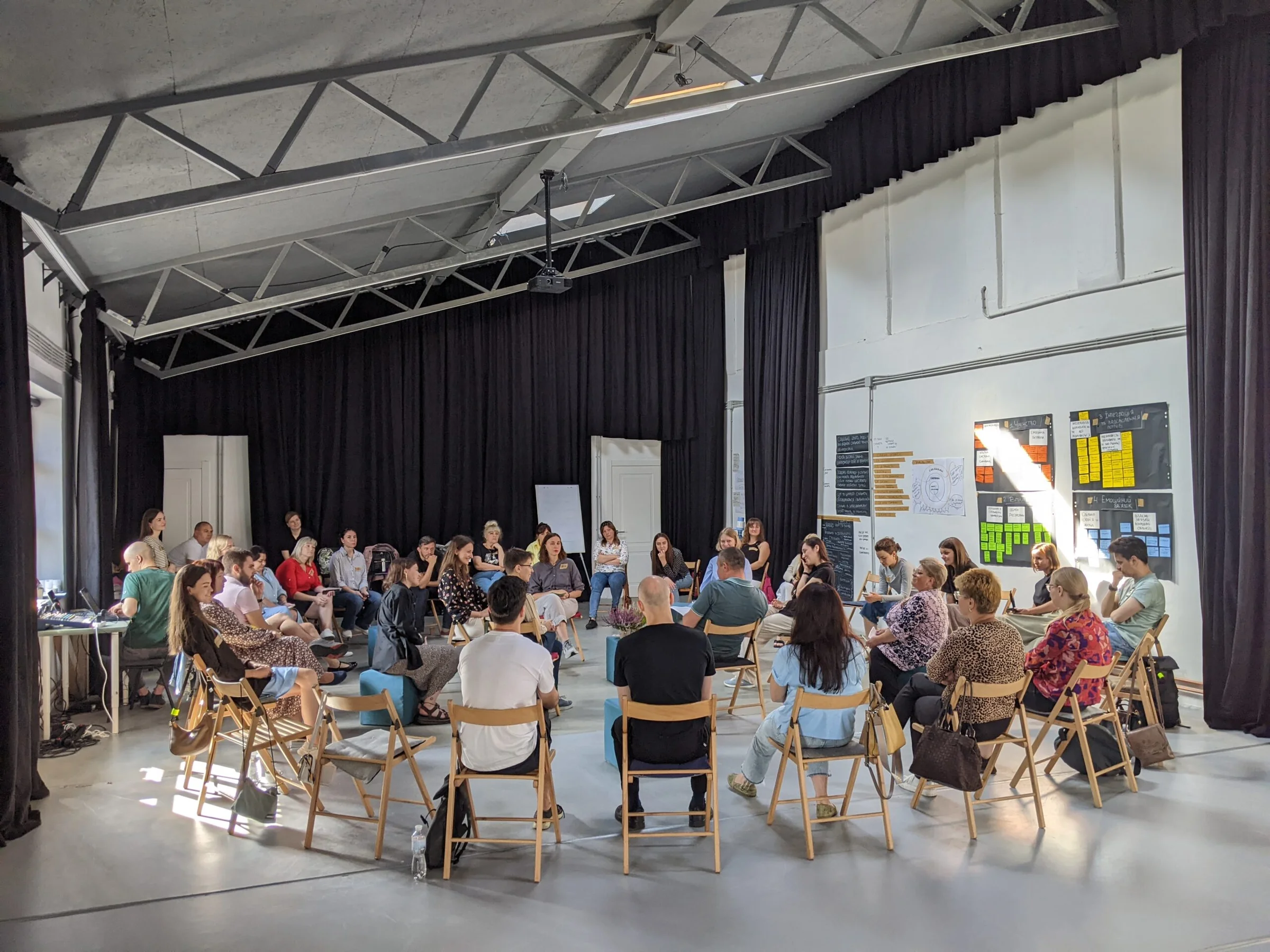

The institutional scaffolding is being built in parallel with the buildings. The Council of Europe's housing programme in Kyiv is helping the government design a social-housing system and reform housing management, and the recovery is studded with pilots — adaptive-reuse of vacant dormitories for displaced people elsewhere in the country has shown the model can work. It is a thinner institutional layer than Vienna's or Berlin's, and almost everything here is improvised and recent. But it is real, and it is being built on the one foundation the war cannot take away: a city of owners who have every reason to want their homes, and their neighbours' homes, rebuilt well.
References
Statistics16Click on any number to see the source
Housing market
Tenure & affordability
Cooperative, social & public
Adaptive reuse & vacancy
Population & migration
From our library10
- Housing for the Common Good: Sustainable Governance from European Best Practice for Recovery in Ukraine — Knowledge
- Council of Europe Office in Ukraine — Housing Programme — Organisation
- Habitat for Humanity Ukraine — Organisation
- Ministry for Development of Communities and Territories of Ukraine — Organisation
- ФОРМА (Forma Architects) — Organisation
- Open Heritage - Community-Driven Adaptive Reuse in Europe: Best Practice — Knowledge
- Vid Sertsya Budova — Organisation
- Cedos — Organisation
- Teplo Misto — Organisation
- International Renaissance Foundation — Organisation
Further sources14
- Ukraine adopts law on the Fundamental Principles of Housing Policy — United Nations in Ukraine / UNECE
- Ukraine adopts new housing law to replace Soviet-era system — Habitat for Humanity
- European partners ready to invest $400M in municipal rental housing — Ukrinform
- Ministry for Development launches Municipal Rental Housing Fund pilot — Kuleba — Ministry for Development of Communities and Territories of Ukraine
- Over a million displaced Ukrainians forced to exhaust savings to cover rent (IOM DTM) — United Nations in Ukraine / IOM
- Bureaucracy under Klitschko paralyses Kyiv post-war housing aid — Kozak — Novyny.live
- 188,000 families received compensation under eVidnovlennia — Interfax-Ukraine
- eOselia issues 6,860 loans in 2025 — Mezha
- KSE Institute — war damage to Ukraine reaches $170 billion — Kyiv School of Economics
- Kyiv allocates UAH 574m for restoration of damaged housing — Klitschko — Interfax-Ukraine
- Council of Europe supports Ukraine social-housing reform — Council of Europe
- CO-HATY — adaptive reuse of vacant dormitories for IDP housing — Metalab
- World Bank — restoring Ukraine’s housing through HOPE — World Bank
- Housing for the Common Good — recovery report (IIBW / NHP) — IIBW / New Housing Policy
Funding & land tenure
What a housing cooperative could actually build on hereLand tenure has not been assessed for Ukraine yet — that is a gap in the research, not a finding.