Overview of the Publication
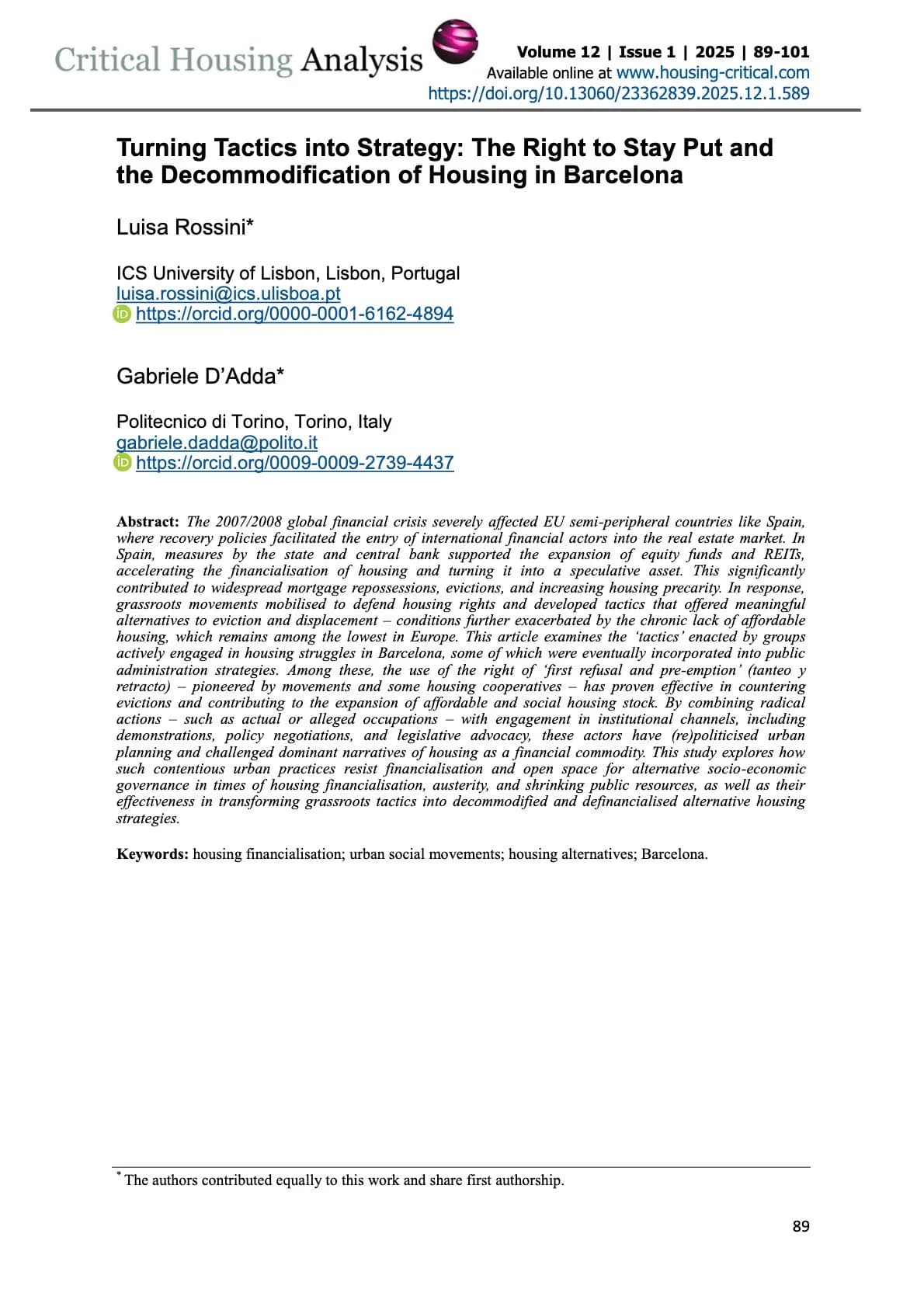
The resource is an academic article titled “Turning Tactics into Strategy: The Right to Stay Put and the Decommodification of Housing in Barcelona.” It is published by Critical Housing Analysis and authored by Luisa Rossini (ICS University of Lisbon) and Gabriele D’Adda (Politecnico di Torino). Both authors are active researchers in urban social movements and housing policy, and their affiliations indicate expertise in European housing issues. The article appears in Volume 12, Issue 1 (2025), pages 89‑101, and is available online through the publisher’s website and a public Vercel storage link.
Context of Barcelona’s Housing Crisis
Barcelona has faced severe housing precarity amplified by the 2007‑2008 global financial crisis, which enabled international financial actors to enter the Spanish real‑estate market. Between 2014 and 2020, purchase prices rose 38.7 % and new rental prices 39.6 %, far outpacing pre‑crisis levels. Social rental housing accounts for only 1.5 % of the city’s stock, well below the EU average of 9.3 % and France’s 14 %. Short‑term rental platforms such as Airbnb have intensified speculation, while REITs (SOCIMIs) have attracted large capital, further driving gentrification and evictions.
Grassroots Tactics and Their Evolution
Housing movements in Barcelona have employed a range of tactics: building occupations, “blocks in struggle,” legal mobilisations, and media campaigns. A notable tactic is the use of the right of first refusal and pre‑emption (tanteo y retracto), originally introduced by Catalan law 18/2007. This tool enables public administrations or cooperatives to purchase properties threatened with speculative sale, helping to preserve affordable housing and prevent evictions. Cases such as Aragó 477, Block Ruth, and Casa Orsola illustrate how occupations combined with legal pressure led to municipal acquisition or negotiated social‑rent contracts.
Key Data on Legal Instruments and Outcomes
- Municipal acquisition of Casa Orsola: €9.2 million purchase secured social rental contracts for all tenants.
- Lioness Inversiones acquisition: 27‑unit building faced eviction threats; activist pressure resulted in city‑funded purchase.
- Tanteo y retracto limitation: municipalities must pay full market price; high acquisition costs often render the tool financially unfeasible.
- Social‑rent contracts: Catalan laws 24/2015 and 1/2022 obligate major landlords to offer social rent before eviction, yet compliance is inconsistent.
Collaboration Between Movements and Institutions
The article highlights growing cooperation between tenant unions, housing cooperatives, and municipal authorities. Cooperative models use the pre‑emption right to acquire buildings at lower cost, then manage them under a “cesión de uso” (use‑right) regime. Public‑private partnerships, such as the collaboration between Barcelona City Council and the non‑profit Habitat 3, demonstrate a strategic shift from purely confrontational actions to institutional engagement, facilitating the de‑commodification of housing stock.
Implications for Sustainable Housing Across Europe
Barcelona’s experience offers a replicable framework for other European cities confronting similar financialisation pressures. The combination of grassroots mobilisation, legal tools like tanteo y retracto, and co‑operative ownership aligns with sustainability goals by reducing the need for new construction, preserving existing urban fabric, and promoting long‑term affordable housing. The article underscores that effective de‑commodification requires political will, adequate funding, and integration of these tactics into broader housing strategies to achieve systemic change.
Conclusion and Future Directions
The study concludes that while grassroots tactics have successfully pressured authorities and secured concrete housing outcomes, structural challenges remain. High market prices, bureaucratic hurdles, and limited municipal resources constrain the scalability of pre‑emption mechanisms. Nonetheless, the documented cases illustrate a viable pathway for transforming tactical resistance into strategic policy influence, offering valuable insights for pan‑European stakeholders seeking sustainable, equitable housing solutions.