Overview of Study and Publication
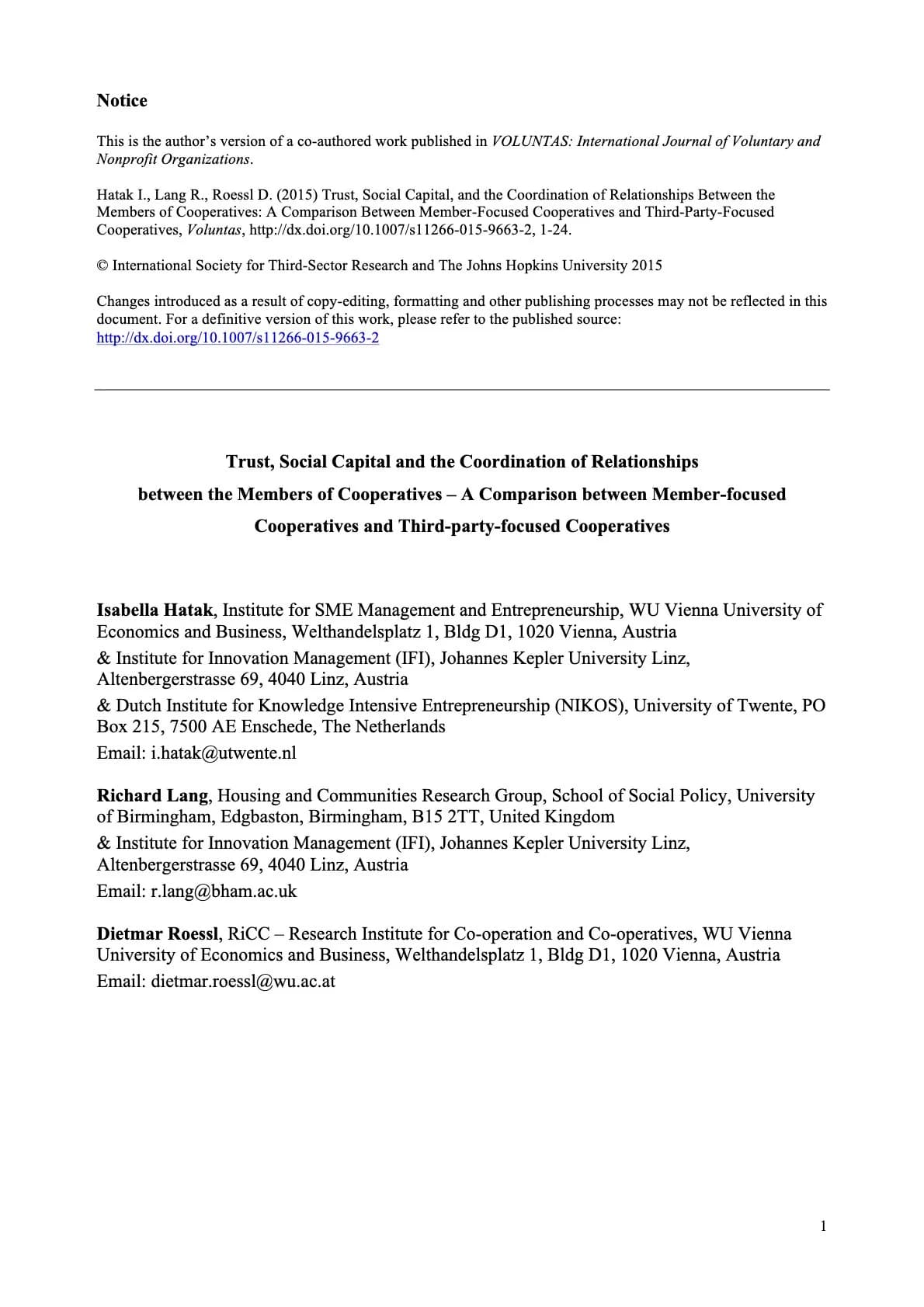
The paper “Trust, Social Capital and the Coordination of Relationships between the Members of Cooperatives – A Comparison between Member‑focused Cooperatives and Third‑party‑focused Cooperative” is authored by Isabella Hatak, Richard Lang and Dietmar Roessl. It appears in VOLUNTAS: International Journal of Voluntary and Nonprofit Organizations, a peer‑reviewed outlet dedicated to research on civil society, nonprofit management and social enterprise. The authors are affiliated with academic institutions in Austria, the United Kingdom, the Netherlands and Italy, bringing expertise in SME management, innovation, housing research and cooperative studies. The article was originally published in 2015 and made publicly available through a research repository.
Research Objective and Question
The authors aim to deepen conceptual understanding of how coordination mechanisms differ between traditional member‑focused cooperatives and newer third‑party‑focused cooperatives (often termed community or social cooperatives). The central research question asks: “How do member coordination and the interplay of social capital, trust and reciprocity differ between the two cooperative types?” By linking trust typologies (instrumental, maxim‑based, norm‑based) with reciprocity forms (transaction‑specific, relation‑specific, generalized) and social‑capital dimensions (bonding, bridging, linking), the study seeks to map distinct organizational arrangements.
Theoretical Foundations
The paper draws on classic cooperative theory (Draheim 1952, Toennies 1963) and contemporary literature on social capital (Putnam 2000, Coleman 1990) and trust (Luhmann 2000, Adler 2001). It distinguishes structural versus relational dimensions of social capital, and identifies three trust types: instrumental (linked to hierarchical control), maxim‑based (relation‑specific reciprocity), and norm‑based (generalized reciprocity). These constructs are positioned within transaction‑cost economics to explain why market and hierarchy alone cannot coordinate long‑term cooperative relationships.
Method and Conceptual Model
The authors develop an ideal‑typical framework that aligns each cooperative type with a prevailing reciprocity form, trust type and social‑capital outcome. Member‑focused cooperatives are associated with relation‑specific reciprocity, maxim‑based trust and bonding social capital, typically emerging from dense, strong‑tie networks. Third‑party‑focused cooperatives are linked to generalized reciprocity, norm‑based trust and bridging/linking social capital, which arise in more open networks with weak ties and external stakeholder links. The model is illustrated in a table summarizing these alignments.
Key Findings on Coordination Mechanisms
- Member‑focused cooperatives rely on repeated personal exchanges that build maxim‑based trust; this trust reduces uncertainty and supports dense network structures that facilitate bonding social capital.
- Third‑party‑focused cooperatives depend on shared community norms and generalized reciprocity; norm‑based trust enables coordination even without extensive personal histories, fostering open networks that mobilize bridging and linking social capital.
- The shift from member‑ to community‑focus changes the dominant coordination mechanism from relation‑specific to generalized reciprocity, altering the type of social capital that can be leveraged for collective action.
Implications for Sustainable Housing Initiatives
The study highlights that community‑oriented cooperatives can more readily attract diverse resources—volunteers, donations, public subsidies—and engage broader stakeholder groups, which is crucial for sustainable housing projects across Europe. By emphasizing norm‑based trust and bridging/linking social capital, such cooperatives can coordinate complex, multi‑actor initiatives like eco‑neighbourhoods, affordable housing retrofits and community‑run energy schemes. Conversely, traditional member‑focused cooperatives may excel in tightly knit resident groups but may face limitations in scaling beyond their immediate membership.
Practical Recommendations for Cooperative Managers
- Foster norm‑based trust through transparent governance, community participation and clear articulation of collective values.
- Build bridging networks by partnering with local authorities, NGOs and private investors to access financing and technical expertise for sustainable building retrofits.
- Maintain relational ties within the membership to preserve bonding capital, ensuring resident commitment to long‑term maintenance and energy‑saving behaviours.
- Design governance structures that balance democratic member control with mechanisms for external stakeholder input, aligning with the open network model of third‑party‑focused cooperatives.
Conclusion and Future Research Directions
The article concludes that distinguishing between trust and reciprocity types provides a richer understanding of cooperative coordination, especially as cooperatives evolve toward broader social missions. It calls for longitudinal, mixed‑method studies to empirically test the proposed framework across different countries and sectors, including the housing and built‑environment domain. Such research could inform policy designs that support cooperative models as viable vehicles for pan‑European sustainable housing transitions.