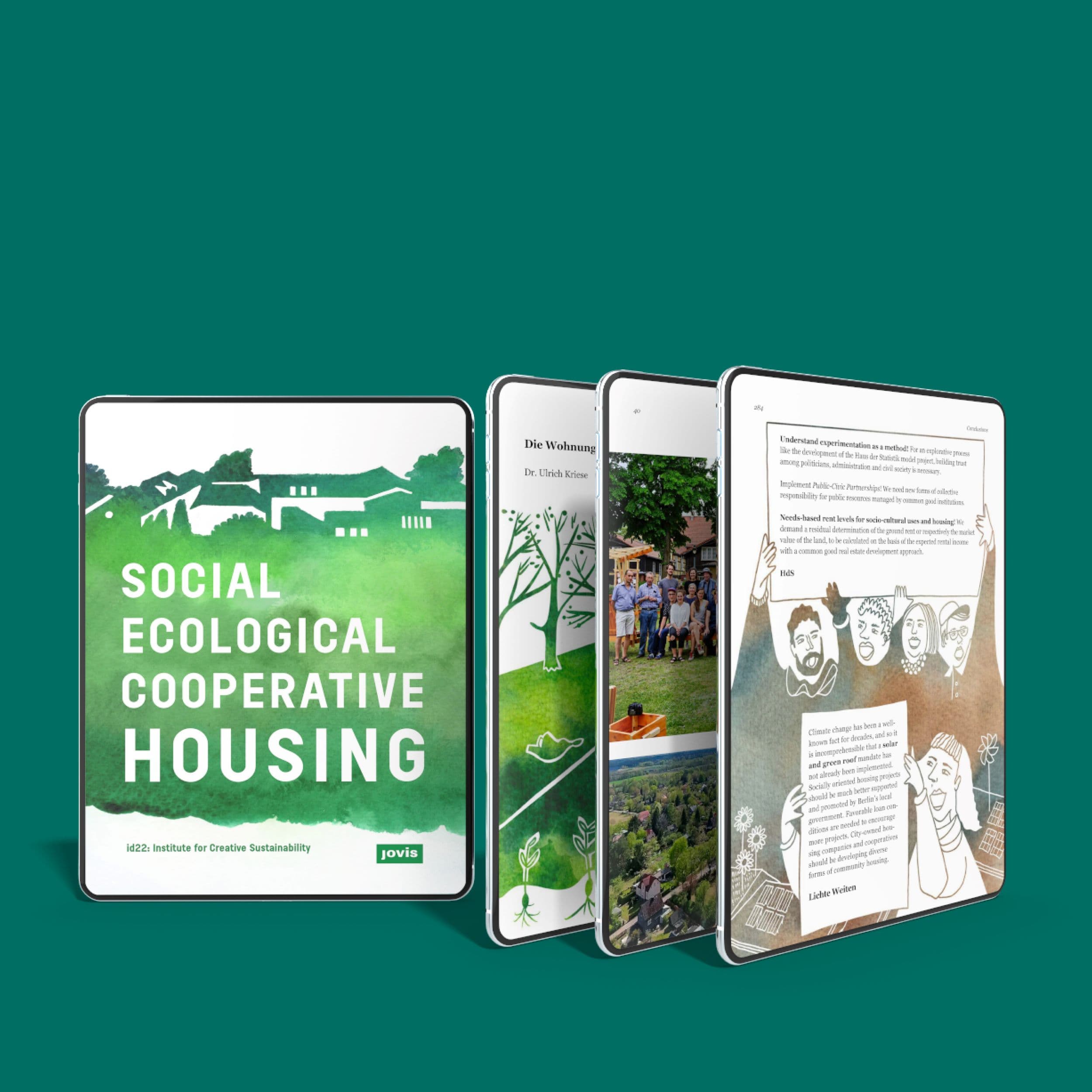
Resource context, publisher and authors
The eBook “Cooperative Social-Ecological Housing” (2024) is published by id22: Institute for Creative Sustainability (Berlin, Germany). The resource is authored by Michael LaFond, Giulia Carones and Alex Valder, who are presented as “activist-experts” drawing on hands-on work and research on cooperative housing.
What the book examines
The publication provides an overview of cooperative and community-based housing projects in German-speaking countries, with a focus on approaches that combine social goals (affordability, inclusion, participation) with ecological goals (lower emissions, resource efficiency). It frames cooperative housing as a practical response to interconnected challenges such as climate change, the housing affordability crisis and social inequality.
Case studies and empirical material
A core element is a set of 12 model projects, mainly located in Berlin and other German-speaking cities. The projects cover both renovation of existing buildings and new construction. Across examples, the book describes how cooperatives aim to secure long-term affordability while introducing environmental measures such as improved energy performance and renewable energy solutions.
Social–ecological strategies in practice
The projects are described as combining design and operational strategies: energy-efficiency measures, shared resources and amenities, and approaches that can reduce individual private space while compensating with communal areas. These practical strategies are presented as ways to lower environmental impacts while improving everyday livability and strengthening community ties.
Ownership, land and non-speculative models
The book highlights alternative ownership and land models intended to keep housing permanently affordable and protected from speculation. Examples referenced include community land trust approaches and the Mietshäuser Syndikat model. These structures are described as mechanisms for long-term cost control and for preventing cooperative housing assets from being sold into profit-driven markets.
Participation and governance
Participatory planning and self-governance are recurring themes. Residents are described as being actively involved in decision-making, shaping both the development process and ongoing management. The book treats this resident-led governance as a defining feature of cooperative housing and as a factor that can align buildings and services with community needs over time.
Constraints and implementation challenges
The resource also documents barriers faced by cooperative projects. Reported challenges include securing financing, balancing affordability targets with the additional costs that can come with ecological features, and sustaining long-term community engagement and organizational capacity. These constraints are presented as practical issues that influence whether social-ecological ambitions can be realized at scale.
Policy support, financing and scaling up
The authors argue that broader policy support and improved financing options are needed to expand cooperative social-ecological housing beyond isolated projects. The book positions community-led initiatives as capable of innovation and responsiveness to social and environmental needs compared with conventional development pathways, while emphasizing that enabling frameworks are required for wider replication.
Overall takeaway and intended use
Overall, “Cooperative Social-Ecological Housing” presents cooperative and community-led housing as a model that can address housing, social and environmental objectives together, using real-world examples and implementation insights. It is framed as a resource for people and organizations interested in developing or supporting similar projects across Europe, with an emphasis on lessons that can be transferred beyond the German-speaking context.