Resource context (publisher and author)
“Living Labs for Housing: Co-operatives Reinvented” is an article published by Assemble Papers and written by Manuel Lutz. It examines three recently built housing co-operatives in Germany and Switzerland—Spreefeld (Berlin), wagnisART (Munich), and mehr als wohnen (Zürich)—focusing specifically on the financing structures that enable these projects to scale while aiming to keep rents affordable.
Co-operatives as “living labs” for affordability and participation
The article frames housing co-operatives as practical experiments in providing “high-quality housing at affordable rents” through member self-organisation. A shared premise across the case studies is “self-help”: members contribute capital and accept adjusted building standards in exchange for a stronger role in defining priorities (for example, what is shared, what is private, and what standards are truly needed). The projects also emphasise community-oriented governance and shared spaces, positioning housing less as an individual commodity and more as collective infrastructure.
Mixed financing models and what they mean for access
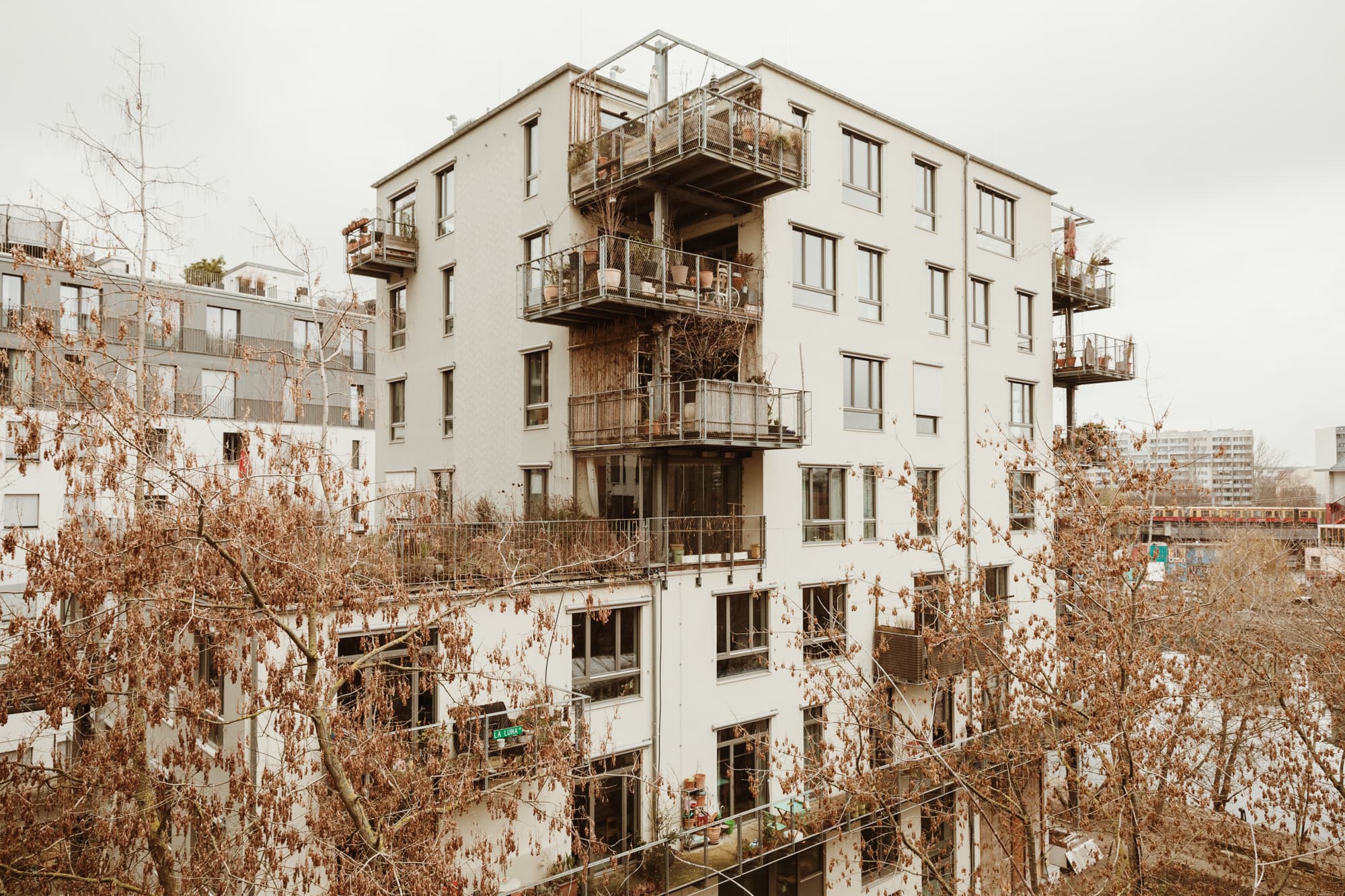
A central comparison concerns how much equity members must provide upfront via mandatory co-operative shares, and how subsidies or public financing can reduce these barriers. Spreefeld in Berlin is highlighted for relying strongly on self-financing: member shares make up about 50% of total project financing. This results in high entry costs—for an approximately 45 m² unit, mandatory shares are around €50,000—while members still pay monthly rent. The model supports substantial shared spaces, rents cited at about €8 per m² (below market), and the inclusion of subsidised apartments for refugees, but it also illustrates how high equity requirements can limit accessibility.
Subsidies and social housing as tools to broaden inclusivity
By contrast, wagnisART in Munich integrates City of Munich subsidies for social housing and low-income housing. Two-thirds of its units are subsidised, with the remaining one-third as market housing. With this mix, required equity is reduced to about 20%, lowering entry costs to roughly €4,400–€23,500 for an average 30 m² unit. The article reports rents ranging from about €5 to €13 per m² depending on the financing model, with a share of apartments described as affordable even for people at poverty level; non-subsidised units are also positioned below market rent.
Zürich’s approach: demographic mix and low equity dependence
The Zürich project mehr als wohnen aims for a resident mix that mirrors the social demographics of the city. Similar to Munich, its viability is linked to subsidised and rent-controlled housing, and to municipal conditions tied to land policy (such as social housing requirements for land sales at fixed prices, or long-term leases and loans). The article points to Swiss-style public support—cheap, state-guaranteed loans and privileged access to public land for non-profit providers—as a mechanism to keep housing durably affordable at high quality. In this framework, equity can be as low as around 10% of total financing (reported as 7% for mehr als wohnen), with entry costs cited at about 12,750 CHF for an average 51 m² unit.
Why scale matters for affordability, shared infrastructure, and sustainability
Beyond financing, the article argues that scale is a second key lever. Many co-operative and co-housing projects remain small (often up to 30 units), whereas the featured projects are substantially larger, with total floor areas reported between 10,000 and 40,000 m² and populations of about 150 (Spreefeld), 305 (wagnisART), and up to 1,200 inhabitants (mehr als wohnen). Larger developments can capture economies of scale and more easily fund community and commercial spaces, shared amenities, renewable-energy investments, and solidarity mechanisms that support lower-income members.
Managing the trade-offs: professionalism, rules, and long-term policy support
The article notes that scaling “do-it-yourself” approaches requires adaptation, including more professional management and sometimes partnerships with other developers. It also discusses governance and fairness mechanisms such as shared-space strategies, participatory planning focused on the common good (rather than individual “dream apartments”), and minimum-occupancy rules used by some Swiss co-operatives to limit excessive space per resident. Overall, the article concludes that broader expansion in German-speaking contexts would require both continued co-operative reinvestment and transparent, reliable subsidies—especially access to land—targeting providers committed to diverse, democratically allocated, durably affordable housing.