Context and Publication
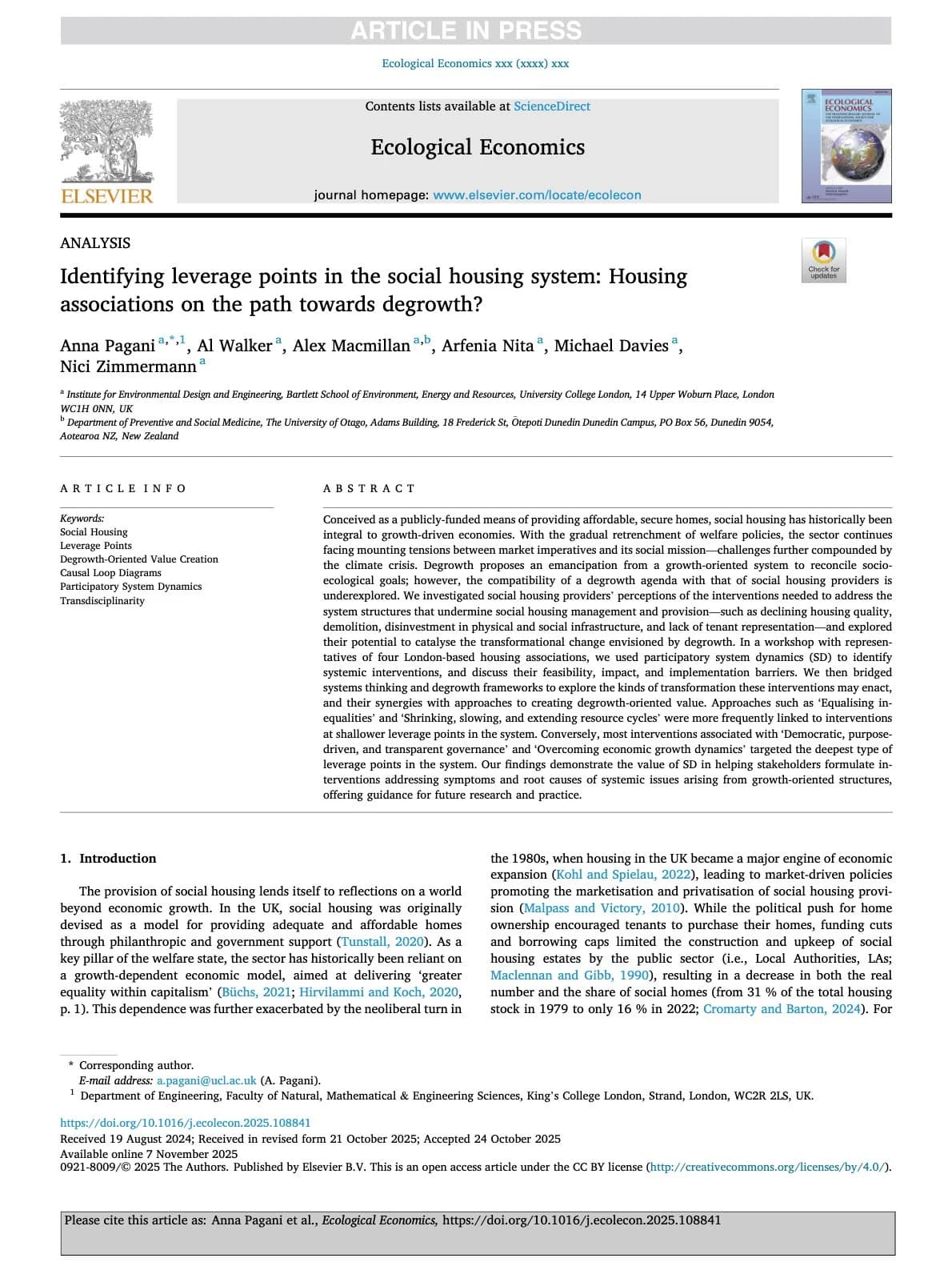
The paper Identifying leverage points in the social housing system: Housing associations on the path towards degrowth? is authored by Anna Pagani, Al Walker, Alex Macmillan, Arfenia Nita, Michael Davies and Nici Zimmermann. The authors are affiliated with the Institute for Environmental Design and Engineering at UCL’s Bartlett School of Environment, Energy and Resources, and with the Department of Engineering at King’s College London. It is published in the journal Ecological Economics (2025, volume xxx). The study investigates how housing associations in London perceive systemic interventions that could align social housing provision with a degrowth agenda.
Research Aim and Methodology
The authors conducted a participatory workshop with representatives from four London‑based housing associations (nine participants in total). Using system dynamics (SD) tools, they presented four causal‑loop diagrams (CLDs) that modelled (i) maintenance and repair, (ii) demolition, (iii) physical and social infrastructure, and (iv) tenant representation. Participants brainstormed interventions, rated feasibility (low = 1, high = 3) and impact (low = 1, high = 3), and discussed barriers and enablers. The interventions were later mapped onto Meadows’ twelve leverage points, Abson et al.’s four system characteristics (parameters, feedback, design, intent), and Froese et al.’s six degrowth‑oriented value‑creation approaches.
Key Findings: Intervention Landscape
A total of 66 distinct interventions were identified. Most targeted shallow leverage points (parameters and feedback) and were linked to the degrowth approaches “Shrinking, slowing, and extending resource cycles” and “Equalising inequalities”. Examples include incentives for retrofit, monitoring equipment, and consistent funding for planned maintenance. Interventions addressing deeper leverage points (design and intent) related to “Democratic, purpose‑driven, and transparent governance” and “Overcoming economic growth dynamics”. These deeper interventions—such as setting demolition as a last resort, whole‑life costing, cooperative estate decision‑making, and revising the subsidised rental system—received lower feasibility scores (average ≈ 1) but were rated high in impact (average ≈ 3).
Leverage Points and Degrowth Alignment
The analysis shows that shallow interventions are perceived as more feasible but generate limited systemic change, while deep interventions, though harder to implement, have the potential to reshape organisational values and governance structures. The authors argue that a combination of both levels is required to move from symptom‑oriented measures (e.g., retrofit incentives) to transformative change (e.g., democratic governance, changing market‑driven paradigms).
Systemic Barriers and Enablers
Participants highlighted financial constraints, government policy inertia, and entrenched growth‑oriented mindsets as major barriers, especially for deep interventions. Conversely, higher government spending, investor interest in social outcomes, and resident leadership were identified as enablers. The workshop revealed tensions between the need for large‑scale funding and the desire for local, resident‑led decision‑making.
Implications for Sustainable Housing Policy
The study suggests that policy frameworks should support both shallow and deep leverage points. Shallow measures (e.g., retrofit incentives, monitoring) can be rapidly deployed to improve housing quality, while deep measures (e.g., redesigning tenancy contracts, democratic governance) require longer‑term political commitment and cultural shift. Aligning housing policy with degrowth principles could help decouple social housing provision from perpetual construction, reduce resource consumption, and improve social equity.
Relevance for a Pan‑European Audience
Although the empirical work focuses on London, the systemic challenges—financial pressure, demolition versus refurbishment, inadequate infrastructure, and limited tenant representation—are common across European social housing systems. The identified leverage points and value‑creation approaches provide a transferable framework for policymakers, housing associations, and civil‑society actors seeking to embed sustainability and degrowth concepts into housing strategies throughout Europe.