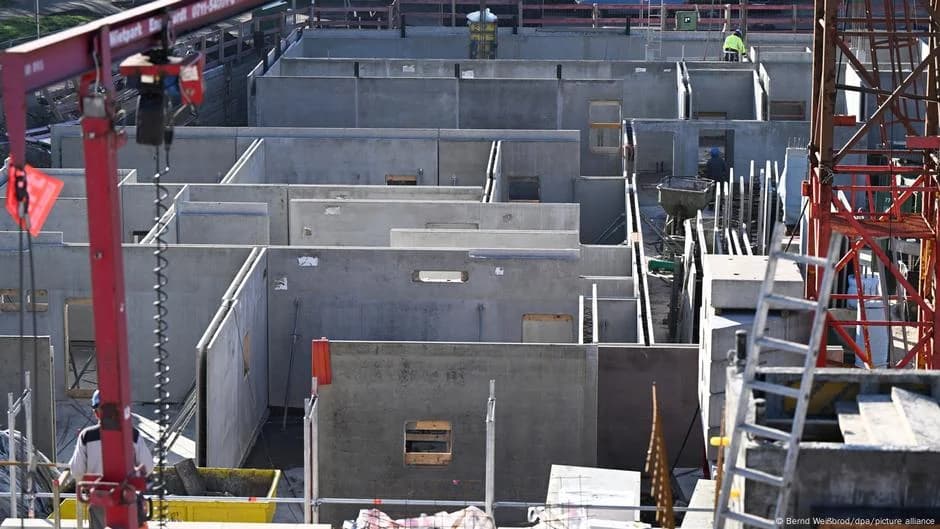
Resource overview
This resource is an article published by Deutsche Welle (DW) and written by Helen Whittle. It reports on policy proposals by Germany’s new Construction and Housing Minister Verena Hubertz to accelerate residential construction and ease the shortage of affordable housing.
The “Bau-Turbo” proposal
Hubertz argues that housing is a defining social issue and that Germany’s planning and approval processes often take longer than the build itself. The centrepiece of the proposal is a new paragraph (§ 246e) in the German Building Code, nicknamed “Bau-Turbo” (“construction turbo”), designed to let municipalities speed up approvals for residential construction, renovations, and change-of-use projects that deviate from existing planning provisions.
Faster approvals and expected savings
Under the plan, planning applications would be automatically approved after two months unless a municipality vetoes them. Germany’s Construction Ministry estimates that the legislative amendment—intended to be passed by the Bundestag—could save companies, citizens, and local authorities around €2.5 billion annually.
What it enables (and what it does not)
Industry representatives describe the measure as removing barriers rather than instantly creating new homes. The head of the Federal Association of the German Construction Industry (HDB), Tim-Oliver Müller, says the law would not by itself deliver “a single new apartment,” but could make approvals easier for local authorities. He also argues that core quality standards such as fire safety and structural integrity would remain in place, while the reform would broaden what is possible—such as building extensions or converting land from commercial to residential use.
Construction market pressures
The article links the construction slowdown to multiple overlapping pressures intensified since Russia’s full-scale invasion of Ukraine, including higher energy prices, rising costs for materials like concrete and steel, inflation, and increased interest rates (from below 1% to roughly 3%–4%). Müller welcomes the direction of the plans but warns that construction activity would not recover overnight.
Environmental and local concerns
Environmental groups warn that loosening planning constraints could increase the risk of building on green spaces, reducing urban cooling capacity during heatwaves. NABU representative Stefan Petzold stresses that green areas help buffer heatwaves through “active cooling.” Separately, economist Matthias Günther of the Pestel Institute calls the proposal “a lot of hot air” and argues it could add bureaucracy because many decisions would still require municipal consent and political majorities.
Demand, rents, and tenant protection dynamics
The article highlights structural demand pressures, especially in large cities, as a key driver of rising rents. It notes that more than half of Germany’s population lives in rented accommodation—the highest share in the EU. Bernard Faller of the Federal Association for Housing and Urban Development (VHW) says strong tenant protections help existing tenants but can reduce mobility for people who need to move, including young people and larger families, while the core problem remains an insufficient number of homes.
Targets, shortfalls, and new funding
Germany’s Federal Institute for Research on Building, Urban Affairs and Spatial Development (BBSR) estimates the country needs around 320,000 new homes per year until 2030. The previous government had pledged 400,000 annually, but by 2024 completions were 251,900, which the article says is 14.4% lower than the year before. The new CDU/CSU–SPD coalition plans to increase the Construction Ministry budget to €7.4 billion (up from €6.7 billion), aiming to support social housing for low-income households, climate-friendly construction, conversion of commercial areas to housing, and policies to promote homeownership for young families.