Resource overview
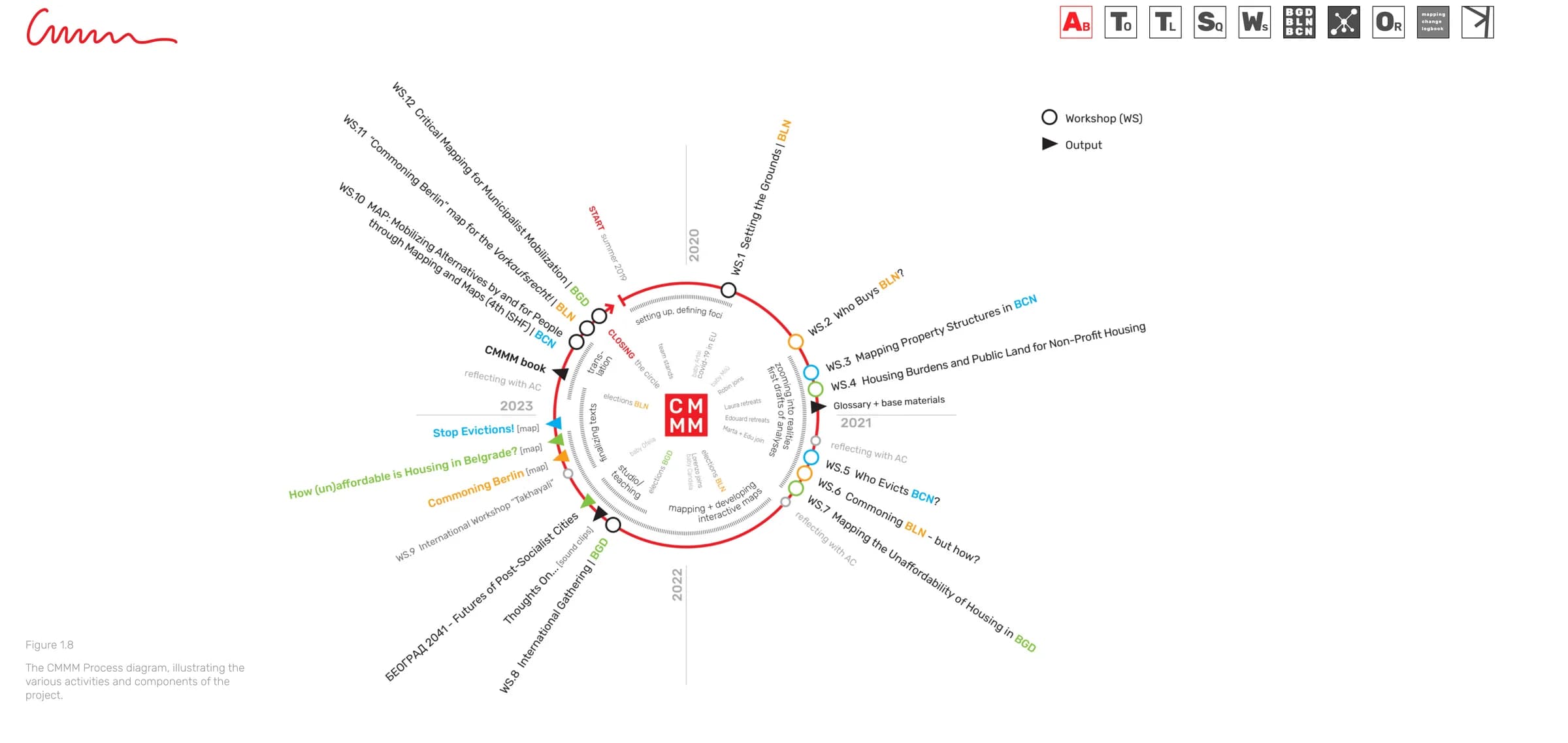
The CMMM (Critical Mapping for Municipalist Movements) project is a practice-oriented research initiative published by CMMM and authored by Julia Förster, Julita Skodra, Katleen De Flander, Natasha Aruri, and Andreas Brück. It documents a 3.5-year collaborative process (2019–2023) that explores how critical mapping can support civil society and municipalist movements working toward political transformation and more just cities, with a strong focus on housing issues across Europe.
Project purpose and approach
The project positions “critical mapping” as more than technical cartography: it is presented as a political and community-oriented method to reshape narratives, make power relations visible, and support collective action. A central emphasis is the democratization of mapping technologies that have historically been accessible mainly to experts and institutions. By widening access to tools and practices, CMMM aims to enable communities to represent complex urban realities and advocate for change.
Cities studied and comparative lens
CMMM’s research and collaboration took place in three urban contexts—Barcelona, Belgrade, and Berlin—chosen to compare different political, social, and housing conditions. The project’s comparative framing highlights that while housing crises appear across Europe, the drivers and governance contexts differ locally, and mapping practices need to account for these differences rather than rely on one-size-fits-all indicators.
Housing as the cross-cutting theme
Housing is treated as the unifying topic because of its broad relevance and the urgency of reform in all three cities. The resource highlights pressures such as affordability constraints, evictions, and the financialization of real estate. By centering housing, the project connects everyday lived experience (tenancy, displacement risk, access to secure homes) with structural dynamics (market logics, policy choices, and investment patterns) that shape urban development.
City-specific housing dynamics
In Belgrade, the housing crisis is described as being intensified by neoliberal policies and a high share of privately owned housing, with civil society actors such as the Ministry of Space collective working on advocacy supported by mapping. In Berlin, where a majority of residents are tenants, the project highlights issues linked to gentrification and affordability and notes civic initiatives advocating for governance oriented toward the common good (Gemeinwohl). In Barcelona, the resource points to tourism-driven demand and insufficient tenant protections as key factors shaping housing stress, alongside active local movements pushing for stronger public housing policies.
Methods, outputs, and collaboration
The project’s methodology includes collaborative workshops, mapping exercises, and the development of interactive tools for visualizing urban data. These activities are guided by principles of feminist data visualization, including pluralism, empowerment, and context sensitivity. The resource underscores international collaboration between activists and researchers, using mapping to connect local struggles, translate knowledge across contexts, and support municipalist strategies aimed at changing urban governance in ways relevant to housing and broader social justice goals.